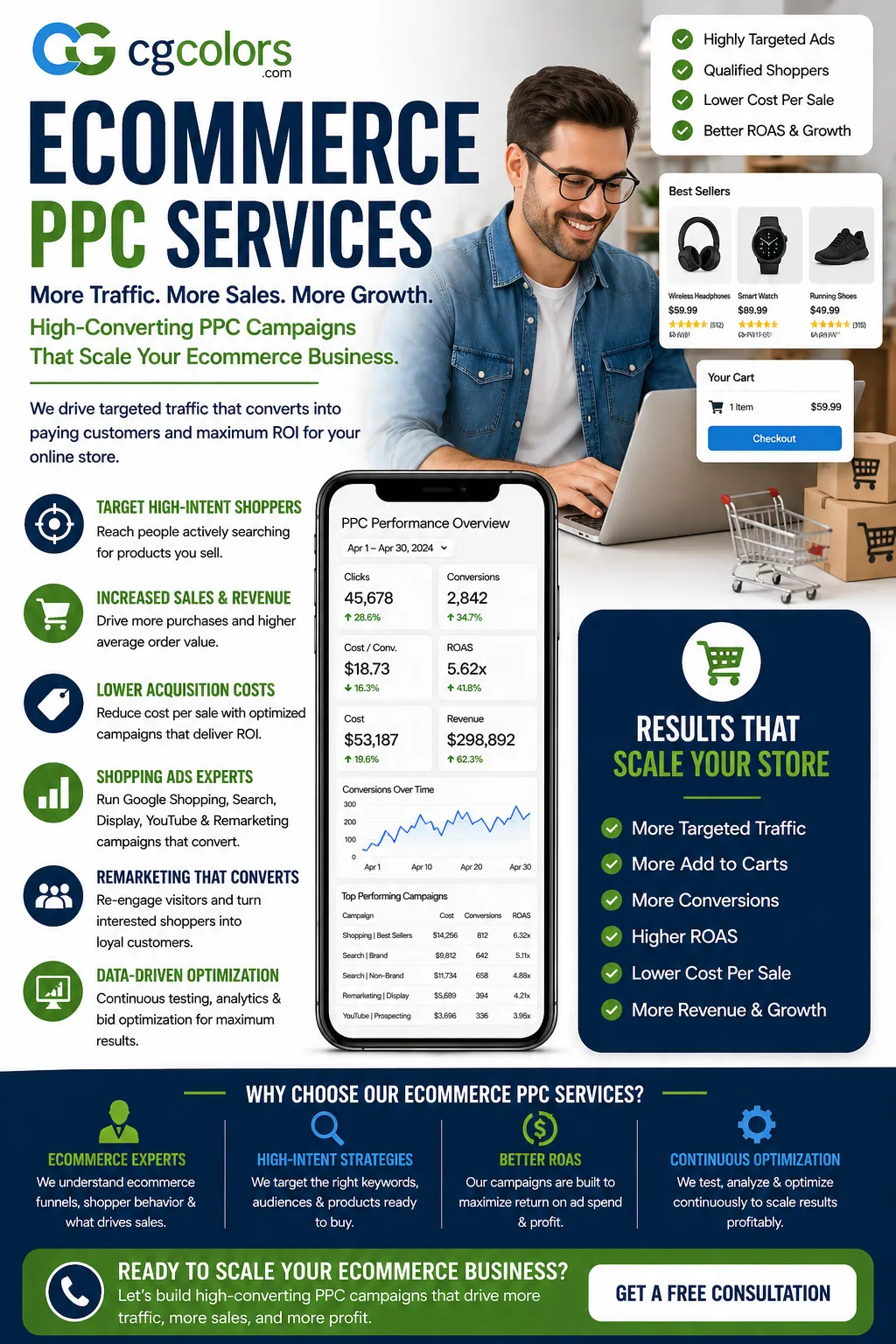
Ecommerce PPC Services

Turn Your Ad Spend Into Product Revenue

  • Google Shopping campaigns built from a clean, optimized product feed
  • Performance Max structured by margin tier, not just product category
  • Dynamic remarketing to recover abandoned carts and lost shoppers
  • Meta Ads driving product discovery and retargeting across Facebook and Instagram
  • ROAS-focused bid strategy aligned with your margins, not just spend volume
  • Reporting tied to revenue, orders, and cost per acquisition
Call Us Now Schedule A Meeting

Need Help with Ecommerce PPC Services

Ecommerce PPC Services

Clicks Are Easy. Profitable Sales Are the Real Problem.

Most ecommerce stores can get traffic. The challenge is getting traffic that converts at a cost that keeps the business profitable. Broad campaigns, unoptimized product feeds, and poor campaign structure burn ad budgets without producing the ROAS needed to grow.

CGColors builds ecommerce PPC around your actual product catalog and margins. We start with Google Merchant Center, fix feed issues that silently kill Shopping performance, structure campaigns by product priority and margin tier, and layer in dynamic remarketing for shoppers who left without buying. Every decision is made with revenue per ad dollar as the primary measure.

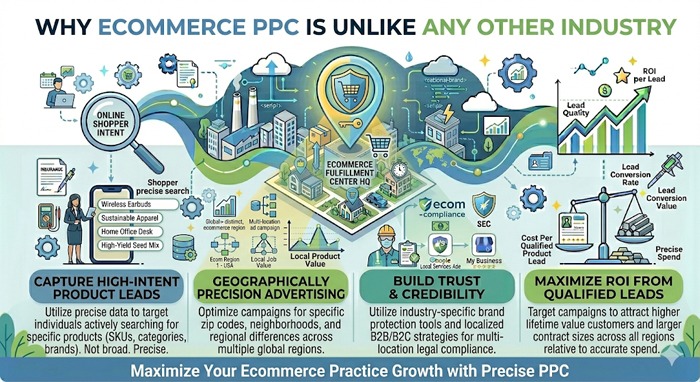
Why Ecommerce PPC Is Unlike Any Other Industry

Ecommerce campaigns run on product-level economics. Your cost per acquisition must stay below your margin. A disapproved product listing in Merchant Center removes your inventory from Shopping entirely. Performance Max can over-index on your top ten bestsellers while ignoring hundreds of other profitable SKUs. And seasonal demand shifts require active campaign adjustments weekly, not monthly.

  • Your Shopping ads pull from a product feed. A weak feed means weak ads regardless of budget.
  • Performance Max needs strategic asset groups and audience signals to avoid burning spend on low-margin products.
  • Cart abandonment represents your highest-intent lost audience. Without dynamic remarketing, that budget leaves permanently.
  • Meta Ads create demand for products people have not searched yet. Google captures existing demand. Both are needed.

What We Do With Your PPC Campaign

  • Product Feed and Merchant Center Optimization

    • Product titles restructured to match how shoppers actually search by brand, model, size, and specification
    • Missing attributes including GTIN, product type, and condition identified and corrected
    • Feed disapprovals resolved and Merchant Center account health monitored continuously
    • Custom labels applied to segment products by margin tier, bestseller status, and seasonal priority
  • Google Shopping and Performance Max Management

    • Shopping campaigns segmented by product category and margin so high-value products get dedicated budget
    • Performance Max campaigns configured with asset groups matched to specific product lines and audience signals
    • Negative keywords applied at campaign level to filter irrelevant Shopping queries before they consume budget
    • Standard Shopping campaigns run alongside PMax to capture queries and control that automated campaigns miss
  • Search Campaigns for Brand and High-Intent Queries

    • Branded search campaigns protecting your product names from competitor bidding
    • Non-branded product search campaigns covering purchase-intent queries Shopping alone does not capture
    • Ad copy focused on delivery speed, product availability, and purchase confidence signals
    • Sitelink and promotion extensions configured for product categories, seasonal offers, and clearance lines
  • Dynamic Remarketing and Cart Recovery

    • Dynamic remarketing tags implemented across product pages, cart, and checkout
    • Ads served showing the exact products each shopper viewed or added to cart but did not purchase
    • Audiences segmented by behavior: product viewers, cart abandoners, and past purchasers
    • Meta dynamic product ads configured to reach the same audiences across Facebook and Instagram
  • Bid Strategy and Margin-Aware Budget Management

    • Target ROAS bid strategies set based on your product margin structure, not generic benchmarks
    • Budget allocation adjusted across campaigns based on performance data and seasonal demand
    • Underperforming product groups paused or restructured to protect overall account ROAS
    • Shopping auction insights reviewed regularly to monitor competitor pressure by product category

What’s Included

🔑
Campaign Setup and Strategy
  • Google Merchant Center setup, feed audit, and product attribute correction
  • Shopping campaigns segmented by product category and margin tier
  • Performance Max campaign structure with margin-aware asset groups
  • Negative keyword lists blocking non-purchase and competitor brand searches
🏢
Ad Creative and Extensions
  • Performance Max asset groups per product line with audience signals
  • Branded and non-branded responsive search ads
  • Dynamic remarketing tags across product pages, cart, and checkout
  • Ad extensions: sitelink, promotion, and structured snippet assets
📍
Bidding and Budget Management
  • Target ROAS bidding matched to your product margin structure
  • Standard Shopping campaigns alongside PMax for query control
  • Seasonal budget adjustments by product category and demand cycle
  • Budget reallocation toward highest-ROAS product segments monthly
⚙️
Tracking and Reporting
  • Purchase event tracking through to revenue attribution
  • Dynamic remarketing audience configuration by behavior segment
  • Google Analytics 4 with revenue and product-level conversion goals
  • Monthly report: ROAS, revenue, orders, and cost per acquisition
✍️
Platform Coverage
  • Google Shopping Ads
  • Google Performance Max
  • Google Display retargeting
  • Meta Ads: Facebook and Instagram dynamic product ads
  • Microsoft Bing Ads

How We Work on Your Campaign

Blogs

Read More
Who Should Write Your Medical Content: Doctors, Writers, or AI?
23 August, 2026

Who Should Write Your Medical Content: Doctors, Writers, or AI?

Every practice hits the same wall. The SEO plan calls for twenty pages of clinical content. The physicians who could write it authoritatively bill several hundred dollars an hour and have no free evenings. The writers who have time have never treated a patient. And the tool that produces a … Read More “Who Should Write Your Medical Content: Doctors, Writers, or AI?”

Physician Bios Are a Ranking Asset: Building E-E-A-T Signals Page by Page
21 August, 2026

Physician Bios Are a Ranking Asset: Building E-E-A-T Signals Page by Page

Most medical practice websites treat provider bios as an obligation. A headshot, three sentences about where the doctor went to school, maybe a line about enjoying hiking. Published once, never touched again.That page is doing two jobs badly. It is the page prospective patients visit most often before calling, and … Read More “Physician Bios Are a Ranking Asset: Building E-E-A-T Signals Page by Page”

Traffic Dropped but Rankings Held: Diagnosing AI Overview Losses on a Medical Site
19 August, 2026

Traffic Dropped but Rankings Held: Diagnosing AI Overview Losses on a Medical Site

A practice calls its agency in a panic. Organic traffic is down forty percent. Something is broken. Fire someone.Then you open Search Console and the picture makes no sense. Impressions are up. Average position improved. The rankings did not move, or they got better. Only the clicks collapsed.That shape is … Read More “Traffic Dropped but Rankings Held: Diagnosing AI Overview Losses on a Medical Site”

Copyright @ 2017-2026 CGCOLORS, INC. . All Right Reserved.