
The partners approved the marketing budget in January. It is now April, the invoices have been paid, and someone at the quarterly meeting asks the question you knew was coming: what have we actually gotten for this?
If your answer is “SEO takes time,” you will lose the room. Not because the answer is wrong, but because it is indistinguishable from what someone says when nothing is happening.
The defensible version is different. It states what should be true by now, what should be true next, and what the specific early indicators are that the work is on track before rankings move. This post gives you that structure, calibrated for healthcare, which runs slower than most industries for reasons you can explain.
The honest range, and why healthcare sits at the slow end
Google’s own guidance is that most changes take four months to a year to show their full effect. That range is not agency hedging; it is the search engine describing its own evaluation cycle.
Healthcare tends toward the slower end of that window for three structural reasons.
Google applies its strictest quality standards to health content. Medical pages are classified as content that could affect someone’s wellbeing, which triggers a higher evaluation bar. Building the credibility signals that satisfy it takes longer than publishing pages. The mechanics are in why medical websites get hit hardest by core updates.
Content production has a review bottleneck. Every clinical page needs a qualified reviewer, and that reviewer sees patients all day. A practice that can publish four pages a month is moving well; most manage two. The workflow that unblocks this is covered in who should write your medical content.
Reviews accumulate at the speed of patient volume. You cannot buy them, you cannot incentivize them, and you can only ask patients who actually came in. A practice seeing forty patients a week has a natural ceiling on how fast its review profile can grow.
Set expectations against those constraints rather than against a generic SEO timeline, and the conversation with the partners changes from excuses to arithmetic.
What should be true at each stage
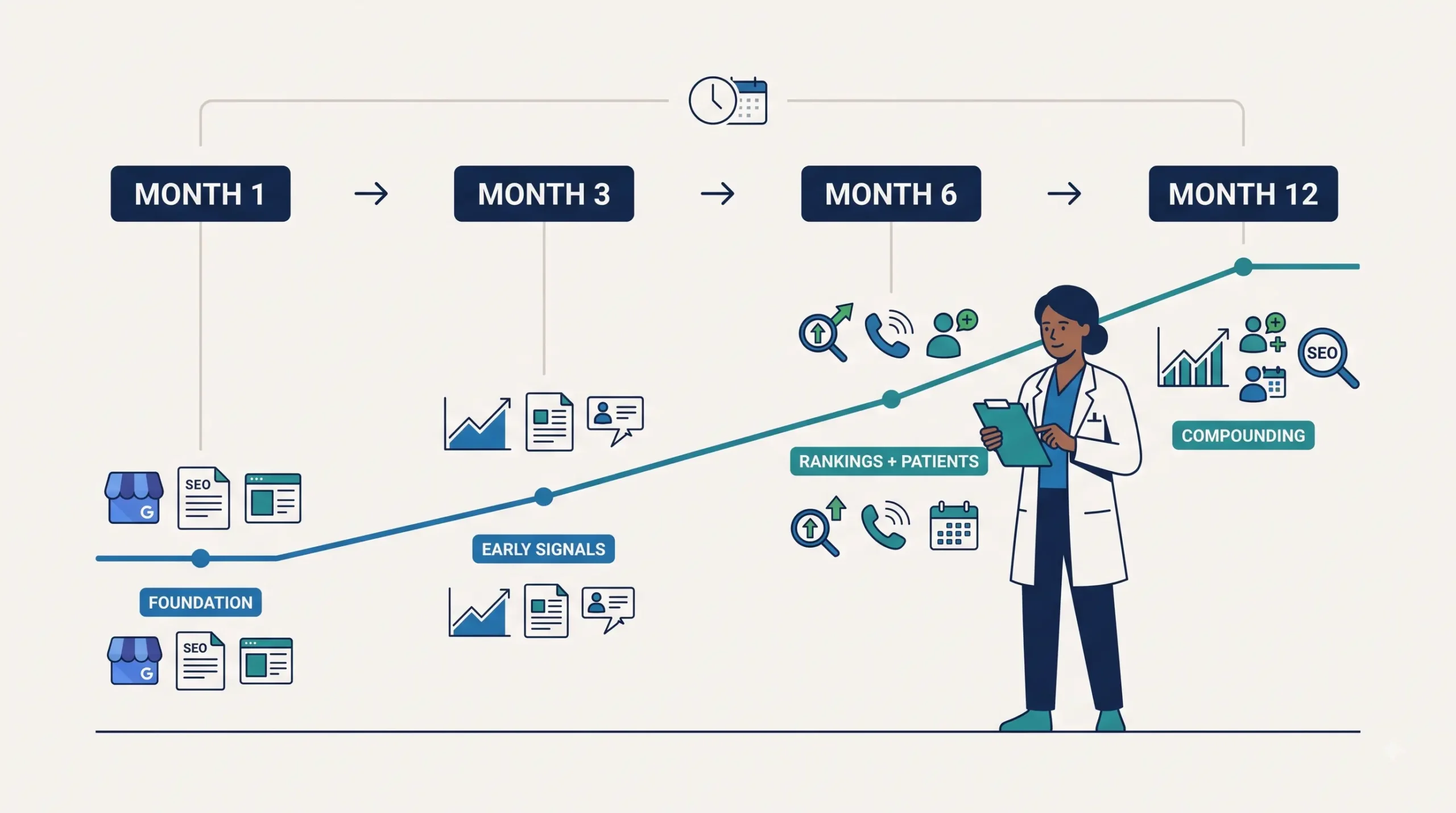
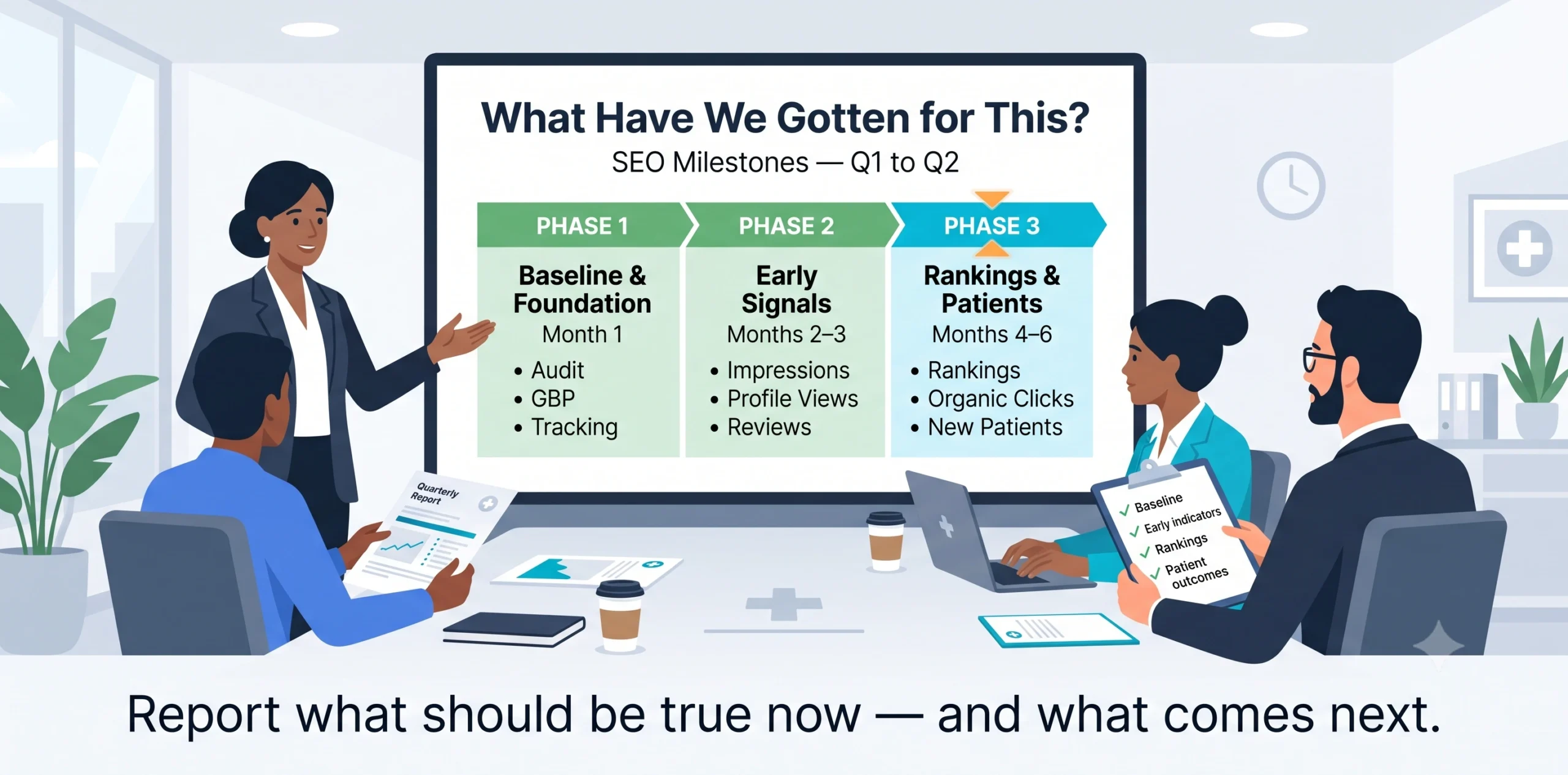
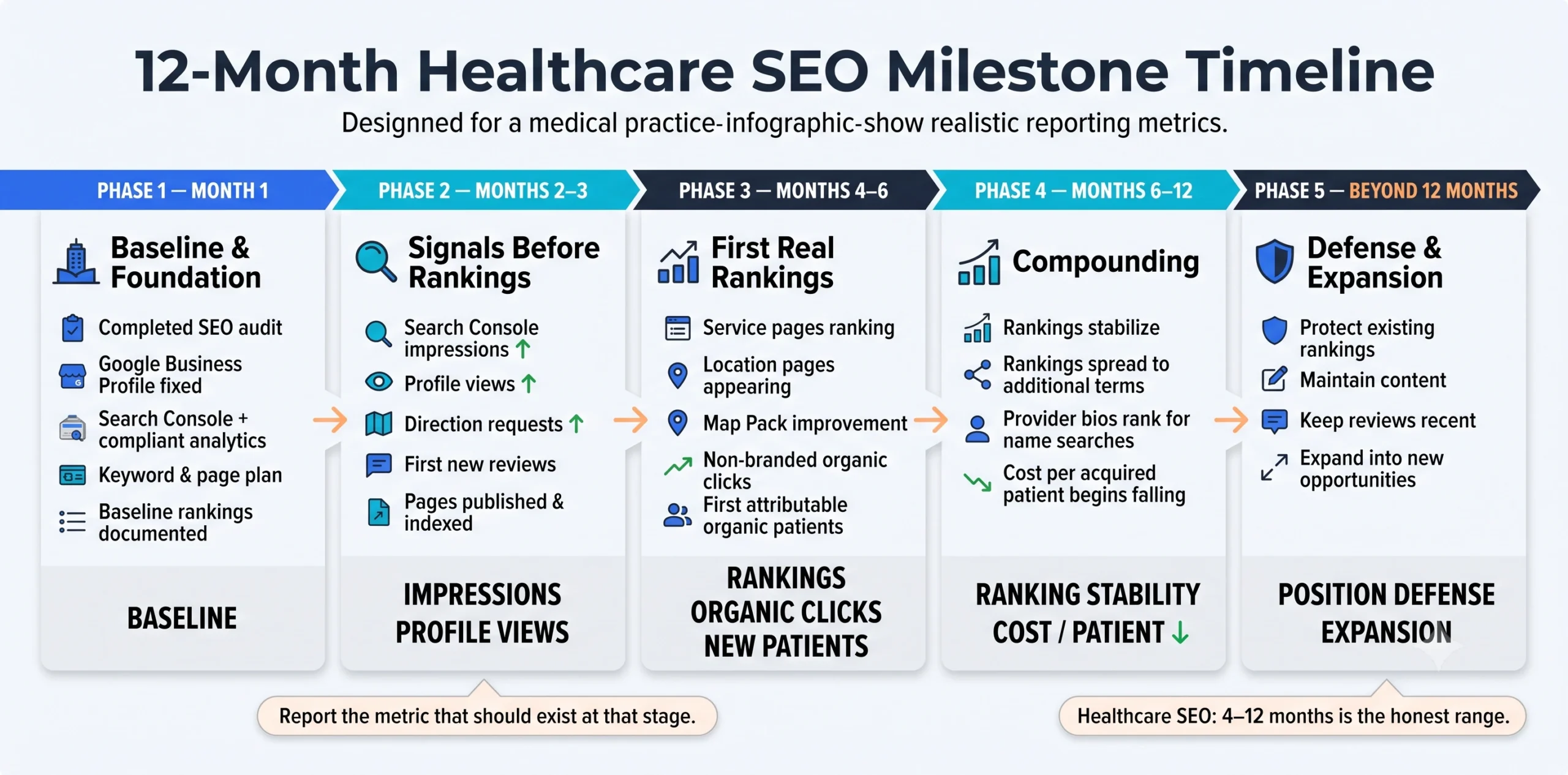
Month 1: baseline and foundation. Nothing ranks yet, and that is correct. What should exist: a completed audit, a fixed Google Business Profile with the right primary category, Search Console and compliant analytics configured, a keyword and page plan, and a documented starting position for every priority term. If month one produced no baseline document, the engagement started badly.
Months 2 to 3: signals before rankings. Profile completeness often produces the first visible movement, sometimes within weeks, because local visibility responds faster than organic. Expect rising impressions in Search Console, more profile views and direction requests, the first new reviews arriving, and initial pages published and indexed. Rankings for competitive terms will not have moved. Long-tail and branded terms may have.
Months 4 to 6: first real rankings. Service and location pages begin appearing for their target terms. Map pack position improves in less competitive neighborhoods. Non-branded organic clicks become a visible pattern rather than noise. This is the stage where most practices see their first attributable new patients from organic search.
Months 6 to 12: compounding. Rankings stabilize and spread. Pages you published in month three start ranking for terms nobody targeted. Provider bios rank for name searches. Cost per acquired patient begins falling because the same asset produces more without more spend.
Beyond 12 months: defense and expansion. Worth stating explicitly to partners, because it prevents the assumption that the work ends. A Semrush study of ranking durability found that while a substantial share of domains reached the top ten within six months, considerably fewer held those positions through the following year. [STAT CHECK: verify the specific percentages, reported as 41% reaching top ten and 27% remaining, against Semrush’s original publication before citing figures.] Positions are held, not won once.
Report leading indicators, not lagging ones
The reason quarterly meetings go badly is that practices report the lagging metric at a stage where only leading metrics exist yet.
Leading indicators, useful in months 1 to 4: pages published and indexed, Search Console impressions, average position trend on target terms, Google Business Profile views, calls and direction requests, review count and recency, citation consistency fixed, technical issues resolved.
Lagging indicators, meaningful from month 4 onward: non-branded organic clicks, map pack positions, new patient calls attributed to organic, booked appointments, and cost per acquired patient.
Present both, labeled honestly. The sentence that wins the room: impressions are up 340% and average position moved from 38 to 14, which means Google is now showing us for these searches and we are close to the click threshold. That is a defensible statement of progress with no ranking gains to point at yet.
The corresponding trap is reporting sessions and pageviews as headline metrics, which have become actively misleading in healthcare. Informational traffic is being absorbed by AI summaries while commercial traffic holds, so a practice can be acquiring more patients while its traffic chart declines. That diagnosis is in traffic dropped but rankings held.
What makes it faster or slower
Give the partners the variables, because a range without conditions sounds like a guess.
Faster: an established domain with existing authority, a less competitive market, thin competitor profiles, a single location, providers who turn around content review quickly, healthy patient volume feeding review generation, and a technically sound existing website.
Slower: a brand new domain, a competitive metro specialty, competitors with hundreds of reviews and strong profiles, multiple locations each needing its own foundation, a slow clinical review cycle, an existing site with technical debt or a history of thin content, and any recent address change that broke citation consistency.
Small and rural markets often move fastest of all, because competitor profiles are frequently incomplete. That situation has its own playbook in SEO for rural and small-market practices.
How to tell it is failing, not just slow
This is the section that makes the timeline credible, because a timeline nobody can fail is not a commitment.
By month 2, you should have: a documented baseline, a corrected Google Business Profile, and a published plan. Absence of these is not slowness. It is nothing happening.
By month 3, you should see: rising impressions in Search Console. Impressions are the earliest honest signal. If impressions are flat after three months of published work, something is wrong with the targeting or the indexing, and the question to ask is which.
By month 4, you should see: pages indexed and appearing for long-tail terms, and review count climbing if a request process was implemented.
By month 6, you should see: measurable ranking improvement on some target terms and at least early attributable inquiries.
Legitimate reasons for a slower curve: a core update landing mid-engagement, a competitive market with well-optimized incumbents, an address change, or a site that needed heavy technical remediation before any content work could count. These are explainable with evidence.
Not legitimate: no baseline, no reporting, no published work, no explanation for flat impressions, or a report that leads with sessions and avoids position data.
The paid search question the partners will ask
Someone will ask why the practice cannot simply run ads and skip the wait. The honest answer has two halves.
Paid search does deliver immediately, and for a practice with schedule gaps it should be running. It also stops the moment the budget stops, and month thirteen costs the same as month one. Organic costs more upfront and less forever after. Most practices should run both in sequence rather than choosing, and the full argument including the acquisition cost math is in SEO vs Google Ads for medical practices.
The framing that lands with partners: paid search is rent, organic search is equity. Practices need both, and the mix should shift as the equity builds.
Frequently asked questions
How long before we see new patients from SEO?
Local visibility work can produce calls within weeks through the Google Business Profile. Attributable patients from organic search pages typically begin around months four to six, with steady volume by months six to twelve.
Why does healthcare take longer than other industries?
Google holds health content to stricter quality standards, clinical review slows content production, and review generation is capped by actual patient volume. All three are structural rather than fixable by spending more.
Can we speed it up by publishing more content?
Only to a point, and unreviewed volume backfires on health topics. Faster wins come from profile completeness, review velocity, and fixing technical problems, not from doubling the blog output.
What should we report to the partners each month?
Leading indicators early, lagging indicators later, both labeled clearly. Impressions, average position, profile views and calls, review count, and pages published in the first months. Organic clicks, rankings, inquiries, and cost per patient from month four onward.
How do we know the agency is not just stalling?
Check for a baseline document, published work you can see, and rising impressions by month three. Flat impressions with no explanation is the clearest failure signal available before rankings move.
Does the timeline reset if Google runs a core update?
Not a reset, but expect volatility, and expect health sites to swing harder than most. Improvements often register at the following update rather than immediately.
What happens if we stop after twelve months?
Rankings decay rather than vanish. Competitors continue investing, content ages, and review recency lapses. Maintenance costs far less than the initial build, which is the argument for continuing rather than restarting later.
The bottom line
Four months to a year is the honest range, and healthcare sits at the slower end for reasons you can name. What makes that defensible in a partner meeting is not the range itself but the structure around it: a documented baseline, leading indicators reported early and labeled as such, lagging indicators once they exist, and clear conditions under which the engagement should be judged to be failing.
Give the partners that, and the April meeting stops being a defense and becomes a status update.
CGColors reports on booked patients rather than sessions, with baseline documentation and monthly leading indicators from the first month. See our local SEO services and SEO services, or the vertical pages for mental health practices and optometrists. However long the build takes, the destination is the same: found first, called first, booked first.