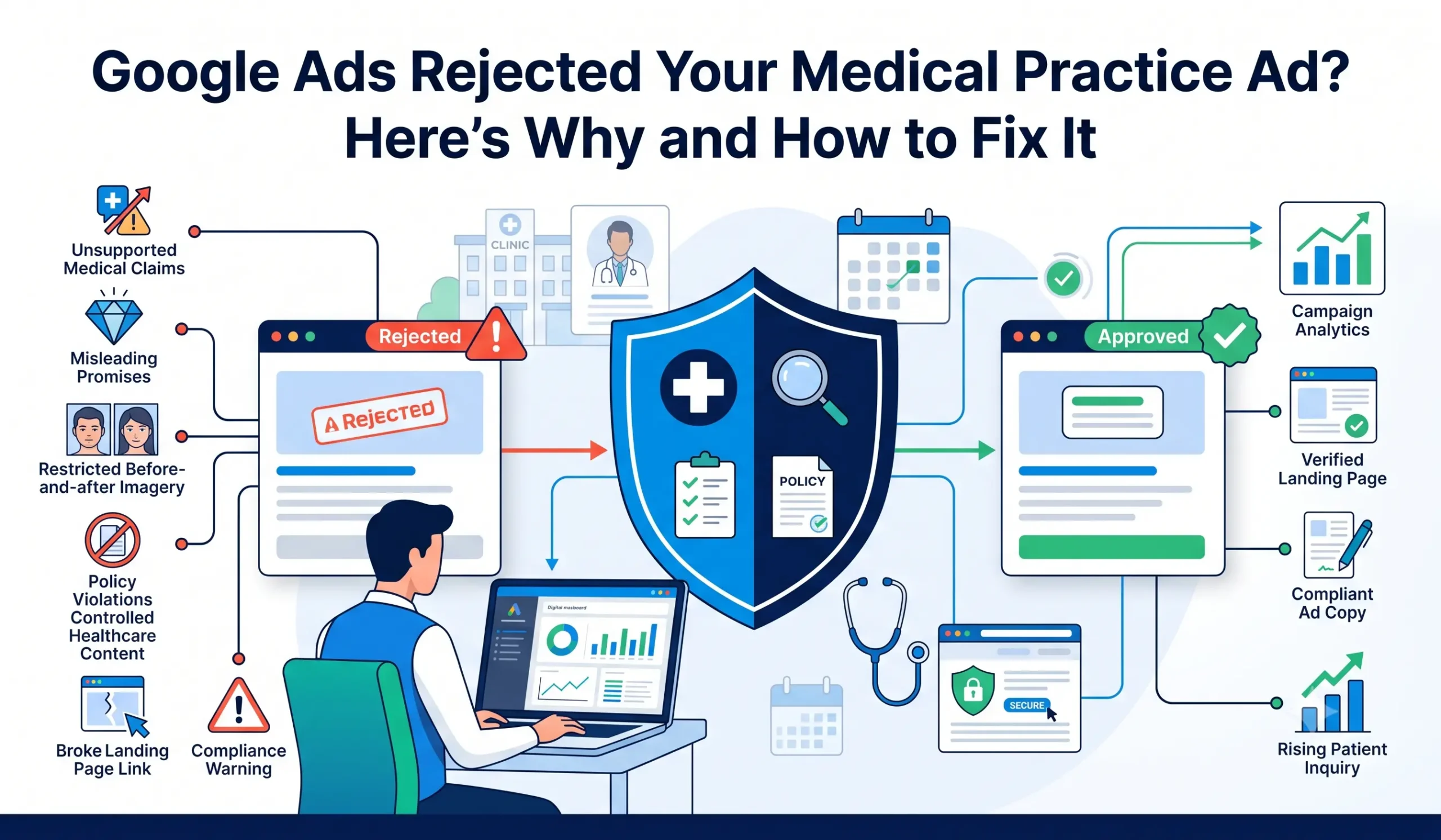
You wrote the ad. You set the budget. You hit launch. An hour later, Google Ads flags your campaign: Disapproved. Healthcare and medicines policy. No further explanation that makes sense to a normal human being.
You are not doing anything shady. You run a legitimate practice with licensed providers. But Google treats every health-related advertiser as a compliance question first and a customer second, and the platform’s healthcare rules are some of the strictest in its entire policy library. Industry reporting suggests a large majority of health-related ads run into rejection or disapproval issues under current regulations. [STAT CHECK: one agency source cites roughly 70% via WLW Future. Verify or soften this figure before publishing.]
The good news: almost every disapproval traces back to one of five causes, and each one has a known fix. This post walks through them.
First, decode the status you are looking at
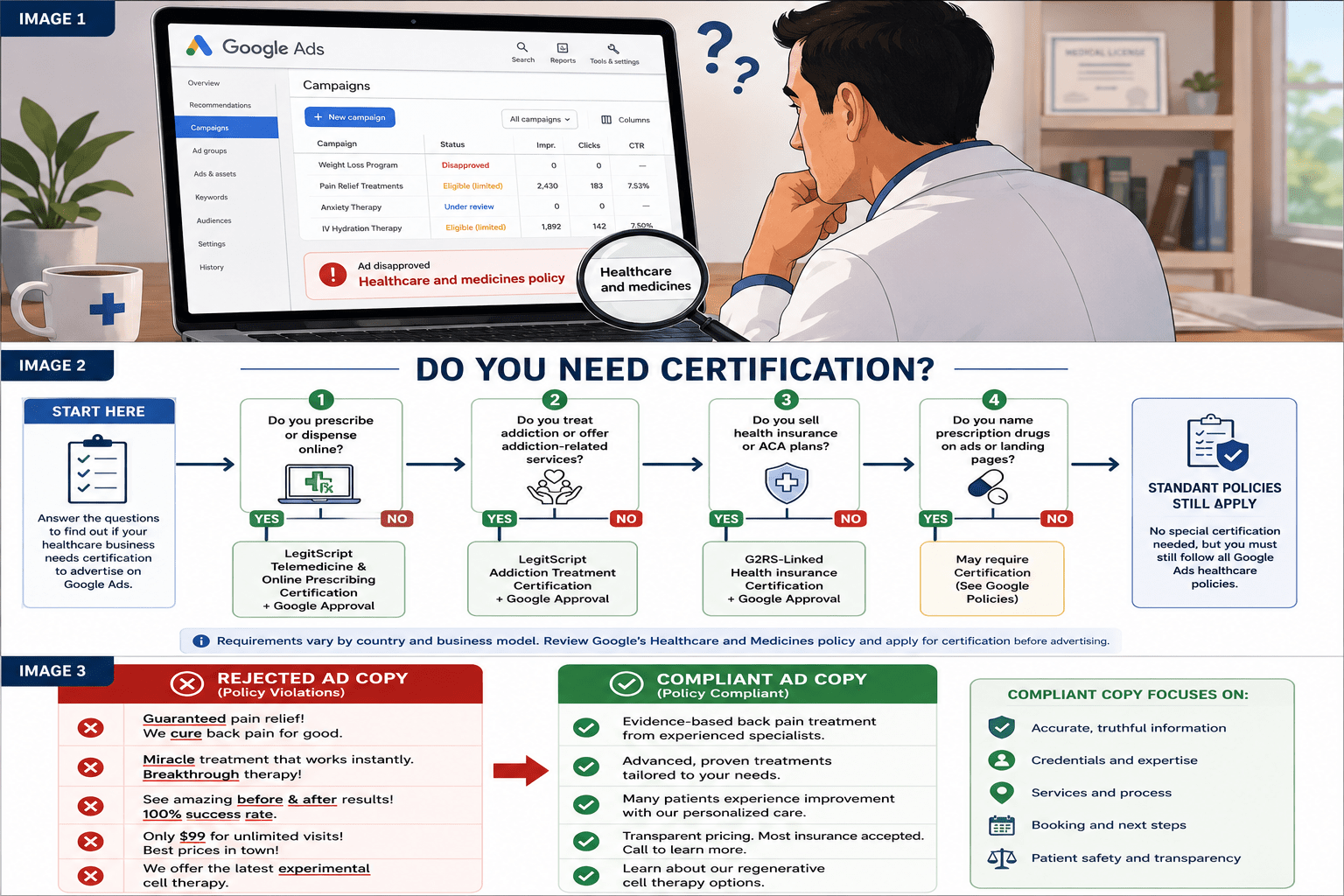
Google does not just approve or reject. Healthcare advertisers see a third status constantly, and misreading it wastes weeks.
Disapproved. The ad violates a policy and will not run anywhere. This requires a fix, a certification, or an appeal.
Eligible (limited). The ad runs, but only in certain locations, to certain audiences, or in certain contexts. Here is the part nobody tells new advertisers: for healthcare, this status is normal. Health services are automatically treated as a sensitive category, so limited serving is the standard operating condition, not a punishment. If your campaigns show Eligible (limited) and impressions are flowing, you may not have a problem at all.
Under review. Healthcare ads often sit in review longer than ads in other industries because policy checks are heavier. Give it a business day or two before assuming something is wrong.
Rule of thumb: diagnose before you edit. Open the ad’s policy details in the Policy Manager and read the specific policy cited. Editing blind and resubmitting repeatedly can look like circumvention, and repeated violations escalate toward account-level trouble. Google does issue a warning at least seven days before suspending an account for healthcare policy violations, so you have time to fix things properly if you act on the first notice.
Reason 1: you need a certification you do not have
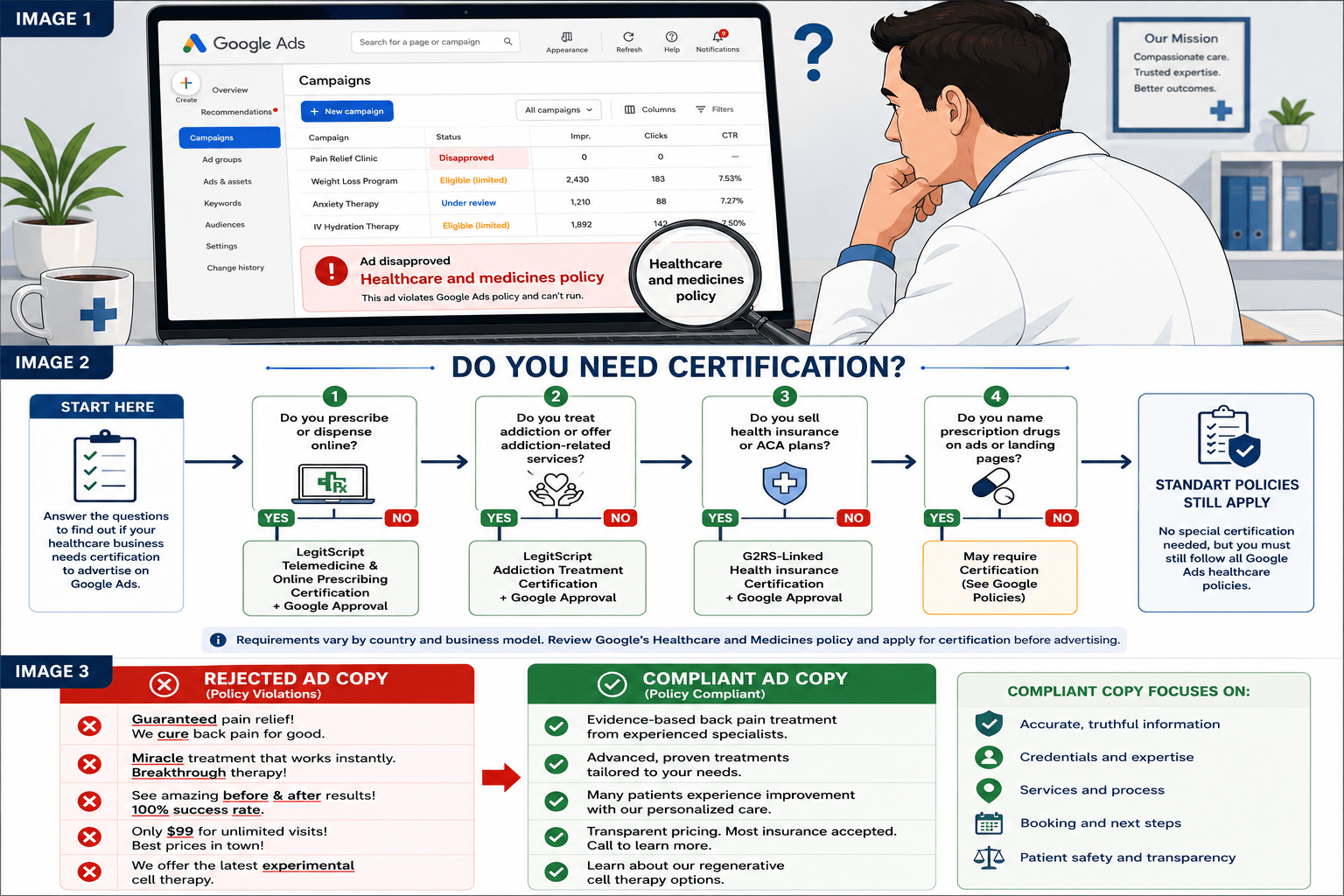
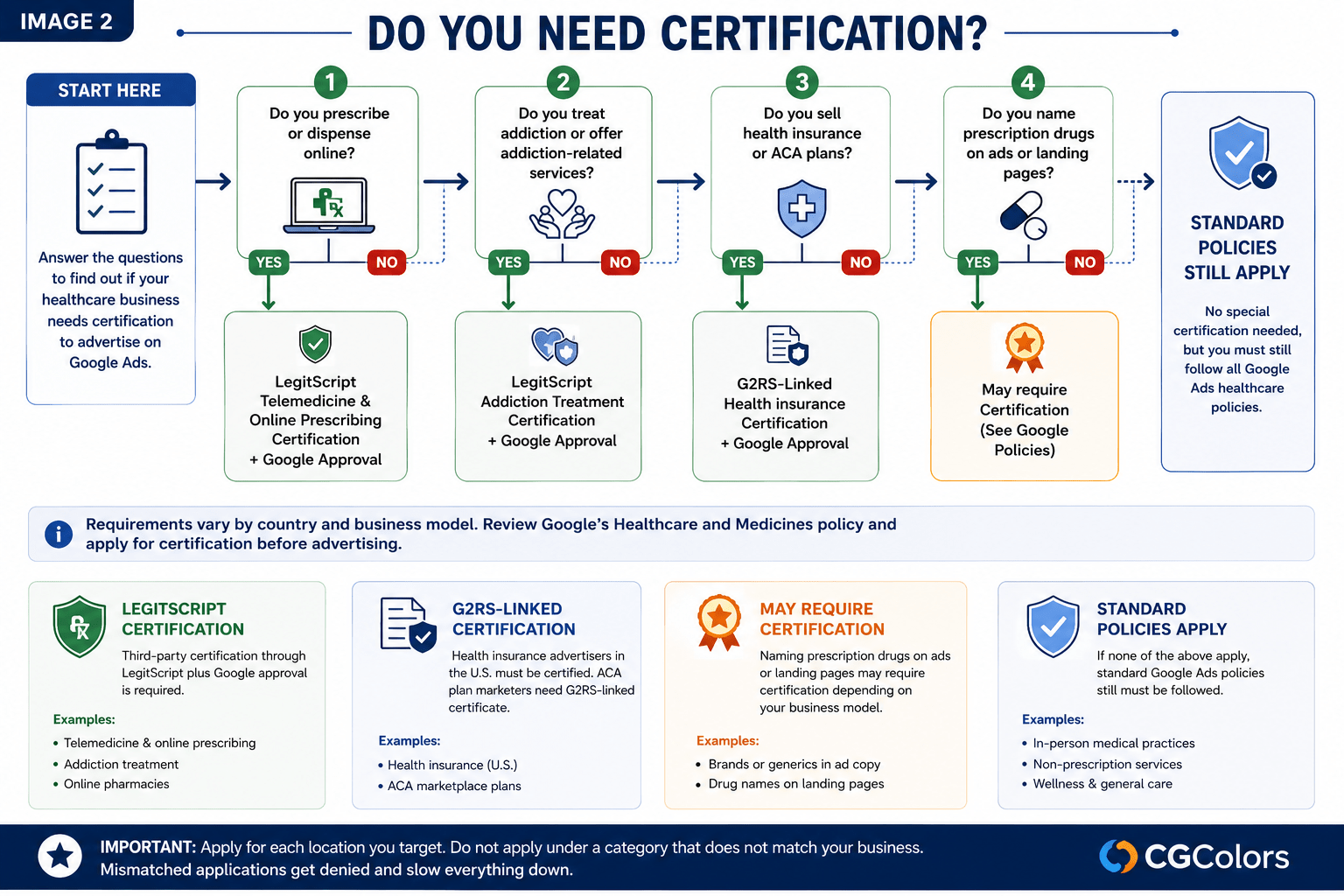
Google requires formal certification before certain healthcare categories can advertise at all. The big ones for US practices:
- Telemedicine and online prescribing. Any service that prescribes, dispenses, or facilitates prescription drugs online needs LegitScript certification and Google approval. Google errs on the side of caution here, so even a landing page that merely links to prescribing services can trigger the policy.
- Addiction treatment. Rehab facilities, treatment centers, and related services require LegitScript addiction treatment certification.
- Online pharmacies. LegitScript certification plus Google approval, with country-by-country restrictions.
- Health insurance. US health insurance advertisers must be certified, and ACA plan marketers need an additional G2RS-linked certificate.
The trap for ordinary practices: you can trip these policies without being in these businesses. A psychiatry practice that mentions medication management, a med spa that names a prescription injectable, or a clinic whose site links to an online pharmacy partner can all get swept into certification requirements.
The fix: identify which certification category actually matches your business model, obtain any required third-party accreditation first (LegitScript, NABP, or G2 depending on category), then submit Google’s healthcare-related advertising application with your Google Ads customer ID. Apply separately for each location you target. Do not apply under a category that does not match your business; mismatched applications get denied and slow everything down.
Reason 2: restricted drug terms in your ads, keywords, or landing pages
Google restricts prescription drug terms everywhere it looks: ad copy, keywords, and the landing page itself. Practices get blindsided by this constantly because the violation often lives on the website, not in the ad.
Your ad says “weight loss program.” Clean. Your landing page names a specific GLP-1 medication. Flagged. Google reviews the entire destination, so a compliant ad pointing to a non-compliant page still gets disapproved.
The fix: audit the full path. Remove or genericize prescription drug names from ad copy and keywords unless you hold the certification to use them. On landing pages, describe the service and the outcome rather than naming the molecule, or pursue certification if named drugs are central to your offer. Never delete keywords or page copy at random to “see what works.” Change one variable, resubmit, and let the review complete.
Reason 3: targeting that touches health conditions
This one produces the most confusion because the same tactics are standard everywhere else in marketing. Google prohibits personalized advertising based on health conditions, treatments, disabilities, or other sensitive health categories. In practice, that means:
- No remarketing lists built from visitors to condition or treatment pages
- No custom audiences implying a health status
- No ad copy that presumes the reader’s condition (“Struggling with depression?” addressed to the reader can be flagged as implying knowledge of personal health)
The fix: move the intent into the search, not the audience. Healthcare PPC wins on high-intent keywords and geography. “Anxiety therapist in [city]” as a keyword targets the search, which is allowed. Building a retargeting pool of people who visited your anxiety page targets the person, which is not. Write ad copy about the service and the practice rather than about the reader’s presumed diagnosis. This restriction overlaps heavily with HIPAA’s limits on tracking pixels, which is a separate problem we cover in our post on Google Analytics and medical websites.
Reason 4: claims Google reads as misleading
Google’s misrepresentation rules apply to everyone, but healthcare gets the strictest reading. Common triggers:
- “Guaranteed results” or any promise of cure
- “Miracle,” “breakthrough,” or superlatives without substantiation
- Before-and-after imagery framed to promise outcomes
- Pricing on the ad that does not match the landing page
- “Speculative or experimental” treatment language, which Google prohibits outright, including most cell and gene therapy promotion
The fix: write like a clinician, not a pitchman. State what the service is, who provides it, credentials, and how to book. Add outcome disclaimers where results vary. This also happens to be what converts in healthcare anyway. Patients choosing a provider respond to credibility and specificity, not hype.
Reason 5: your landing page fails the policy check
Beyond drug terms, Google evaluates landing pages for the same standards as ads. Frequent failures on practice websites:
- Unsubstantiated claims in old page copy nobody has read in years
- Missing or unclear business information
- Broken pages, redirect chains, or gated content behind forms
- Testimonials phrased as guaranteed outcomes
The fix: treat the landing page as part of the ad, because Google does. Before launching any healthcare campaign, review the destination page against the same claim standards you applied to the ad copy. A dedicated, compliant landing page per campaign outperforms a generic homepage on both approval odds and conversion rate.
The repair workflow when you are already disapproved
- Read the actual policy citation. Open the disapproved ad, view policy details, and note the exact policy name. Guessing wastes review cycles.
- Fix the real cause. Edit the ad, the keywords, or the landing page depending on what the citation points to. Saving the edit triggers an automatic re-review.
- Certify if certification is the blocker. No amount of copy editing fixes a missing LegitScript or Google certification. Start the application; timelines run days to weeks depending on category. [STAT CHECK: confirm current typical certification processing times before publishing.]
- Appeal when you believe Google erred. File the appeal from inside the account with a clear explanation. Include documentation. Agencies applying on behalf of a practice should attach proof of the relationship.
- Document the resolution. Keep a simple log of what was flagged and what fixed it. Healthcare accounts that show a pattern of repeat violations face escalating enforcement, and your log prevents relitigating the same issue next quarter.
Build campaigns that clear review the first time
The practices that rarely see disapprovals share the same habits. They keep a pre-launch compliance checklist covering claims, drug terms, targeting settings, and the landing page. They hold required certifications before writing the first ad. They avoid audience tactics that touch health status and put the budget into search intent and geography instead. And they treat Eligible (limited) as the cost of doing business in a sensitive category rather than a fire to fight.
One more 2026 note for practices that market to other providers rather than patients: Google reintroduced limited healthcare professional targeting for eligible advertisers, opening compliant B2B options that were shut for years. [STAT CHECK: confirm current HCP targeting eligibility criteria before publishing.] Consumer health targeting remains locked down.
Frequently asked questions
Why does my ad say Eligible (limited) instead of Approved?
Healthcare is a sensitive category, so Google restricts where and to whom the ads serve. For most medical practices this status is normal and the campaign still runs. Check impressions before assuming anything is broken.
How long does Google take to review a healthcare ad?
Most reviews complete within one business day, but healthcare ads can take longer because of the extra policy checks. If an ad sits under review for more than two or three business days, contact Google Ads support rather than resubmitting duplicates.
Will one disapproval get my account suspended?
No. Healthcare policy violations trigger a warning at least seven days before any suspension, and single disapprovals are routine. Repeated or uncorrected violations are what escalate. Fix the cited issue and keep a record.
Do I need LegitScript certification to advertise my medical practice?
Only if your business falls into a certified category, primarily telemedicine and online prescribing, addiction treatment, or online pharmacy. A standard in-person practice usually does not, but mentioning prescription drugs on ads or landing pages can still trigger restricted term policies.
Can I run remarketing ads to people who visited my treatment pages?
No. Google prohibits personalized advertising based on health interests, and HIPAA raises separate problems with the tracking pixels those audiences require. Redirect that budget into search keywords and location targeting.
My ad was disapproved but my competitor runs nearly identical ads. Why?
Enforcement is automated and imperfect. Your competitor may hold a certification you lack, may be serving under limited status, or may simply not have been flagged yet. Their ad running is not evidence that yours complies.
The bottom line
Google Ads works for medical practices. It just refuses to work the way it does for everyone else. Learn the five failure points, hold the certifications your model requires, keep claims clinical, and point every ad at a page that could survive the same review. Do that, and disapprovals become rare interruptions instead of a monthly crisis.
CGColors manages healthcare PPC with compliance built into the workflow: certification guidance, pre-launch policy checks, compliant landing pages, and search-intent targeting that replaces the audience tactics Google took away. Your campaigns stay live, your budget reaches patients who are actively searching, and your practice gets found first, called first, booked first.