
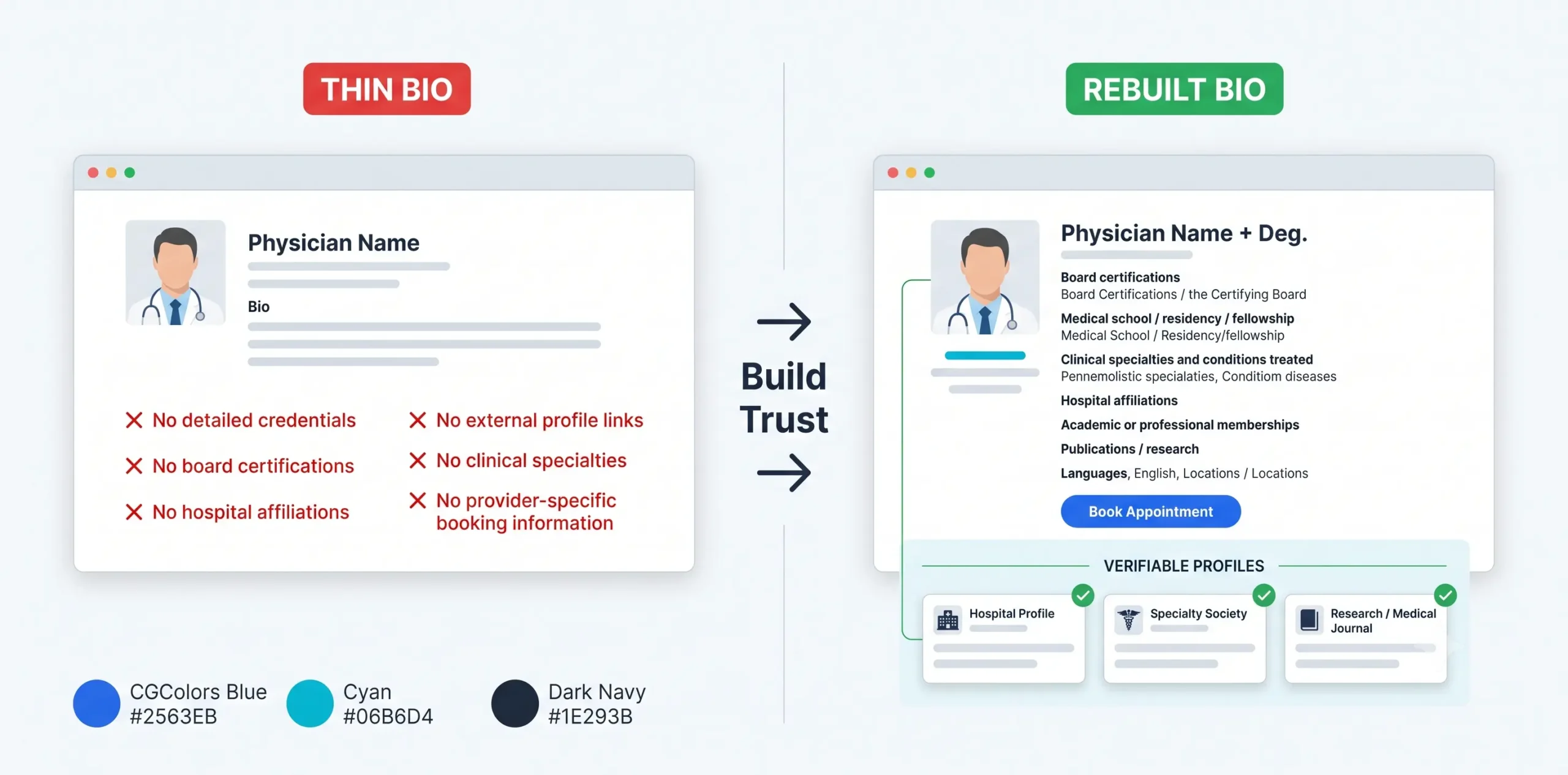
Most medical practice websites treat provider bios as an obligation. A headshot, three sentences about where the doctor went to school, maybe a line about enjoying hiking. Published once, never touched again.
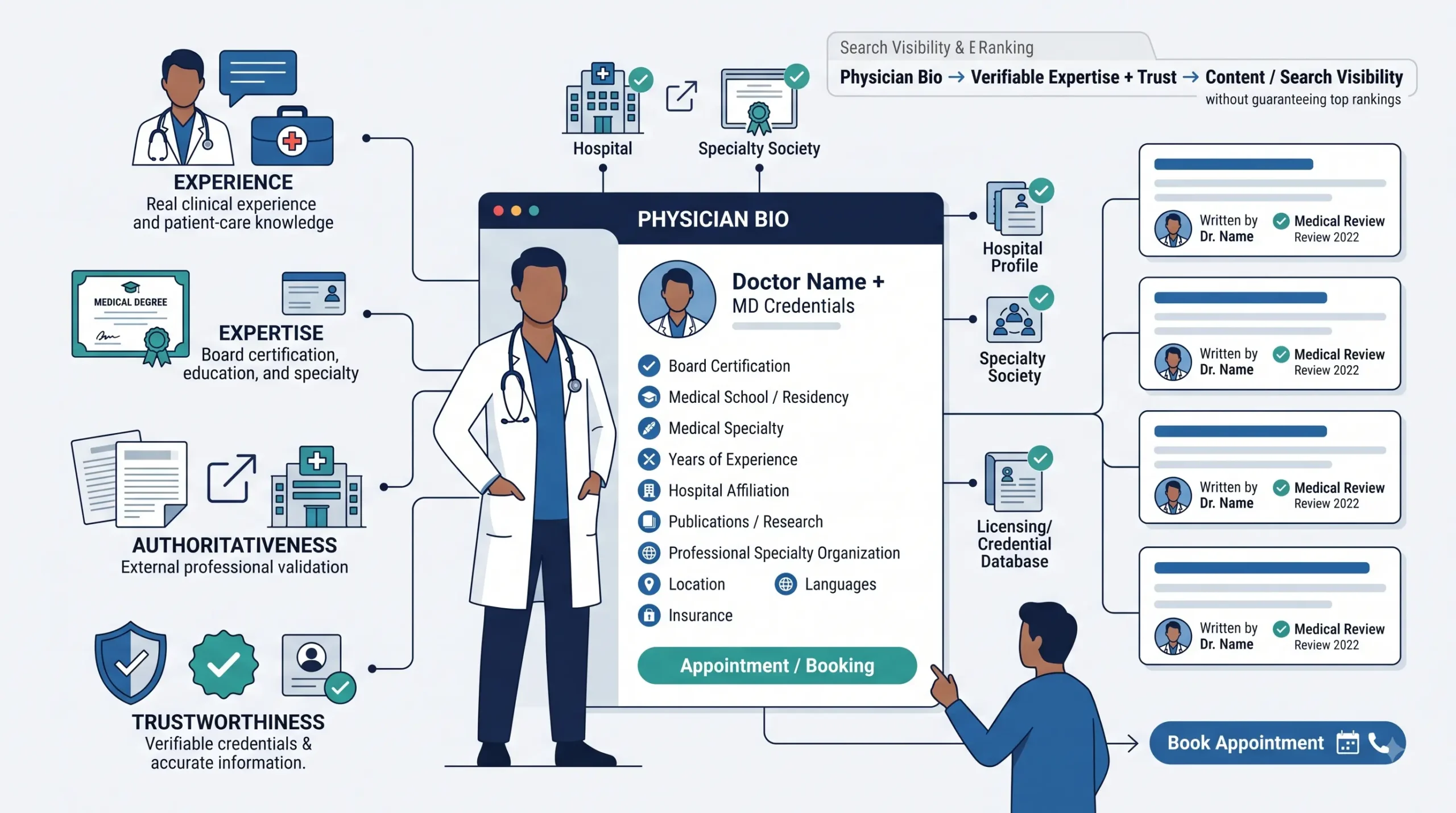
That page is doing two jobs badly. It is the page prospective patients visit most often before calling, and it is the anchor for every trust signal Google evaluates when deciding whether your content deserves to rank in a category where it holds content to its strictest standard.
Anonymous health content does not compete anymore. Google’s quality rater guidelines look for author information on content that could affect someone’s health, and every clinical page you publish either connects to a credible, verifiable person or it does not. The bio page is where that connection lands. This post covers how to build it properly and how to wire it into the rest of the site.
Why the bio page carries so much weight
Three separate functions converge on one page.
It is the conversion page nobody optimizes. Patients choosing a provider read the bio before they call. They are deciding whether to trust this person with something that matters. A three-sentence bio answers none of the questions they actually have.
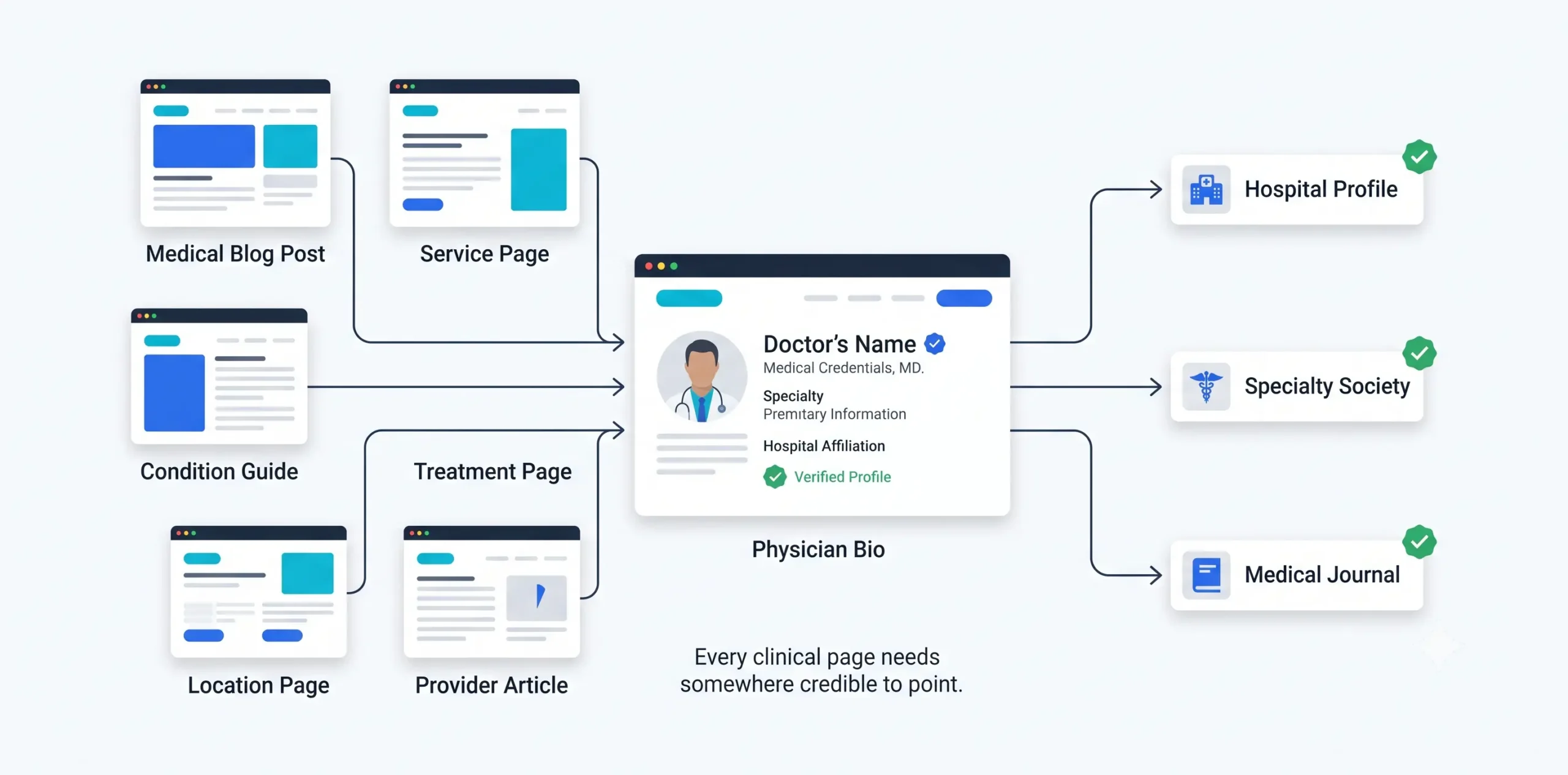
It is the destination for every author byline. Content without an author is content without accountability. When each clinical page carries a byline linking to a substantive bio, the entire site inherits a verifiable human source. When bylines point to nothing, or to a thin page, the signal collapses.
It is your entity anchor. Search systems try to connect the person on your site to the same person in hospital directories, specialty society listings, licensing databases, and published literature. Consistency across those sources is what makes a provider a recognized entity rather than a name on a page. The bio is where you make that connection explicit.
We covered the broader framework in our post on YMYL and core updates. The bio page is where Expertise, Authoritativeness, and Trustworthiness become concrete things on a URL instead of abstractions in a guideline.
What belongs on a provider bio page
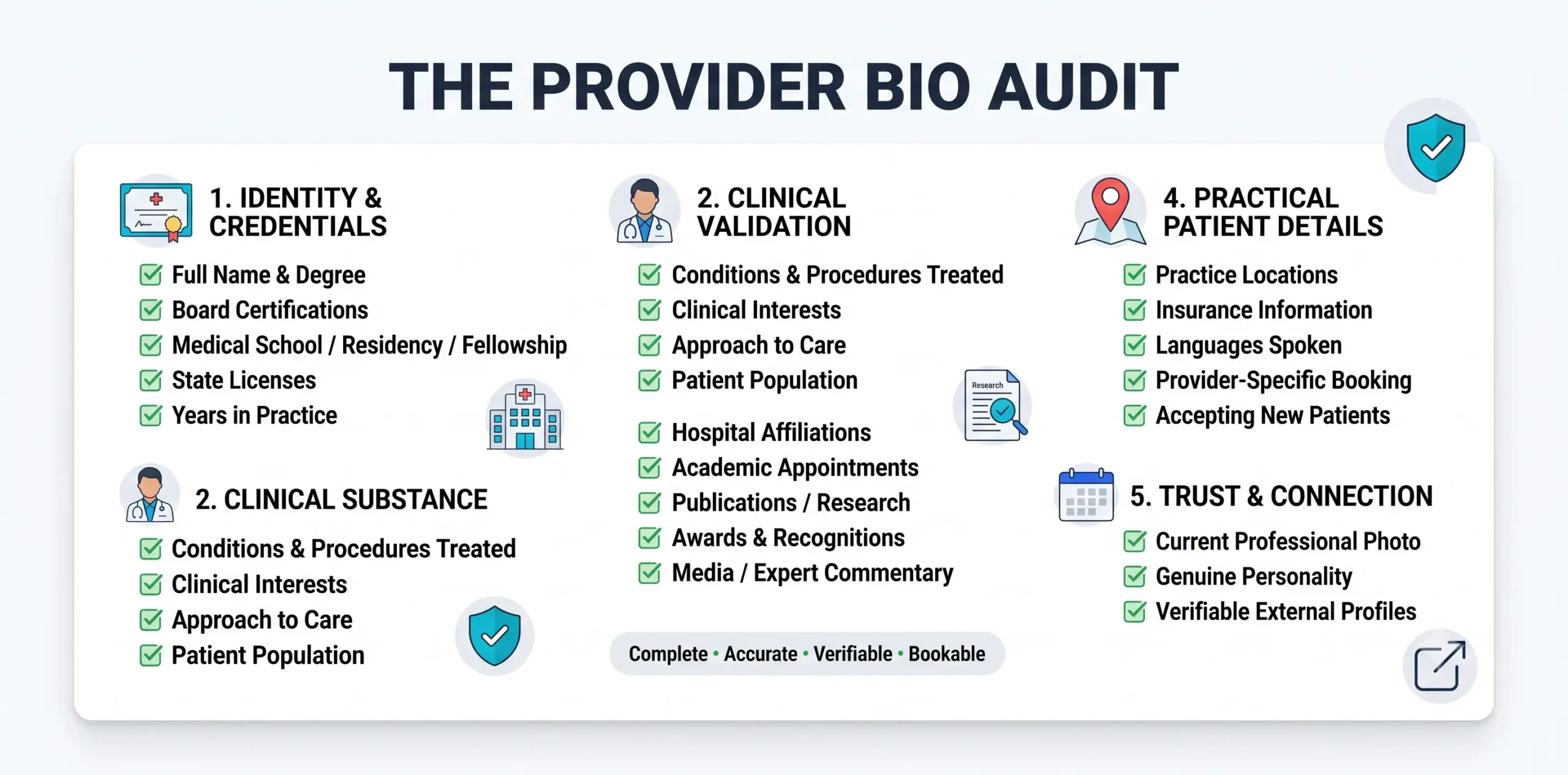
Work through this list. Most practice bios contain two or three of these items. Strong ones contain most.
Identity and credentials
- Full name with degree and any post-nominal credentials
- Board certifications, named specifically, with the certifying board
- Medical school, residency, and fellowship with institutions and years
- State licenses held
- Years in practice
Clinical substance
- Specific conditions and procedures this provider treats, named the way patients search them
- Clinical interests and areas of focus
- Approach to care, written in their own voice rather than agency boilerplate
- Patient population served, including age ranges and any specialization
External validation
- Hospital affiliations and admitting privileges
- Academic appointments
- Specialty society memberships
- Publications, research, or presentations
- Awards and recognitions, with the awarding body named
- Media appearances or expert commentary
Practical detail patients need
- Locations where this provider sees patients
- Insurance accepted, or a link to the current list
- Languages spoken
- How to book with this specific provider
- Whether they are accepting new patients
Trust and connection
- A current, professional photograph
- A short section of genuine personality, kept brief
- Links to verifiable external profiles
That last item matters more than it looks. Linking out to a hospital profile, a specialty society listing, or a research profile lets anyone confirm the credentials independently. Verifiability is the substance behind trustworthiness.
The byline system
A strong bio page does nothing if no content points to it. Build the connective tissue.
Every clinical page gets a named author. Not “Admin,” not the practice name, not a marketing coordinator. A person with relevant credentials, with the name linked to their bio page.
Add a medical reviewer line where the author is not a clinician. A professional writer drafting from clinician input is a normal workflow. The page should then display who reviewed it, their credentials, and the review date. Both names, both linked.
Put credentials near the top. A byline buried in a footer is not doing its job for the reader or for anything evaluating the page. Name, credentials, and review date belong above or immediately below the opening.
Show the date, and keep it honest. Display the review date rather than only the original publish date, and update it when the content is actually reviewed. A refreshed date on unchanged content is a trust problem, not an optimization.
Match the author to the topic. A cardiologist reviewing dermatology content weakens rather than strengthens the signal. Relevance of expertise to the specific subject matters more than the impressiveness of the credential.
Structured data, done simply
Schema markup helps machines connect what humans read.
Use Person schema on each bio page, populated with name, job title, credentials, affiliation, medical specialty, and a sameAs array pointing to verified external profiles. That array is the entity connection made machine readable.
Use Physician or MedicalBusiness schema for the practice, with providers associated to it.
On clinical content, reference the author and reviewer so the article connects to the bio.
Two cautions. Schema describes what is already on the page; it does not create credibility that the visible content lacks. And every claim in the markup must be accurate, because false credential markup is a serious problem well beyond SEO.
Common failures worth checking today
One bio for the whole practice. A combined “our team” page with a paragraph each. Each provider needs their own indexable URL.
Credentials in an image. Certifications rendered as a graphic are invisible to anything reading the page. Put them in text.
Stale affiliations. A provider who left, a hospital privilege that lapsed, a certification that expired. Inaccurate credentials are worse than missing ones, and they can create regulatory exposure alongside the trust problem. Audit annually.
Agency boilerplate voice. Fifteen provider bios that all say the same thing about patient-centered compassionate care. It reads as unwritten, because it was.
No path from bio to booking. The bio is a conversion page. It needs a way to book with that specific provider, not a generic contact link.
Bios excluded from the sitemap or set to noindex. More common than it should be, usually from a template default nobody checked.
Where this pays off beyond rankings
Provider bio pages tend to rank for provider name searches, which matter more than practice owners assume. Patients get a referral, hear a name, and search it. If your bio page is thin, the top result for your own doctor’s name may be a third-party directory profile with outdated information and two reviews, and that is where the patient forms their impression.
Strong bios also feed the systems that increasingly sit between patients and practices. Whatever surface a patient uses to evaluate a provider, the underlying question is the same: is this person real, qualified, and locally relevant. A complete bio with verifiable external connections answers that question in a form both people and machines can use.
Frequently asked questions
Does every provider need their own page?
Yes. Individual indexable URLs let each provider rank for their own name, give bylines a specific destination, and let structured data describe one person accurately.
How long should a bio be?
Long enough to cover credentials, clinical focus, affiliations, and practical booking detail, which typically runs several hundred words. Length is a byproduct of completeness, not a target.
Can a marketing writer author medical content?
Yes, with clinical review displayed on the page. The failure mode is not who typed it; it is content with no accountable clinical name attached.
Does a “medically reviewed” badge actually help?
The badge itself is cosmetic. What matters is a named reviewer with relevant credentials, a linked bio, and a real review date. Do the substance and the visual follows.
How often should bios be updated?
Annually at minimum, and immediately when credentials, affiliations, locations, or new-patient status change. Inaccurate credentials are a liability, not just a stale page.
Should bios list conditions treated even if service pages cover the same ground?
Yes. Service pages describe the service; bios describe what this specific provider does. Both are legitimate, and they support each other through internal links.
What if a provider does not want a detailed public profile?
Respect the preference, but be clear about the trade-off. Referral patients will search that name and will land on whatever third-party profile exists instead. A minimal accurate bio you control beats a directory listing you do not.
The bottom line
Provider bios are the cheapest high-leverage work available on most medical websites. The information already exists in your credentialing files. Putting it on the page properly, linking every clinical byline to it, connecting it to verifiable external profiles, and keeping it current builds the trust infrastructure that both patients and search systems are looking for.
Practices spend months producing blog content that hangs off bio pages too thin to support it. Build the anchor first.
CGColors builds provider bio infrastructure as the foundation of medical content programs: complete credential architecture, byline and medical review workflows, structured data, and the internal linking that connects every clinical page to an accountable expert. That is how a practice earns the trust that gets it found first, called first, booked first.