
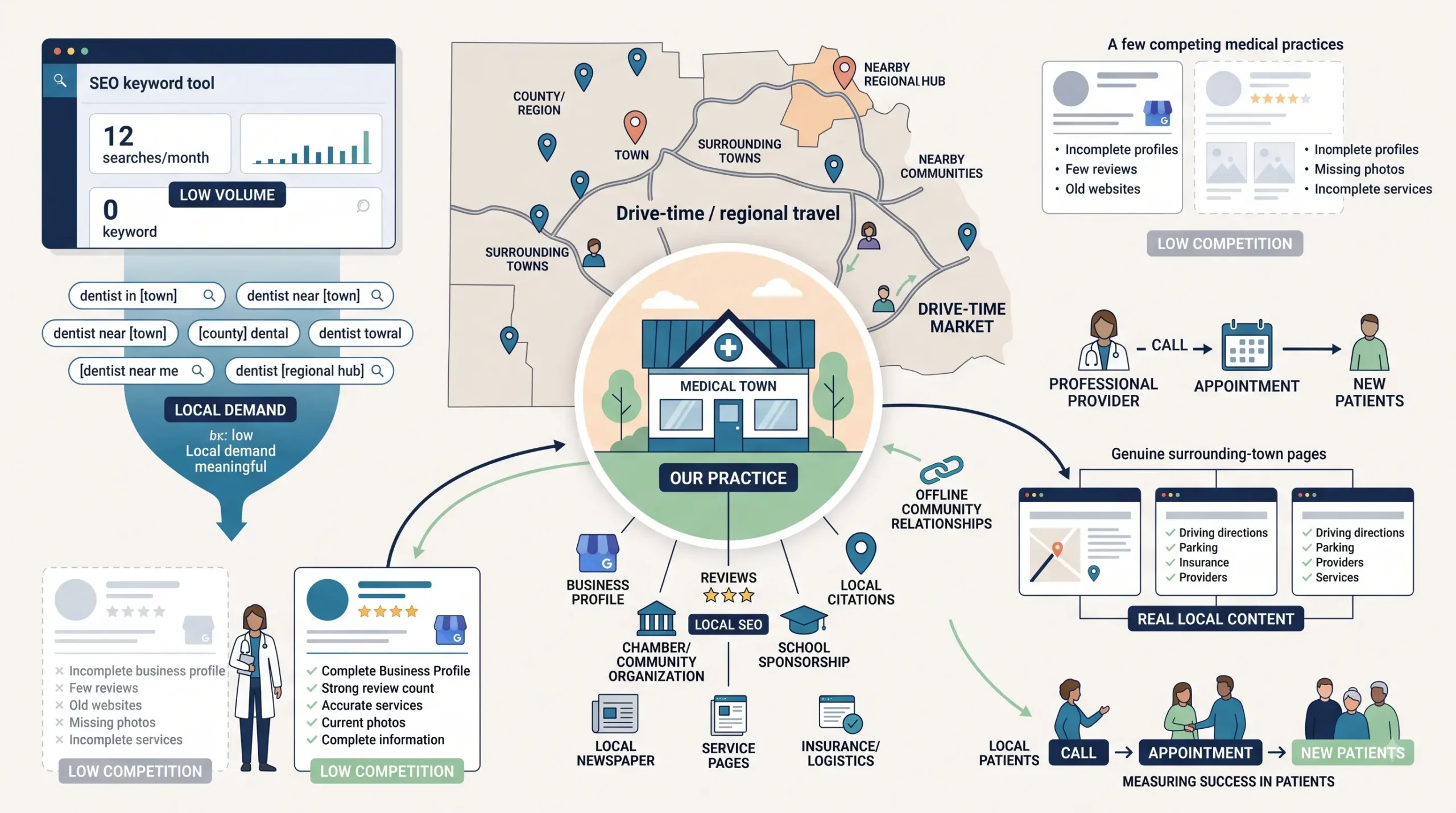
You run a practice in a town of eleven thousand people. An agency runs a keyword report and comes back with bad news: the main term you would want to rank for shows twelve searches per month. Some show zero. The recommendation is to skip SEO and spend on ads instead.
That advice is wrong, and the reasoning behind it is a misunderstanding of what those numbers mean.
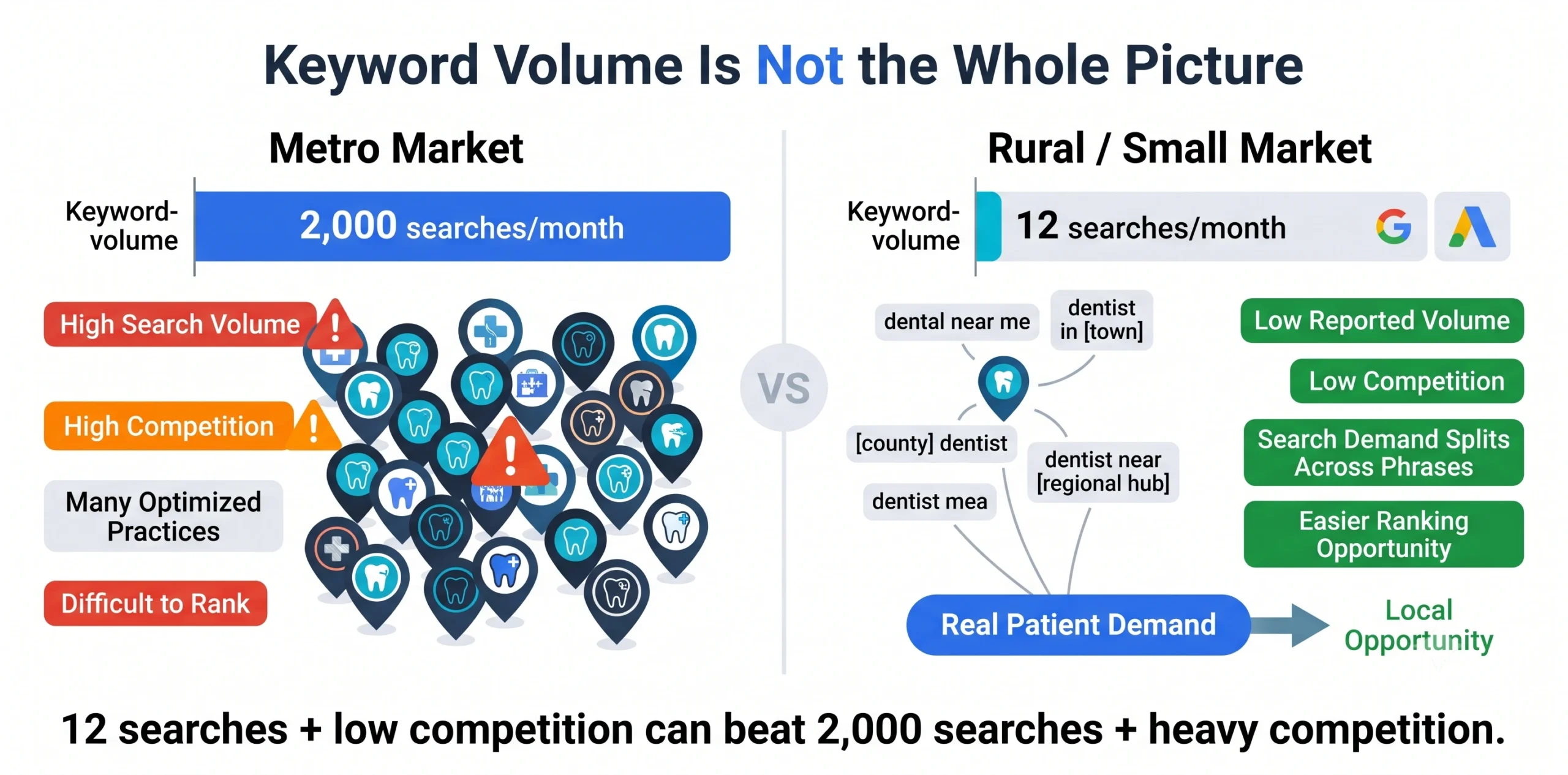
Low reported volume in a small market does not mean nobody is searching. It means the tool cannot measure accurately at that scale, the searches are distributed across dozens of phrasings, and the competition is often close to zero. Small markets are frequently the easiest local search environments in healthcare. The strategy just looks different from what works in a metro.
Why the volume numbers mislead you
Four things happen at small scale that keyword tools handle badly.
Rounding to zero. Tools report estimates, and low-volume terms get rounded down or suppressed entirely. A term showing zero may have fifteen real searches a month. Fifteen patients a month is a meaningful practice.
Volume splinters across phrasings. In a big city, search demand concentrates into a few high-volume phrases. In a small town, the same demand spreads across “dentist in [town],” “dentist near [town],” “[county] dental,” “dentist [nearby larger town],” and dozens of long variations. Individually each looks negligible. Added together they are your entire patient acquisition channel.
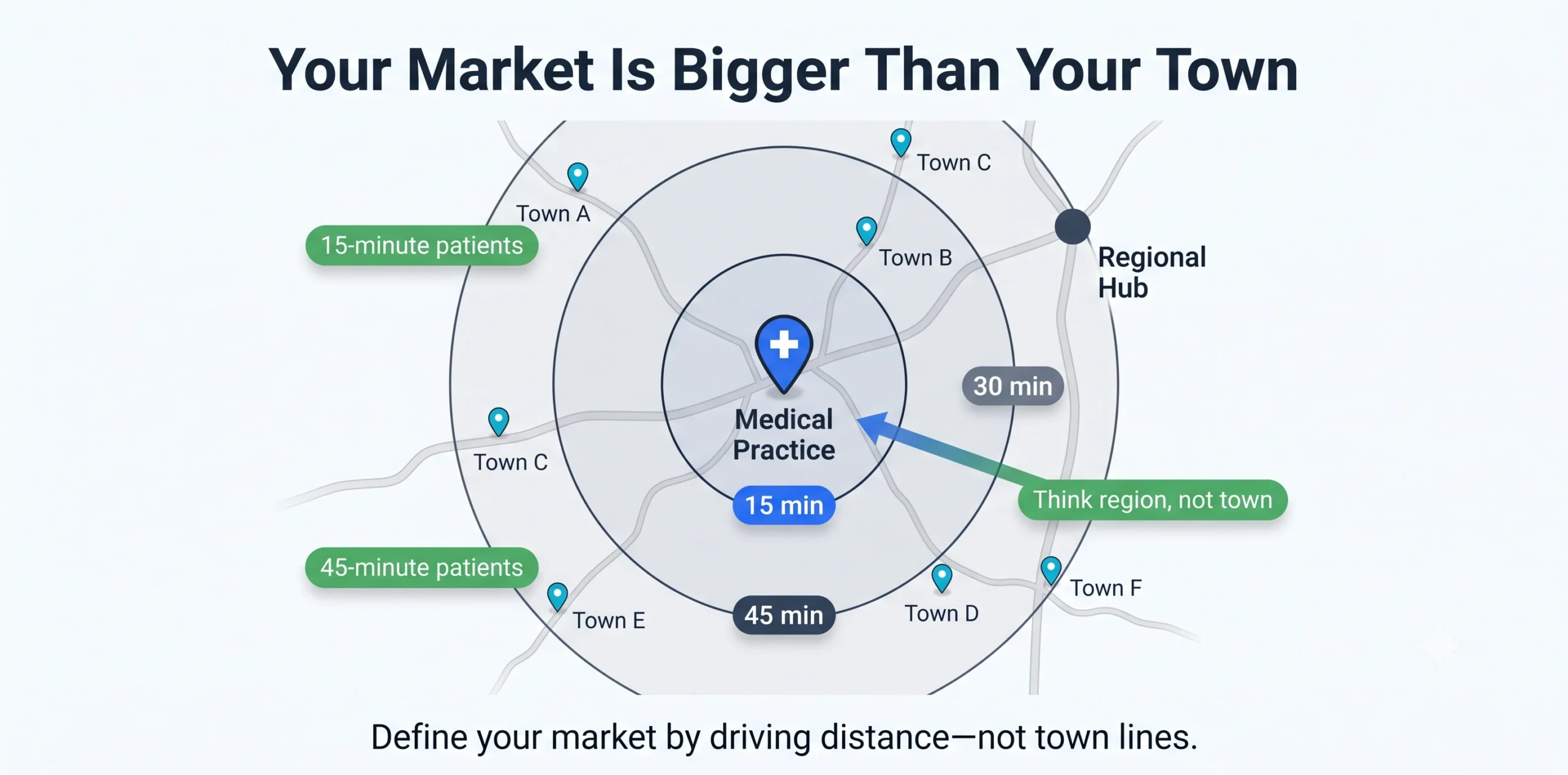
Regional intent is invisible in town-level data. Rural patients search for the nearest available provider, not the nearest town. Someone thirty miles out searches the county name, the larger regional hub, or simply “near me” from wherever they are. Your real service area is far larger than your town, and volume tools anchored to your town miss most of it.
Competition is not measured at all. Twelve searches with zero competing optimized practices is a better opportunity than two thousand searches against eight practices with strong profiles and hundreds of reviews. Conversion economics matter more than volume, and one new patient per month in a specialty with meaningful lifetime value can justify the entire program.
Where small markets have structural advantages
Almost nobody is competing. In most small markets, the competing practices have an unclaimed or barely completed Google Business Profile, a website from 2014, and eleven reviews. The bar to reach position one is completeness, not brilliance.
Real relationships convert into real links. Chambers of commerce, school sponsorships, county fairs, local news, church bulletins, and civic organizations produce genuine local backlinks and citations. In a metro these are hard to get and easy to overvalue. In a small town you already have them; they simply are not on the internet yet.
Word of mouth becomes branded search. Small communities talk. Someone hears your name at a bake sale and searches it that evening. Branded search is the highest-converting query type there is, and small markets generate proportionally far more of it. Your job is to make sure the result they find is yours and not an outdated directory listing.
Distance works differently. Proximity matters in the map pack, but when there are only two practices in a fifty-mile radius, being second on proximity is much less costly than in a dense market.
The strategy: think region, not town
The single most important shift is defining your market by driving distance rather than by town name.
Map your actual patient geography. Pull the towns and ZIP codes your existing patients come from. That set is your real market, and it is usually far wider than the practice assumes.
Set your service area honestly. In your Google Business Profile, define a service area that matches your realistic footprint rather than an inflated radius. Overexpansion weakens relevance signals rather than extending reach. The Google Business Profile optimization guide covers the service area configuration in full.
Build pages for the surrounding towns you genuinely serve. Not thin doorway pages with the town name swapped. Pages that explain what makes the practice practical for someone in that town: driving time, the route, parking, whether you accept the insurance common to employers in that area, and which providers see patients from there. The structure discipline is the same as for multi-location practices, covered in how to build location pages that do not look templated.
Target the county and the regional hub. County-level terms are frequently uncontested and carry real intent. If a larger town sits within driving range and has no provider in your specialty, that is often your highest-value target.
The five things that actually move rankings here
In priority order, because resources are limited in small markets.
1. Complete the Google Business Profile fully. In a market where competitors have half-finished profiles, completeness alone can take the top position. Correct primary category, every service listed, accurate hours including holidays, real photos, attributes filled in, Q&A seeded. This is the highest-return work available and it is free. The mechanics are in why the map pack is your real homepage.
2. Generate reviews steadily. Review counts in small markets are low across the board, which means the gap between twelve reviews and sixty is enormous and achievable. Healthcare has compliance constraints here that other businesses do not, and both sides are covered in the guides to asking patients for reviews without violating HIPAA and responding to reviews without a HIPAA fine.
3. Turn offline relationships into online signals. List with the chamber. Get the school sponsorship acknowledged on the school’s website with a link. Ask the local paper to cover a new provider or a new service. Join the county medical society and confirm the directory listing is accurate. Each of these is a real local citation or link, and in a small market a handful of them is enough to establish prominence.
4. Build service pages and provider bios properly. Fewer pages than a metro practice needs, but each one substantive. Provider bios matter disproportionately in small communities because patients search doctors by name. The full treatment is in physician bios are a ranking asset.
5. Own the logistics queries. Cost, insurance, wait times, whether you take new patients, what to bring to a first visit. These are searched everywhere and answered almost nowhere. In a small market, being the only practice that answers them clearly is a genuine competitive position.
What not to bother with
Small markets reward focus, so here is what to skip.
High-volume national keywords. Competing for general condition terms is a losing strategy in any market and especially wasteful when resources are thin. The reasoning is in why you will never outrank WebMD.
Doorway pages for every town within a hundred miles. Pages for towns you do not realistically serve produce nothing and can be treated as spam. Build pages only for places patients actually come from.
Heavy content volume. A metro practice may need forty pages. You may need twelve, done well.
Aggressive link building campaigns. Your links come from the community, not from outreach programs.
Paid search in a thin market
Ads behave differently at low volume, and it cuts both ways.
In your favor: cost per click is usually far lower than metro rates because fewer advertisers are bidding. A budget that buys almost nothing in a major city can dominate impression share in a small market.
Against you: there may not be enough search volume to spend a meaningful budget, and campaigns can starve for data, making optimization slow. Broad geographic targeting to compensate often pulls in clicks from people who will never drive to you.
The practical setup: tight geographic targeting to your genuine drive-time area, high-intent service and location keywords, and realistic expectations about volume. Local Service Ads are worth evaluating where your category is eligible, since they operate on geographic relevance and reviews rather than keyword bidding, which suits thin markets well. For healthcare specifically, the platform restrictions covered in the posts on ad disapprovals and retargeting limitsapply regardless of market size.
Measuring when the numbers are small
Standard SEO reporting breaks at this scale. Twelve sessions versus nine sessions is noise, and ranking reports fluctuate wildly on low-volume terms.
Measure what matters instead: new patient calls, booked appointments, and where those patients came from. Ask the source question at intake and total it monthly. Track Google Business Profile calls and direction requests, which are often the clearest signal in a small market.
Expect lumpy data. A month with three new patients and a month with nine are both normal at this scale. Judge on quarters, not weeks.
Set the target in patients, not traffic. Decide how many new patients per month would make the program worthwhile, then measure against that. In a specialty with high lifetime value, the number may be surprisingly small.
Frequently asked questions
My keyword tool shows zero volume. Should I skip SEO?
No. Tools round low volumes down and suppress sparse data, and demand in small markets splinters across many phrasings. Verify against Google Business Profile insights and Search Console impressions, which show real activity the tools miss.
How long does it take to rank in a small market?
Often faster than in a metro. Profile completion can show effects within weeks, and full local visibility commonly lands in three to six months, sometimes sooner when competitors have neglected their profiles.
Should I target the nearest big city?
Only if patients realistically travel from there. Ranking in the map pack for a city where you have no address is not achievable, but organic and paid visibility for that market can work if the drive is reasonable and your specialty is scarce there.
We only need two or three new patients a month. Is SEO worth it?
Frequently yes, because the cost of the work is also lower in a thin market. Calculate lifetime value per patient against the program cost rather than judging by traffic volume.
Our whole town knows us already. Why bother?
Because people who know you still search you, and because new residents, referrals from other providers, and patients from surrounding towns do not know you. Branded search that lands on an outdated directory listing loses patients you have already earned.
Do reviews matter as much in a small town?
More, if anything. Review counts are low across the board, so the leader stands out sharply, and in a small community a visible pattern of recent reviews carries social weight beyond the ranking effect.
The bottom line
Small-market SEO is not a smaller version of metro SEO. It is a different game with easier terms: define your market by drive time rather than town lines, complete the profile your competitors never finished, convert the relationships you already have into online signals, and measure in patients rather than sessions.
The agency that told you the volume was too low was reading the wrong number.
CGColors builds local search programs for practices in markets of every size, including regional and rural. Explore our local SEO services, or the vertical pages for mental health practices, optometrists, veterinary hospitals, and senior care facilities. Whatever the market size, the goal is the same: found first, called first, booked first.