
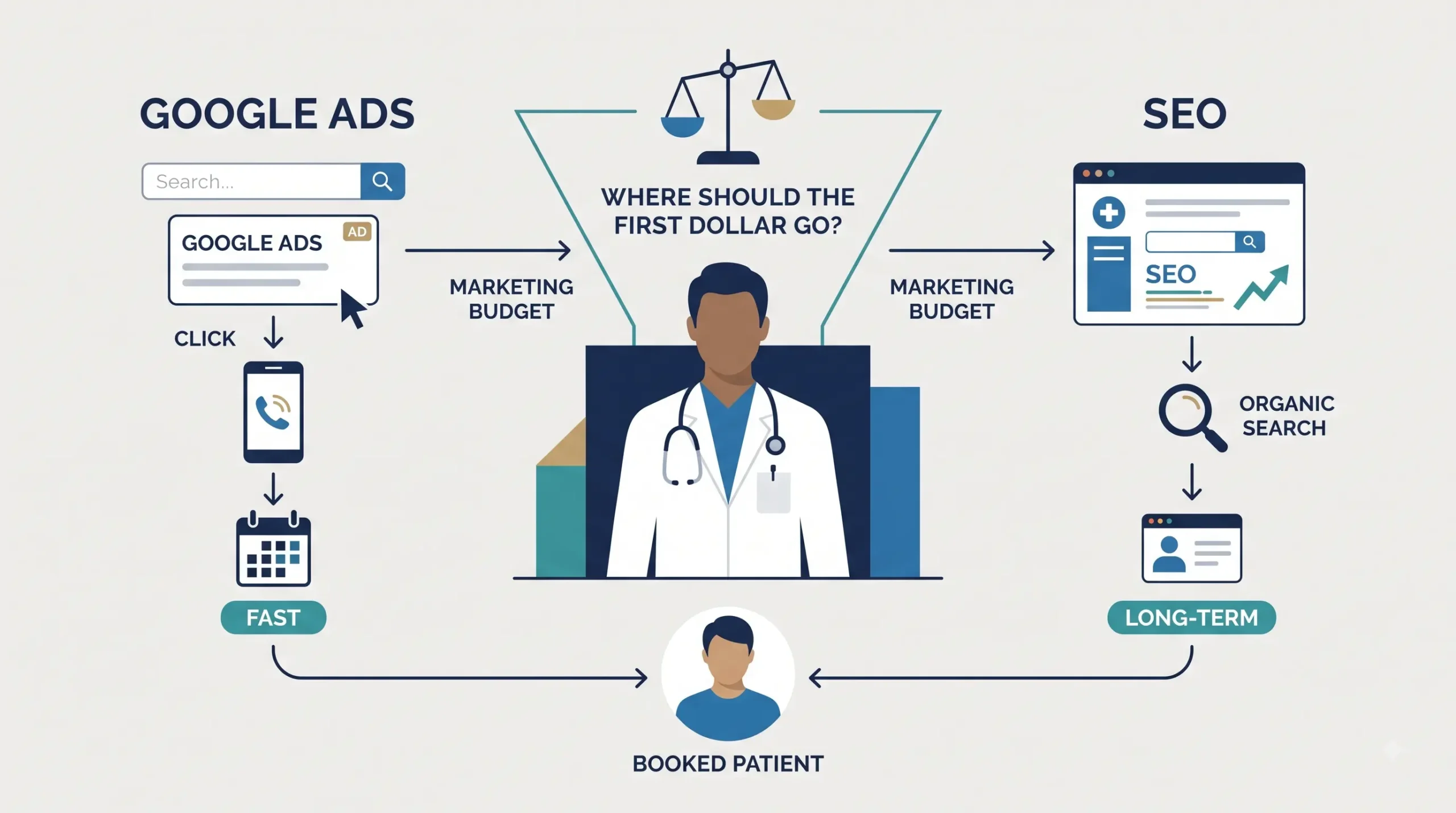
A practice owner with a fixed marketing budget asks the obvious question, and gets a useless answer. The SEO agency says SEO. The PPC agency says PPC. Both produce a deck.
The real answer depends on three things nobody asks about: how full your schedule is right now, what a patient is worth over their relationship with your practice, and how competitive your market is. Get those three numbers and the decision usually makes itself.
This post covers the honest economics of both channels in healthcare, including where each one genuinely fails, and the sequence most practices should follow.
The honest case for each
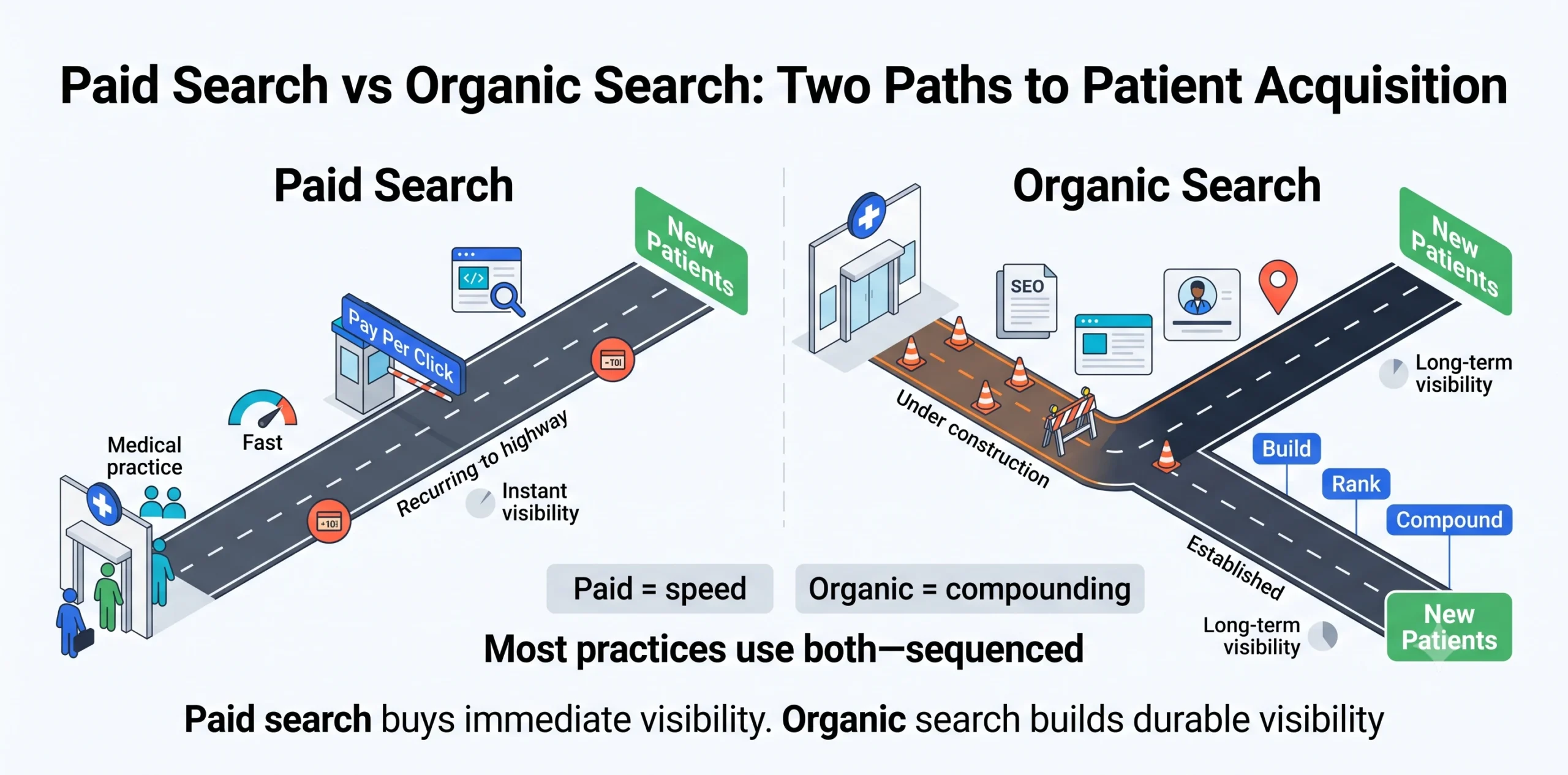
Paid search delivers today. A campaign launched this morning can produce a phone call this afternoon. For a new practice, a new location, a new service line, or a schedule with visible gaps, nothing else moves that fast. It also produces something SEO cannot: real conversion data on which search terms actually book patients, which is genuinely useful intelligence for building content later.
Paid search stops the moment you stop paying. There is no accumulation. Month thirteen costs the same as month one, and pausing the budget removes you from the results page immediately.
SEO compounds and keeps working. A service page that ranks produces patients every month without incremental cost. Provider bios rank for name searches. A Google Business Profile in the map pack generates calls indefinitely. Cost per patient falls over time rather than staying flat.
SEO is slow and uncertain. Most practices see meaningful local ranking movement in three to six months, with fuller results taking six to twelve. In competitive metros it takes longer. If your schedule has gaps now, SEO does not solve this quarter.
The healthcare complication
Two things make this decision harder in medicine than in other industries.
Clicks are expensive. Healthcare and legal are consistently among the most costly categories in paid search. A single click for a competitive procedure term in a major metro can run into double digits, and it takes multiple clicks to produce one call and multiple calls to produce one patient. The arithmetic gets uncomfortable fast at low conversion rates.
Half the standard PPC playbook is illegal. Retargeting, condition-based audiences, patient list uploads, and lookalikes are all unavailable to medical practices, which removes the tactics that normally make paid search efficient. We covered why in the retargeting ban, and the platform policy layer that causes disapprovals in why Google rejected your medical practice ad.
The consequence: healthcare PPC only works when it is built around high-intent search and a landing page that converts on the first visit. There is no second chance through retargeting.
The only number that decides this
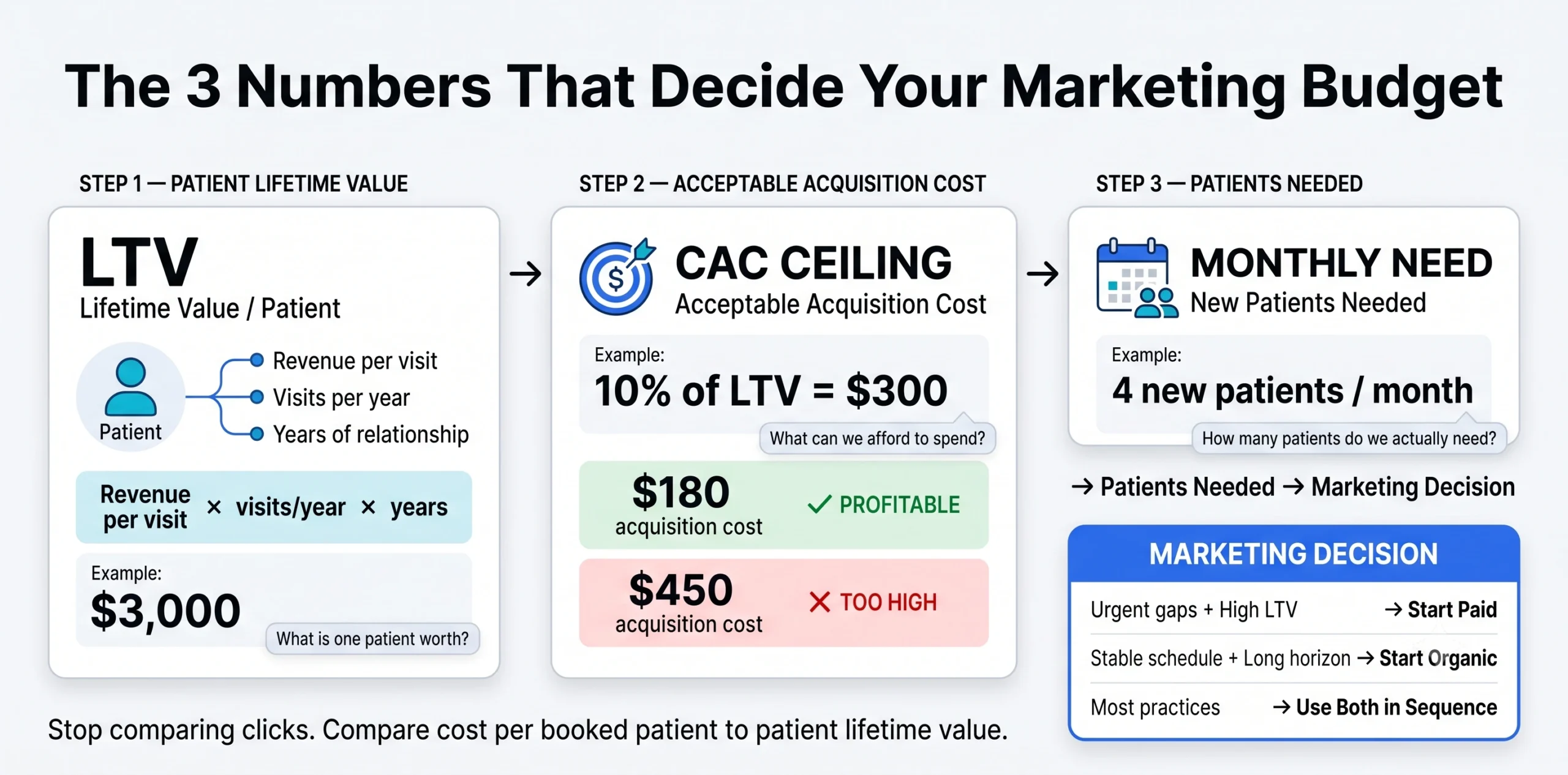
Stop comparing cost per click. Compare cost per booked patient against patient lifetime value.
Work out lifetime value first. Average revenue per visit, times expected visits per year, times expected years of relationship. A private pay therapy client at $150 per session, weekly for six months, is roughly $3,600. A general dentistry patient across several years is often several thousand. A single high-value surgical case can exceed both by an order of magnitude.
Then work backward. If a patient is worth $3,000 over the relationship and you are willing to spend 10% of that to acquire one, your ceiling is $300 per patient. Paid search that delivers patients at $180 is profitable regardless of how expensive the clicks looked in isolation.
Then check the volume. Multiply by how many new patients you actually need. A solo practitioner needing four new patients a month has a very different problem from a group practice needing sixty.
Once those three numbers exist, most practices find the answer is obvious. High lifetime value plus urgent capacity gaps points to paid. Modest lifetime value plus a stable schedule points to organic. The measurement side of this has a compliance layer of its own, which we covered in what therapists can legally track and how to prove ROI anyway.
The free work that comes before either
There is a category of work that is neither SEO nor advertising in the budget sense, and it should happen before you spend on either.
Complete the Google Business Profile. Correct the primary category. Get accurate hours, real photos, every service listed. Start generating reviews. For most practices this is the single highest-return activity available, it costs nothing but attention, and it improves paid performance too, since patients who see your ad often check the profile before calling.
The mechanics are in why the map pack is your real homepage and the Google Business Profile optimization guide. The compliance-safe way to build review volume is in the guide to asking patients for reviews.
An agency that pitches you a paid campaign before fixing an incomplete profile is selling the expensive thing first.
The sequence most practices should follow
Months one to two: fix the foundation. Google Business Profile completion, review generation started, service pages for your core services, provider bios built properly. This work supports both channels and some of it is free.
Months one to three: run paid on your highest-value services only. Not everything you offer. The two or three services with the best margins and clearest intent. Tight geographic targeting, dedicated landing pages, and call tracking configured without capturing protected health information. This fills the schedule while organic builds, and it generates the conversion data that tells you which terms are worth writing content around.
Months three to nine: build organic on what paid proved. Your search term report is now a keyword research document backed by real bookings rather than estimates. Build service and location pages around the terms that actually converted, not the ones a tool suggested. The strategic filter for which queries are worth pursuing is in why you will never outrank WebMD.
Months nine and beyond: rebalance. As organic rankings hold, reduce paid spend on terms you now rank for organically, and redirect that budget to new services, new locations, or terms organic has not reached. Keep branded search running regardless; it is cheap and it defends against competitors bidding on your name.
The pattern is paid buys time and data, organic converts that into durable position, and the mix shifts as the position solidifies.
Where each channel fails
Paid search fails when the landing page is your homepage, the budget is spread across every service you offer, geographic targeting is loose, nobody answers the phone within minutes, or the account is set up once and never touched. Speed to lead matters enormously in healthcare; a form submitted at 8pm that gets a callback in two days is usually a lost patient.
SEO fails when the practice expects results in six weeks, when content is thin and anonymous, when the Google Business Profile stays incomplete, or when nobody accounts for the reality that Google evaluates health content against its strictest standards. That last problem is covered in why medical websites get hit hardest by core updates.
Both fail when the practice measures the wrong thing. Sessions, clicks, and impressions do not pay salaries. Booked patients and cost per booked patient do.
Special cases
Brand new practice with an empty schedule. Paid first, and heavily. You need patients this month, and organic cannot deliver that. Run the foundational free work in parallel.
Established practice, full schedule, wanting growth. Organic first. You can afford the timeline, and lowering long-run acquisition cost is worth more than another month of paid volume.
New service line at an existing practice. Paid, targeted narrowly at that service, to validate demand before investing in content.
Small or rural market. Often organic-leaning, because competition is thin and rankings come faster, though paid clicks are also cheaper. The specifics are in SEO for rural and small-market practices.
Highly competitive metro specialty. Both, indefinitely. Organic alone will not clear the field, and paid alone never stops costing.
Frequently asked questions
Which is cheaper, SEO or Google Ads?
Over a month, usually paid looks cheaper because it produces patients immediately. Over three years, organic is almost always cheaper per patient because the asset keeps producing after the work is done. Compare over the horizon you actually care about.
How much should a medical practice spend on marketing?
Practices commonly budget a single-digit percentage of revenue, higher when growing or newly opened. The more useful frame is acquisition cost against lifetime value rather than a percentage rule.
How long before SEO produces patients?
Profile and review work can show effects in weeks. Meaningful ranking movement typically takes three to six months, with fuller results at six to twelve. Competitive markets take longer.
Can I pause Google Ads once SEO is working?
On terms where you rank strongly organically, reducing spend is reasonable. Keep branded search running, since it is inexpensive and prevents competitors from capturing patients searching your name.
Do Google Ads help my SEO rankings?
Not directly. Indirectly they help a great deal, by revealing which search terms actually convert into booked patients, which is far better keyword research than any tool provides.
Our clicks cost $25. Is that too much?
Unanswerable without lifetime value. At $25 per click and a 10% call rate and a 50% booking rate, you are at roughly $500 per patient. That is terrible for a $200 lifetime value and excellent for a $10,000 one.
Should we hire separate SEO and PPC agencies?
Usually not. The channels share landing pages, tracking, keyword intelligence, and the compliance layer that healthcare requires. Splitting them tends to produce two partial pictures and no owner of the number that matters.
The bottom line
Paid search buys immediate patients and real conversion data. Organic search buys a position that keeps producing after you stop paying. Most practices need both, sequenced: fix the free foundation, run paid on your highest-value services to fill the schedule and learn what converts, build organic on what paid proved, then rebalance as rankings hold.
The one thing that makes the decision straightforward is knowing what a patient is worth. Practices that know that number rarely argue about channels.
CGColors runs both sides for medical practices with the healthcare compliance layer built in. See our SEO services and local SEO services, or the vertical pages for mental health practices and orthodontic lead generation, which reports on case starts rather than sessions. Whichever channel comes first, the goal is the same: found first, called first, booked first.