
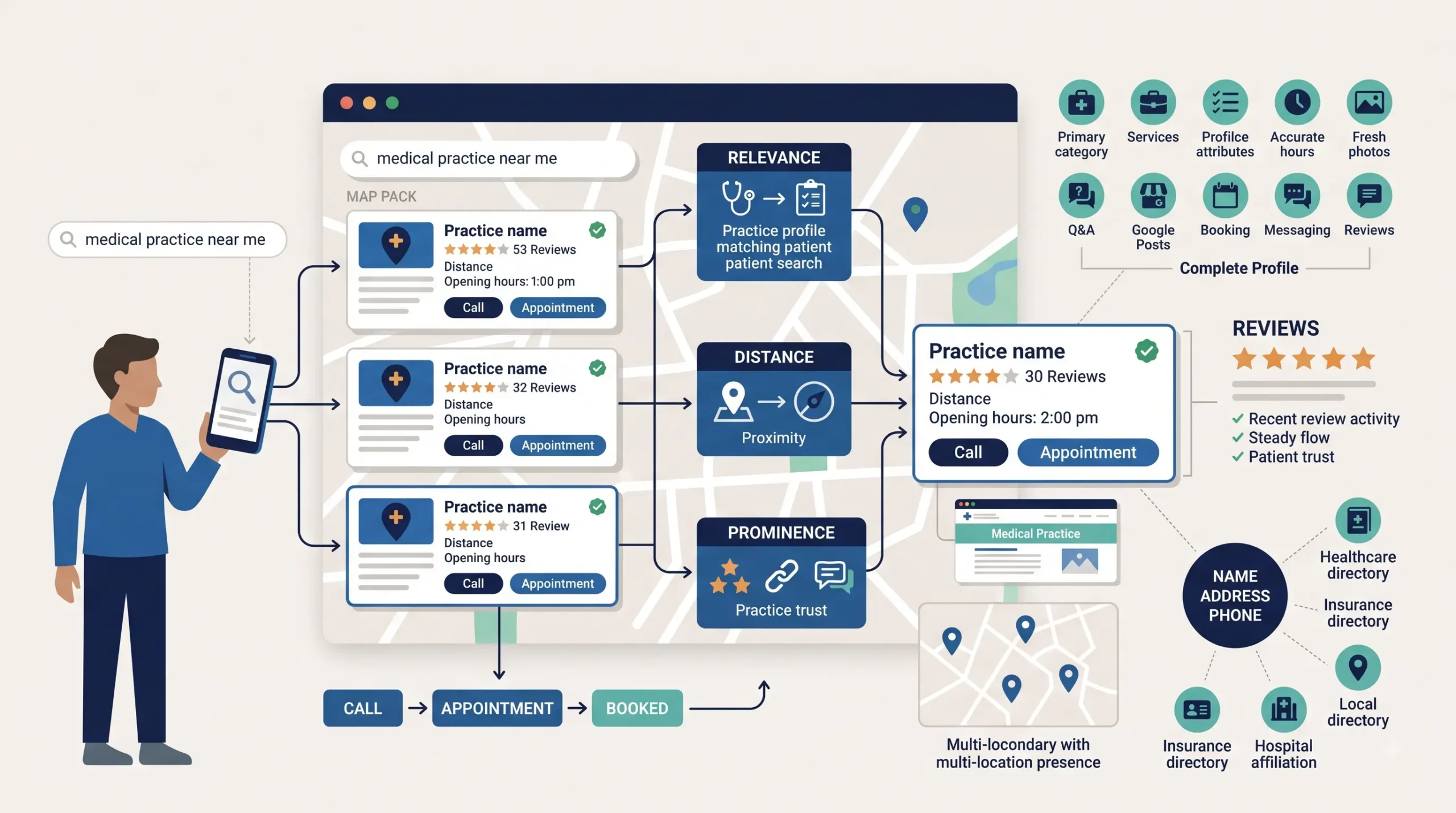
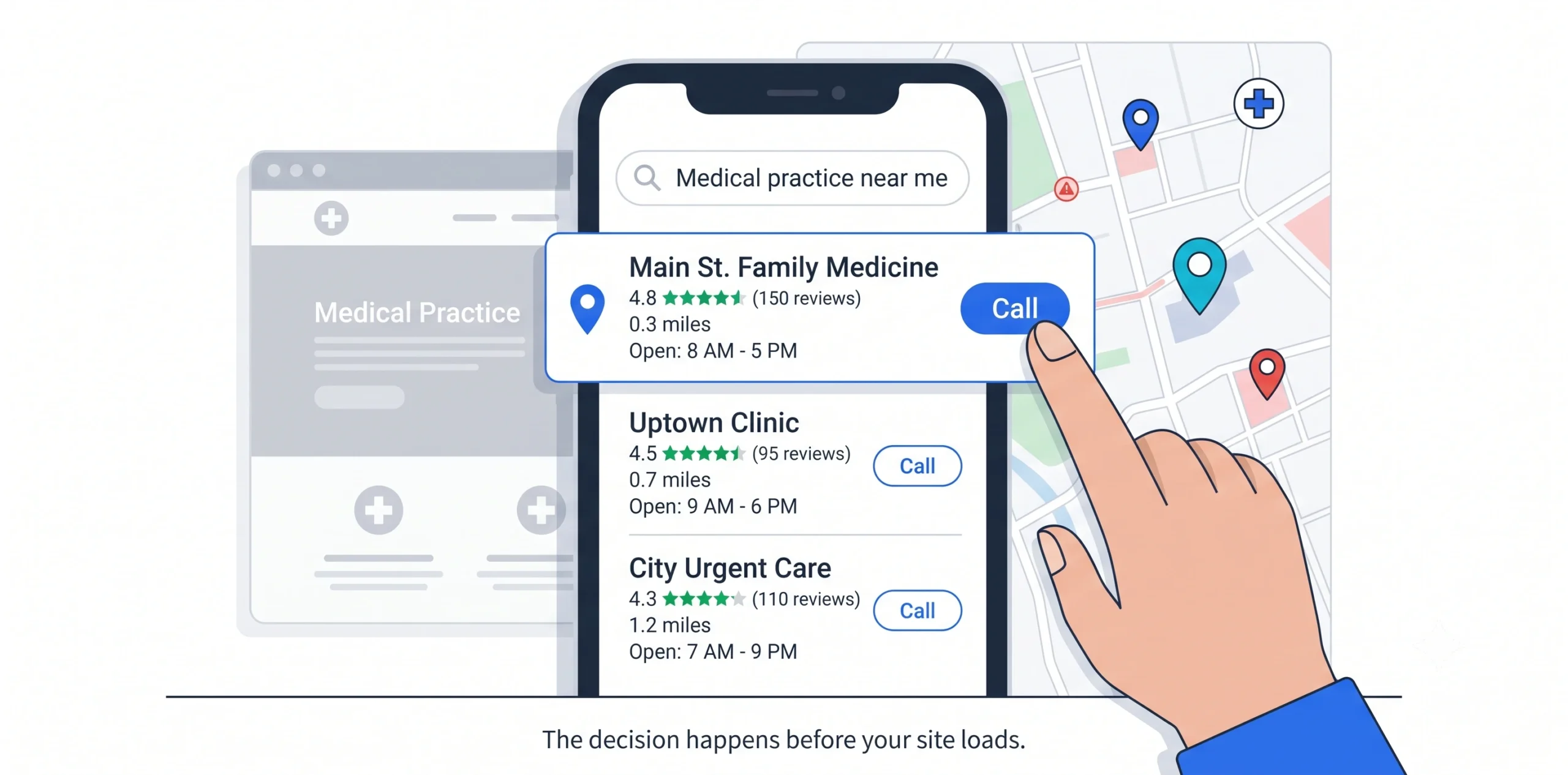
A patient wakes up with a problem, opens their phone, and searches for a provider near them. Google shows three practices with a map, star ratings, distance, hours, and a call button. They tap one and call.
Your website was never part of that. No homepage visit, no about page, no reading your carefully written service copy. The entire decision happened in a box that most practices have never deliberately optimized.
This is the structural reality of healthcare search. The map pack is where new patient acquisition happens, and your Google Business Profile is functionally your homepage for anyone searching with local intent. This post covers how those three positions are decided, what practices can actually influence, and what to fix first.
The three factors that decide the map pack
Google has confirmed three factors determine local ranking: relevance, distance, and prominence. Understanding which of these you can move is the difference between productive work and wasted effort.
Relevance is how well your profile matches what was searched. This comes from your category selection, your services list, your business description, and how well your website content aligns with the query. Fully controllable.
Distance is how close you are to the searcher or the searched location. Almost entirely outside your control. What you can do is make sure Google has your address correct and your service area defined accurately, so it places you where you actually are.
Prominence is how well known and well regarded your practice is, drawn from reviews, citations, links, and overall web presence. This is where most of the available work sits, and where most practices have done none of it.
The practical takeaway: you cannot move your building, so you compete on relevance and prominence. In dense markets that means winning on reviews and completeness against practices that are physically closer. It is winnable, and most competitors are not trying.
Profile completeness is not a checkbox exercise
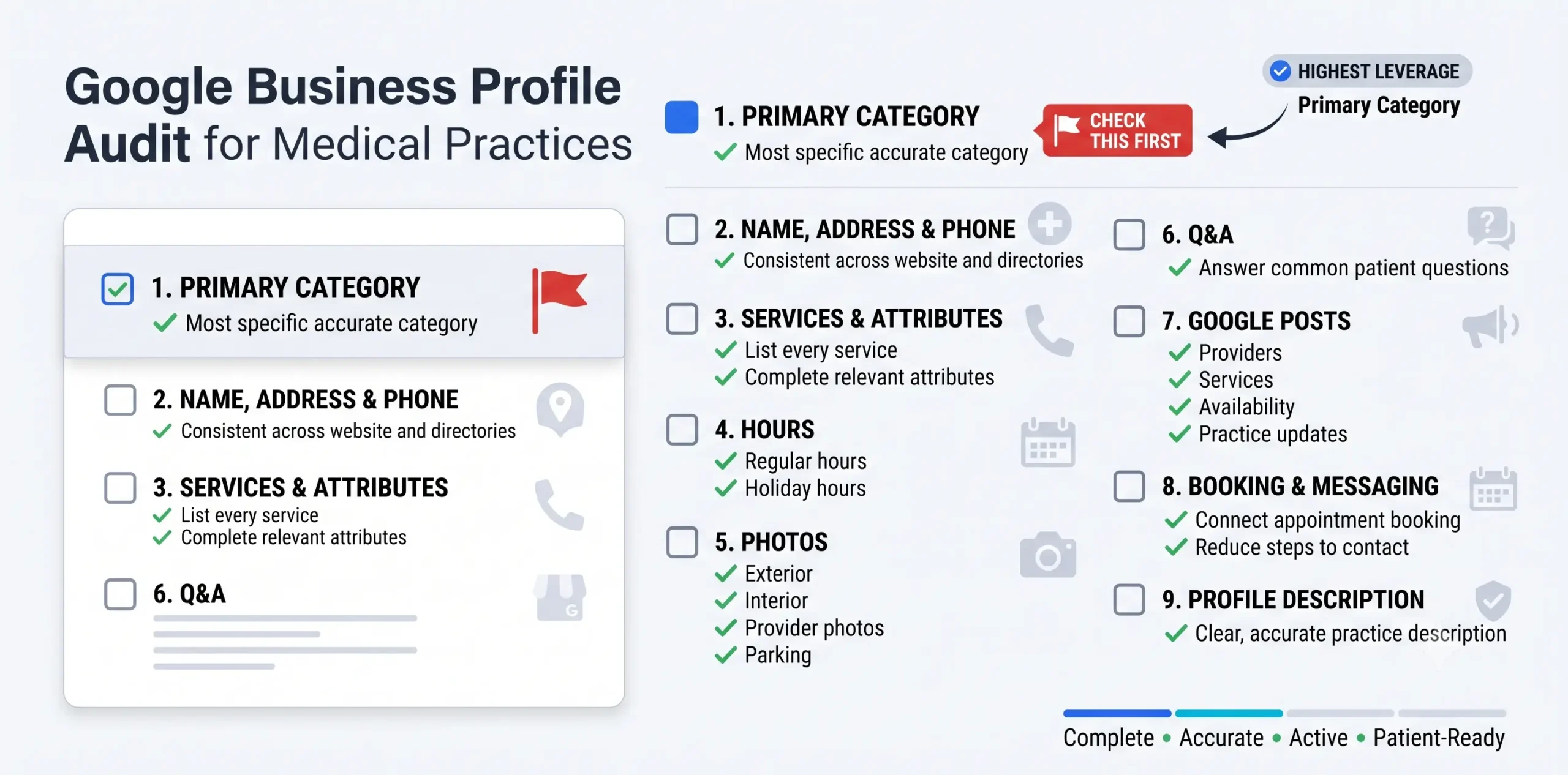
The elements that matter most, roughly in order of impact:
Primary category. The single highest-leverage field on the profile. A dermatology practice categorized as “Doctor” instead of “Dermatologist” is invisible for the searches that matter most. Pick the most specific category that describes the practice, then add secondary categories for additional services. Review this first; miscategorization is the most common serious error we find.
Name, address, phone. Exactly consistent with your website and every directory listing. Not “Dr. Smith Family Medicine” in one place and “Smith Family Medical Group” in another. Do not stuff keywords into the name field; it violates Google’s guidelines and can get the profile suspended.
Services and attributes. List every service as a separate entry using patient language, not billing codes. Fill in attributes: wheelchair accessible, accepts new patients, languages spoken, telehealth available. These feed both relevance and the filters patients apply.
Hours, including holidays. Wrong hours generate one-star reviews from patients who showed up to a closed door.
Photos, updated regularly. Exterior shots so patients recognize the building, interior shots of the waiting area, provider photos, and parking. Profiles with fresh photo uploads consistently see more views and more clicks than profiles with five images from three years ago.
Q&A, seeded by you. You can post and answer questions on your own profile. Seed the ones patients actually ask: do you take my insurance, do you see children, do you offer same day appointments, where do I park. An empty Q&A section leaves space for a stranger to post something inaccurate that sits there indefinitely.
Google Posts. Regular posts about new providers, new services, seasonal availability, and practice updates. Low effort, and it signals an active profile.
Booking and messaging. Connect appointment booking where your system supports it. Every extra step between the map pack and a booked appointment costs you patients.
Reviews are the prominence engine
Review quantity, quality, recency, and diversity all feed local ranking, and they also decide whether a patient calls you or the practice below you. A profile with forty reviews averaging 4.7, the most recent from last week, beats a profile with twelve reviews averaging 4.9 from two years ago on both counts.
Healthcare has a compliance layer here that other industries do not, and it cuts both ways. You cannot respond to reviews the way a restaurant does, because confirming someone is a patient is itself a disclosure. You also cannot screen patients and send only the happy ones to Google. Both constraints are manageable with a system, and we have covered them in detail:
- Generating reviews compliantly: [HIPAA-compliant ways to ask patients for Google reviews]
- Responding without disclosing anything: [how to respond to patient reviews without a HIPAA fine]
Two things to get right regardless of vertical. Never buy reviews or use services that supply them, because Google detects this and penalizes profiles severely. And build the ask into a normal business process rather than a campaign, so volume arrives steadily instead of in suspicious bursts.
Citations and the NAP problem
Citations are mentions of your practice name, address, and phone across the web. Consistency is the whole point: conflicting information across directories creates uncertainty, and uncertainty suppresses prominence.
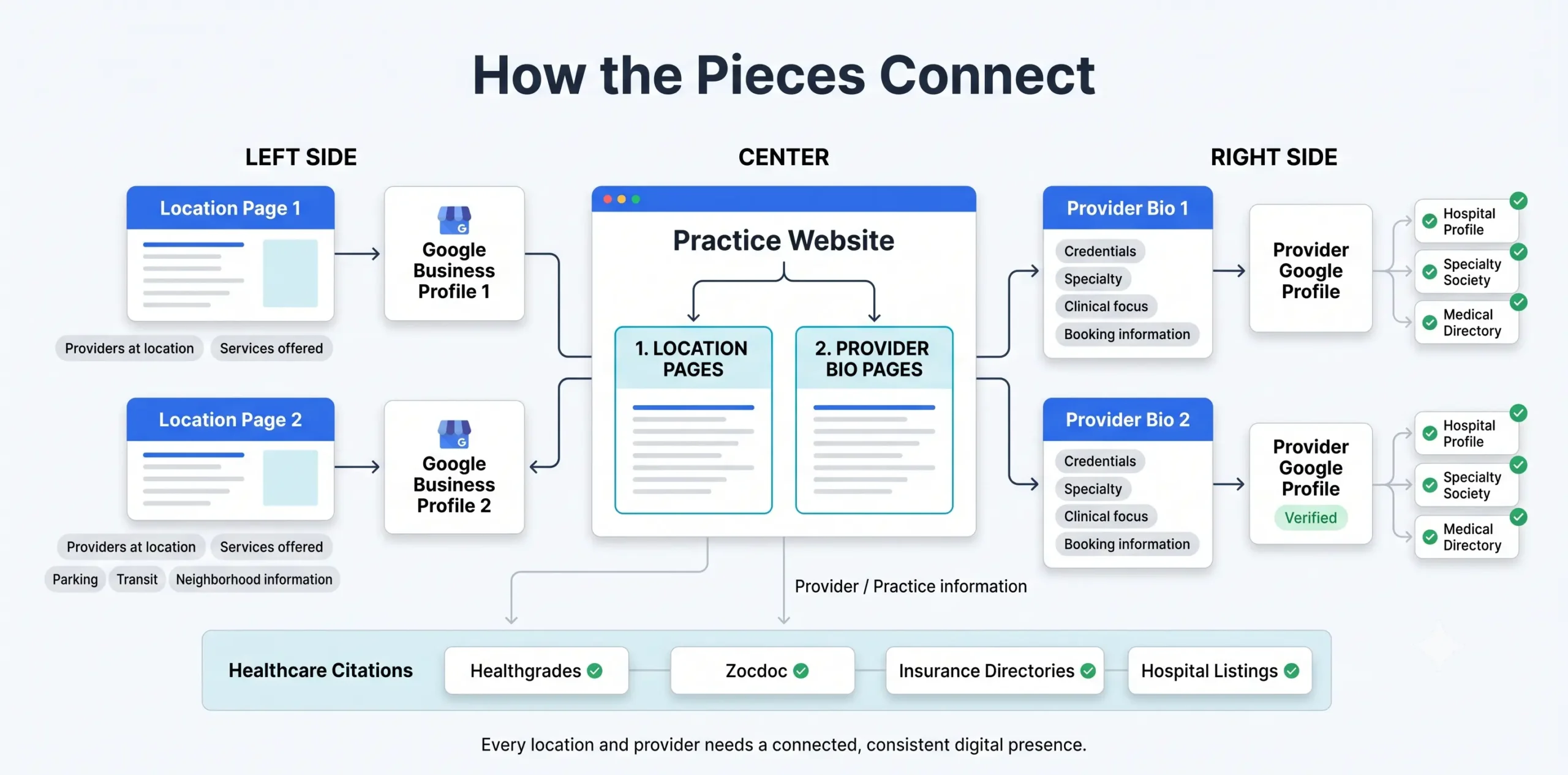
For medical practices, the citation set has two layers. The general layer is the same as any local business: Google, Bing Places, Apple Maps, Yelp, Yellow Pages, Facebook. The healthcare layer is where practices usually have the most damage: Healthgrades, Vitals, Zocdoc, WebMD Physician Directory, insurance provider directories, and hospital affiliation listings.
Insurance directories deserve specific attention. They are updated by the insurer, frequently wrong, and patients treat them as authoritative. An outdated address in a payer directory sends patients to a building you left three years ago.
Two cleanup tasks worth doing once, properly. Find and remove duplicate listings, including unverified and auto-generated ones. And check every listing again after any address change, phone change, or rebrand, because that is when consistency breaks silently.
Multi-provider and multi-location structure
Two structural decisions that cause lasting problems when they are made wrong.
Individual providers can have their own profiles. Practitioners who are public-facing and personally reachable qualify for their own Google Business Profile, separate from the practice profile. This is legitimate and useful, since patients search provider names directly. It also needs to be handled cleanly, with the practice profile as the location and provider profiles associated to it, no duplicates, and consistent information across both. This works best when each provider also has a substantive bio page on your site, which we covered in our post on [physician bios as a ranking asset].
Each location needs its own profile and its own page. One profile per physical location, each linked to a distinct, substantive location page on your website. Not one page listing all locations. Not identical location pages with the city name swapped. Each page needs real content about that location: which providers practice there, which services are offered there, parking, transit, and neighborhood context that a patient actually needs.
What on your website still matters
The map pack is not the whole story. Google evaluates your website when assessing relevance, and organic local results sit directly beneath the pack.
Service pages per service, per location. The foundation of local relevance and the most commonly skipped work.
Location pages with real substance. Covered above, and worth repeating because templated location pages are the single most common failure in multi-location healthcare SEO.
LocalBusiness and Physician schema. Structured data that tells search engines exactly what the practice is, where it is, and who practices there.
Mobile performance. Local health searches skew heavily mobile and often urgent. A slow site loses patients who are already in a hurry.
Click to call above the fold. For an urgent search, the call button is the conversion. Make it impossible to miss.
Where to start
If you do nothing else, do these five, in this order.
- Verify your primary category is the most specific accurate option. Fifteen minutes, highest leverage single fix available.
- Complete every field on the profile. Services, attributes, hours, photos, description.
- Start a compliant review generation process. Steady volume beats bursts, and it compounds monthly.
- Audit citations for NAP consistency, starting with healthcare directories and insurance listings.
- Build or fix location pages so each profile points to a real page with real content.
Our [local SEO audit checklist for small businesses] walks through the full technical version of this, and for practices that want it handled, our [local SEO services] page covers what the managed version includes.
Frequently asked questions
How long does it take to rank in the map pack?
Profile fixes like category correction can affect visibility within weeks. Prominence work through reviews and citations builds over months. Most practices see meaningful local ranking movement in three to six months, faster in less competitive markets.
Can we rank in a city where we do not have an office?
Not in the map pack for that city, since distance is a real factor and Google requires a genuine address. You can rank organically below the pack with strong location-relevant content, and paid search reaches those patients immediately.
Should each doctor have a separate Google profile?
Practitioners who see patients directly and are publicly reachable can, and it helps capture provider-name searches. Set it up cleanly with the practice as the location, no duplicate listings, and consistent information everywhere.
We moved offices and our rankings dropped. Why?
Address changes reset local signals and break citation consistency at the same time. Update the profile first, then work through every citation, then check for a duplicate listing at the old address, which is extremely common.
Do we need a physical address, or can we use a home office?
You need a real, verifiable address where you can receive mail. Profiles with a verified commercial address generally position more strongly than hidden home-address setups.
How many reviews do we need?
More than the practices ranking above you, arriving steadily. Recency carries real weight, so a profile whose newest review is a year old reads as inactive regardless of the total.
Is local SEO still worth it with AI Overviews changing search?
Yes, and arguably more. Local commercial queries are the ones AI summaries handle least well, because a summary cannot tell someone which nearby practice takes their insurance and has an opening Thursday. We covered how to separate those losses in our post on [diagnosing AI Overview traffic drops].
The bottom line
Patients searching for care are not evaluating your website. They are evaluating three results in a box, and they are choosing on proximity, rating, review count, and whether the profile looks alive. Fix the category, complete the profile, generate reviews compliantly, clean the citations, and give every location a real page.
Most of your local competitors have done none of this. That is the opportunity.
CGColors builds [local search programs] for medical and [mental health practices], from Google Business Profile optimization and compliant review systems through location page architecture and citation cleanup. That is how a practice gets found first, called first, booked first.