
Every practice hits the same wall. The SEO plan calls for twenty pages of clinical content. The physicians who could write it authoritatively bill several hundred dollars an hour and have no free evenings. The writers who have time have never treated a patient. And the tool that produces a draft in nine seconds keeps confidently stating things that are subtly wrong.
So the content either does not get made, or it gets made badly, and both outcomes cost the same in lost visibility.
The answer is not choosing one of the three. It is a workflow that takes what each is actually good at and removes them from the parts they are bad at. This post lays out that workflow, including realistic time commitments, and covers where AI genuinely helps versus where it creates liability.
What each source is actually good at
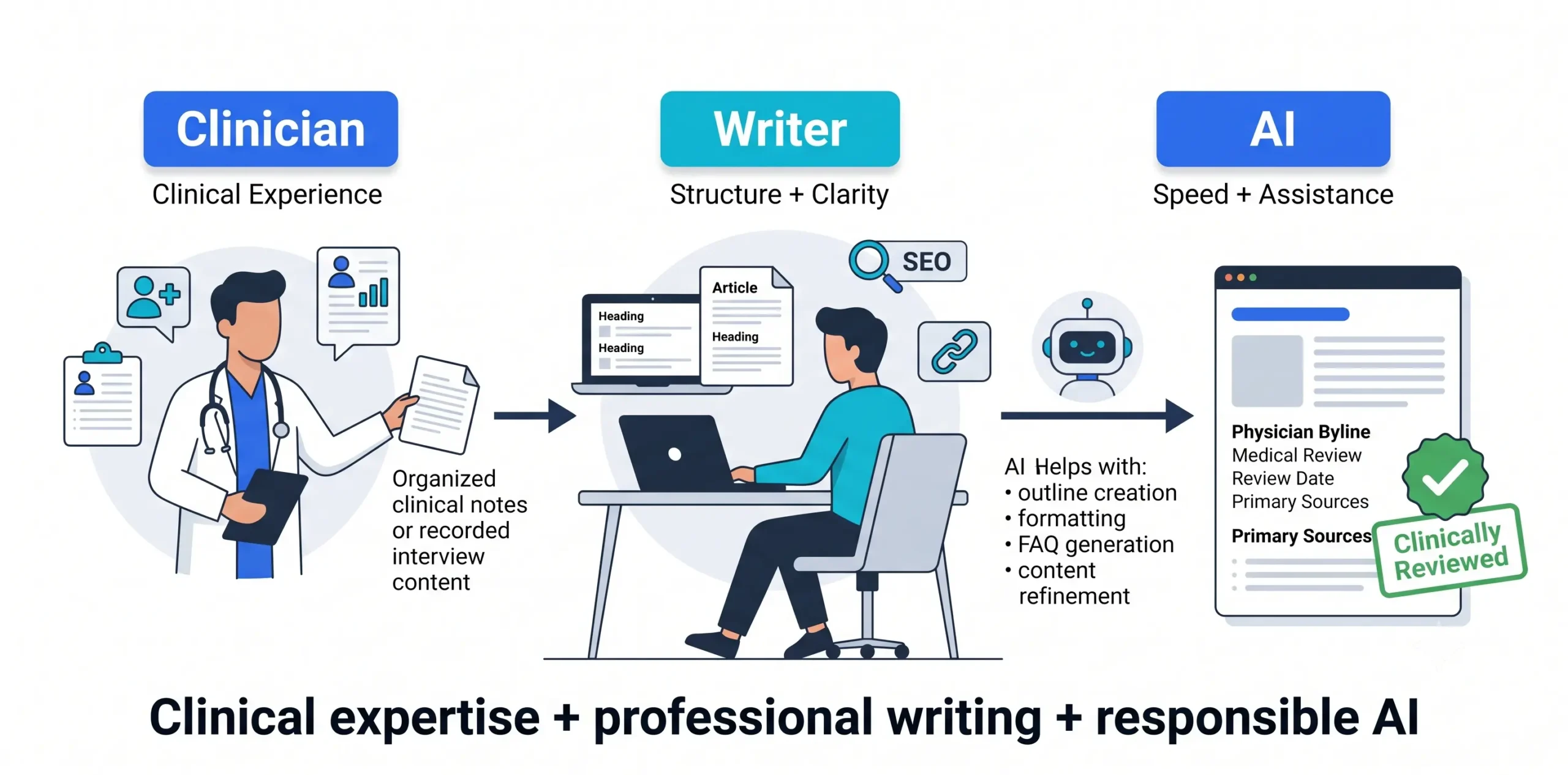
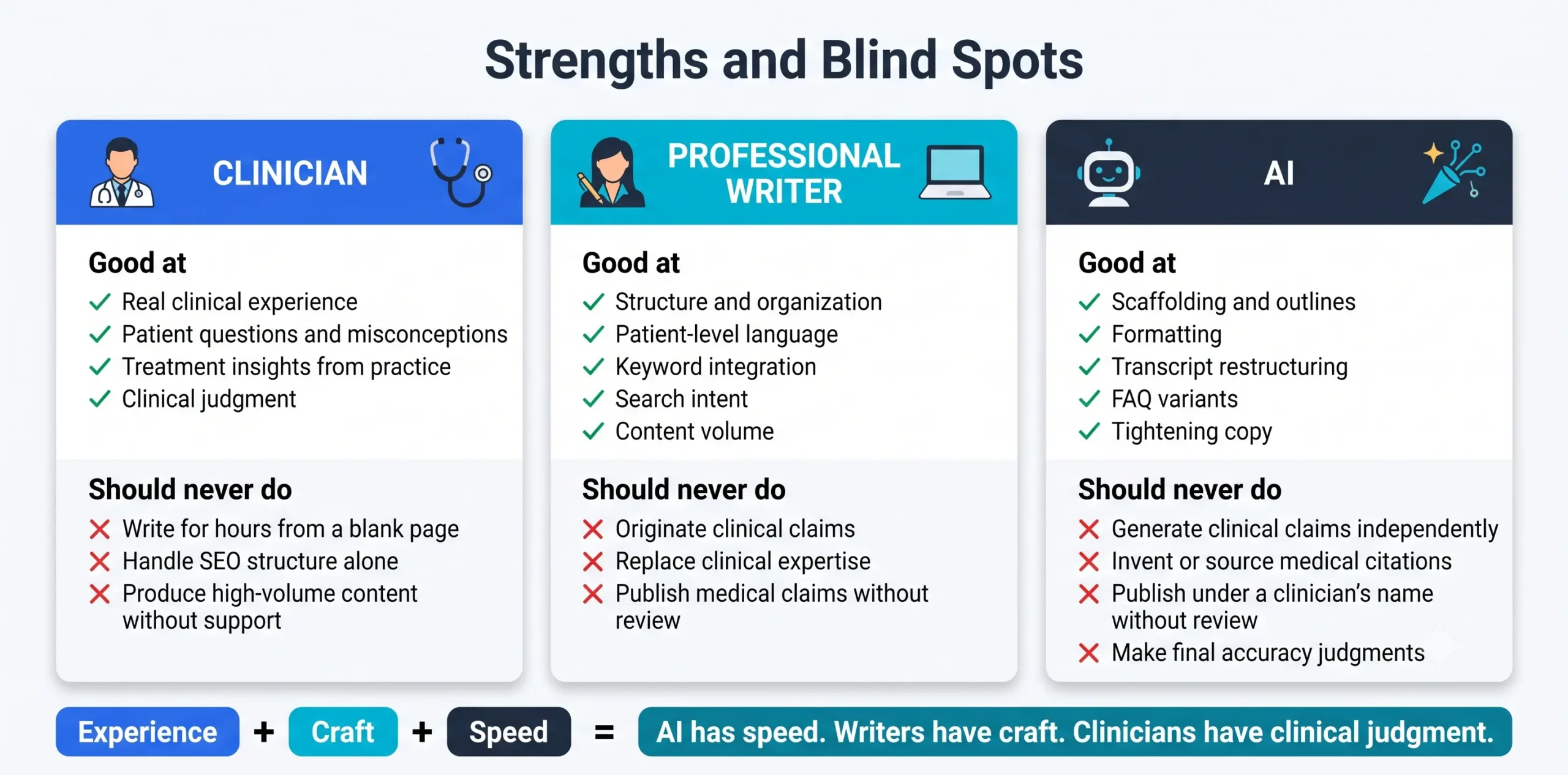
Clinicians hold the one thing that cannot be sourced elsewhere: real clinical experience. How patients in your market actually present, which questions come up in every consultation, the misconceptions that show up weekly, what genuinely differs between treatment options in practice rather than in a textbook. Google added Experience to its quality framework specifically to reward this, and no writer or model can manufacture it. What clinicians are not good at, generally, is structuring content for search, writing at a patient reading level, and finding four uninterrupted hours.
Professional writers are good at structure, clarity, keyword integration, patient-appropriate language, and volume. They are not qualified to originate clinical claims, and content built only from other published articles inherits the same weakness we described in the post on why practices cannot outrank health publishers: it is a rewrite of what already ranks, with nothing new in it.
AI is fast at scaffolding, formatting, reworking a transcript into prose, drafting FAQ variants, and tightening copy. It is unreliable at clinical accuracy, invents plausible citations, reflects a knowledge cutoff that may predate current guidelines, and produces the average of what it has read, which on health topics is a mix of good sources and content farms.
Notice these gaps are complementary. The clinician has the substance and no time. The writer has the craft and no substance. AI has speed and no judgment.
The workflow that works
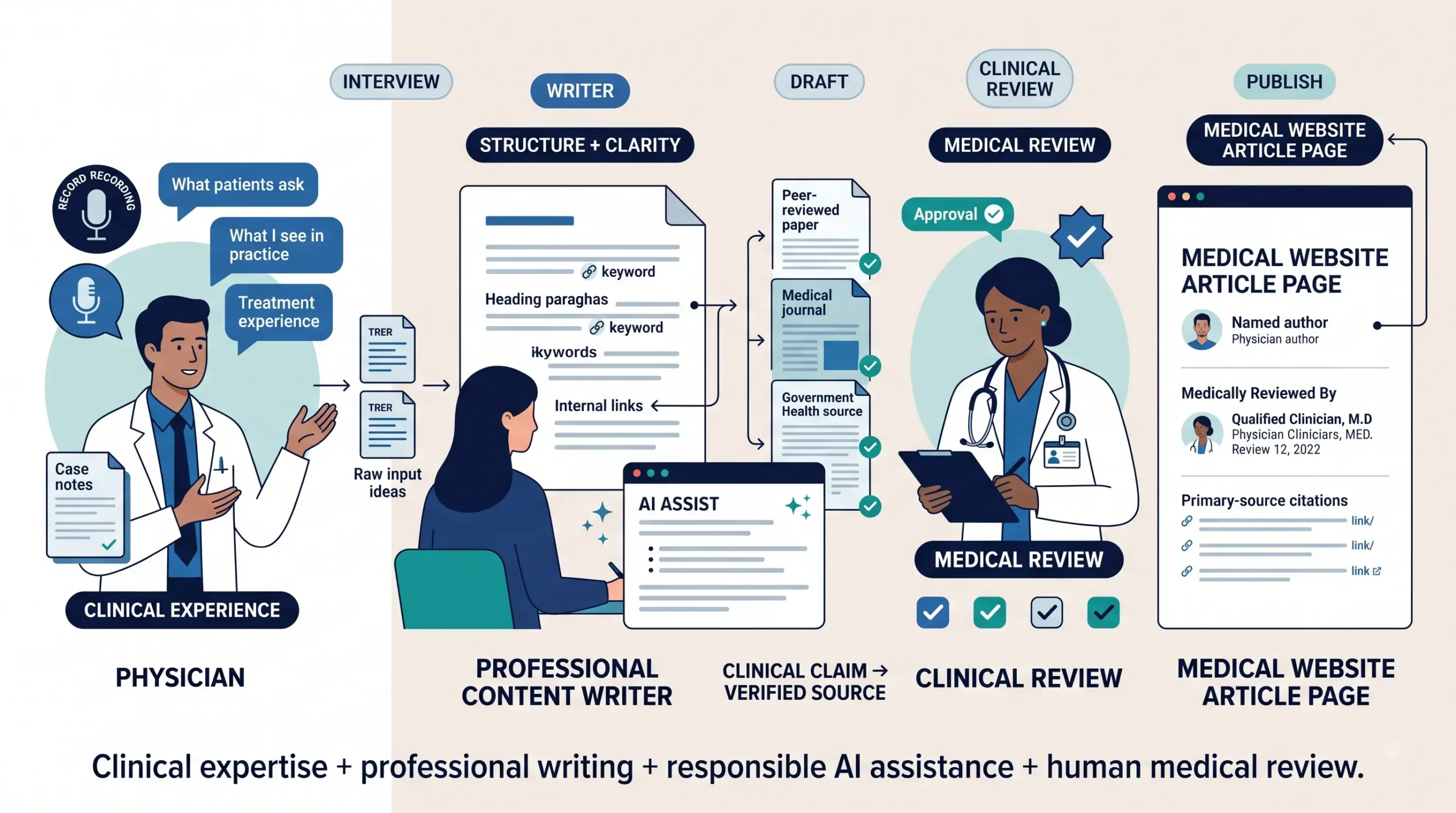
The core move is simple: extract clinical substance by talking, not writing, then let the writer and the tooling handle everything else.
Step 1: the clinical interview, 20 to 30 minutes. Record a conversation with the provider about the topic. Good prompts: what do patients always ask about this, what do they get wrong, what would you tell a friend, what surprises people about the recovery, what makes you recommend one option over another. This is the only step that requires the clinician’s expensive time, and it produces material nothing else can.
Step 2: transcription and extraction. Turn the recording into text and pull out the clinical claims, the original observations, and the quotable explanations. AI is genuinely useful here and carries little risk, since it is organizing something a clinician already said rather than generating medical claims.
Step 3: research and sourcing. The writer supports each clinical claim with a primary source: peer-reviewed literature, specialty society guidelines, or government health sources. Not other agency blogs. Any claim from the interview that cannot be sourced gets flagged back to the clinician rather than published on their authority alone.
Step 4: drafting. The writer builds the page: structure, headings, patient-level language, search intent, internal links. AI can assist with scaffolding and tightening. The clinical substance stays anchored to the interview and the sources.
Step 5: clinical review. The provider reads for accuracy, not for style. Frame it that way explicitly or you will lose an hour to comma preferences. Fifteen to twenty minutes per page once the workflow is running.
Step 6: publication with attribution. Named author, named medical reviewer with credentials, review date, both linked to full bio pages. The infrastructure covered in our post on physician bio pages is what makes this step meaningful rather than decorative.
Step 7: scheduled re-review. Health content needs revisiting when guidelines change and at least every six months. Log the review date and honor it.
Total clinician time per page: roughly 35 to 50 minutes across two touchpoints, neither requiring a blank page. That is the number that makes the whole thing feasible.
Getting more from each interview
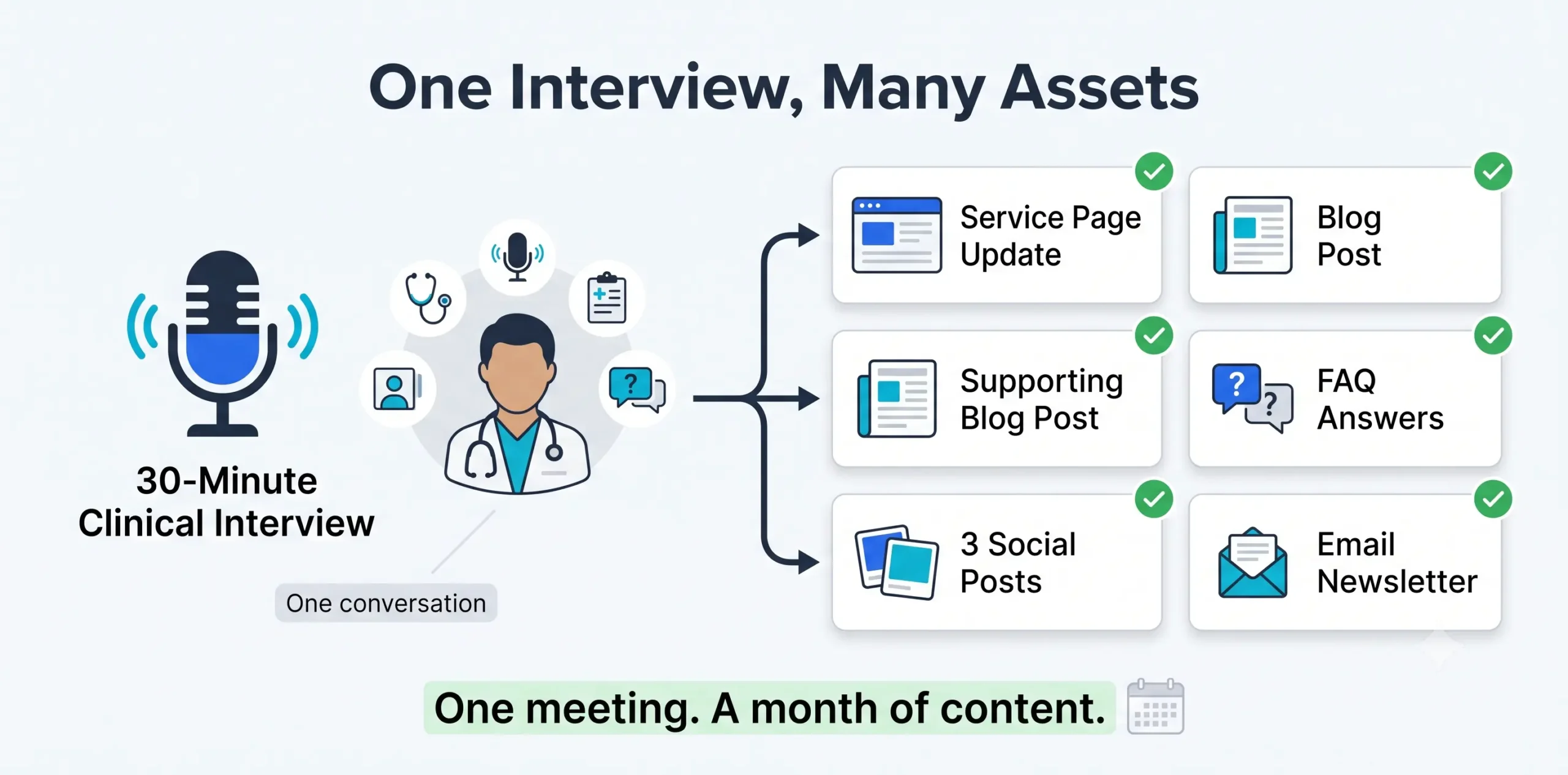
One thirty-minute conversation should not produce one page. Batch it.
Interview around a topic cluster rather than a single article, and a single session can yield a service page update, two or three supporting posts, a set of FAQ answers, and several social or LinkedIn posts. The clinician experiences one meeting; the content calendar gets a month.
Two other extraction sources worth mining. First, the questions your front desk answers repeatedly. Those are search queries in spoken form. Second, the explanations providers give in consultations every single week, which are already refined by hundreds of repetitions and usually better than anything written from scratch.
The AI question, answered directly
Google’s stated position is that it rewards high quality content regardless of how it was produced, and penalizes content produced primarily to manipulate rankings. So AI use is not disqualifying by itself.
The practical problem is different from the policy question. On health topics, unreviewed AI output tends to fail in specific ways: it produces the consensus average rather than clinical insight, it fabricates citations that look real, its training may predate current guidelines, and it cannot distinguish a specialty society recommendation from a content farm’s summary of one. It also cannot supply the Experience signal, because it has none.
A defensible split:
Reasonable AI use. Restructuring a transcript, drafting outlines, generating FAQ variants from approved material, tightening prose, adapting an approved page into a social post, and suggesting related subtopics.
Unacceptable AI use. Generating clinical claims, sourcing citations, producing content that publishes under a clinician’s name without their review, and anything published without a human who is accountable for its accuracy.
The bright line: a named, qualified human must be responsible for every clinical statement on the page. Where that holds, AI is a production tool. Where it does not, you are publishing unverified medical claims under a real doctor’s credentials, which is a professional liability problem before it is ever an SEO one.
Making it stick
Assign one content owner. Someone whose job includes scheduling interviews and chasing reviews. Content programs die from calendar friction, not from lack of ideas.
Batch clinician time. One monthly block for interviews and one for reviews beats scattered requests.
Set a review deadline with a default. Seventy-two hours, and if the reviewer does not respond, the page waits rather than publishes. Never publish unreviewed clinical content to hit a calendar.
Keep a claim log. Record which source supports which claim. It makes re-review fast when guidelines change, and it doubles as substantiation documentation for the advertising rules we covered in the compliance hub.
Start with fewer pages, done properly. Ten well-sourced, reviewed, credentialed pages outperform fifty anonymous ones, and the fifty can actively hurt.
Frequently asked questions
Can we publish content written entirely by a marketing agency?
Only with clinical review displayed on the page. An agency can write; a qualified clinician must verify the medicine and be named as reviewer.
Is AI-written medical content penalized by Google?
Not for being AI-written. It fails when it is inaccurate, unsourced, anonymous, or indistinguishable from every other page on the topic, which unreviewed AI output usually is.
How much clinician time does this really take?
Roughly 35 to 50 minutes per page once the workflow runs, split between a recorded conversation and a short accuracy review. Batching interviews across a topic cluster lowers the per-page cost considerably.
What if our providers will not participate at all?
Then scope the content to what does not require clinical origination: service descriptions, logistics, insurance, preparation, location content. It is a smaller program, and it is honest about what it can support. Publishing clinical content nobody reviewed is the worse option.
Should the physician be the listed author or the reviewer?
Either works. If they supplied the substance, authorship is defensible. If a writer drafted it, list the writer as author and the clinician as reviewer. What matters is that both names are real, credentialed where relevant, and linked.
Do we need a physician on staff to review, or can we contract one?
Contracted medical reviewers are a normal arrangement. They need relevant credentials for the subject matter and a real bio page, and the relationship should be documented.
How do we handle content about conditions we treat but do not specialize in?
Keep it brief, source it well, and point toward the services you do specialize in. Depth should follow expertise, not keyword volume.
The bottom line
The doctors-versus-writers-versus-AI framing is the wrong question. Extract clinical substance through conversation, let writers build the page, use AI where it saves time without touching accuracy, and attach a named accountable clinician to every claim.
That workflow costs each provider under an hour per page and produces content that carries something no competitor can copy: what your clinicians have actually seen. Everything else on the internet is a rewrite of everything else on the internet.
CGColors runs this production model for medical practices: clinical interviews, primary source research, patient-level writing, review workflows, and the credential infrastructure that makes it all count. Your expertise gets onto the page without consuming your schedule, and your practice gets found first, called first, booked first.