
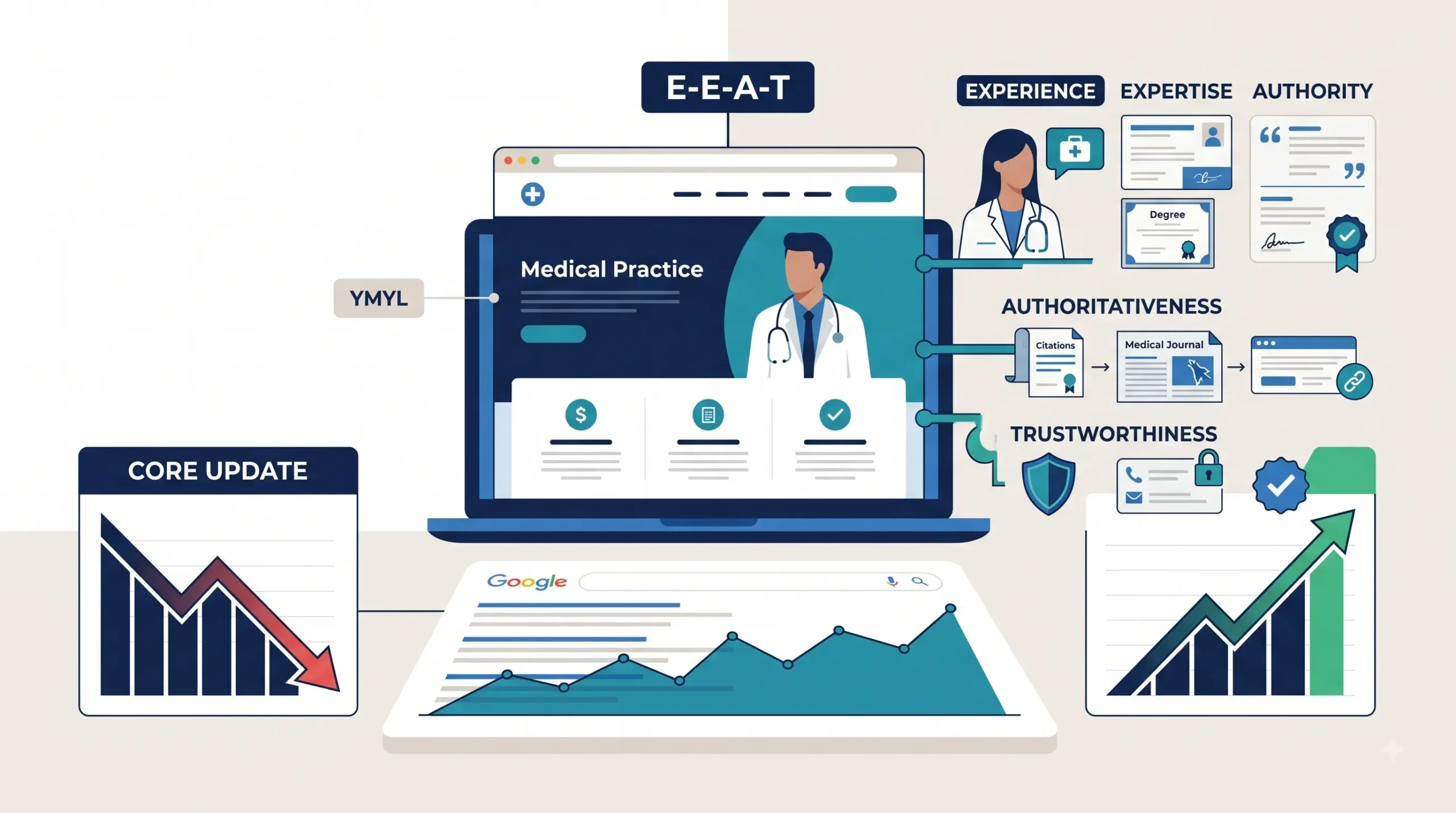
Every core update produces the same week in medical practice inboxes. Rankings move, traffic charts break, and nobody changed anything. A practice that held position three for eighteen months is suddenly on page two. Another that never ranked well jumps into the map pack.
This is not bad luck and it is not random. Google classifies health content as YMYL, applies its strictest quality standards to it, and adjusts those standards with every core update. Medical sites swing hardest because they are the category with the most to lose when Google recalibrates what it considers trustworthy.
The useful news: the standards are documented, they have been consistent in direction for years, and most practice websites fail them in the same three or four predictable ways. This post explains what is actually being measured and what to fix.
What YMYL means and why your site is in it
YMYL stands for Your Money or Your Life. Google introduced the term in its Search Quality Rater Guidelines to flag content that could significantly affect a person’s health, financial stability, safety, or wellbeing. Health content sits at the center of the category by definition. Every page on a medical practice website is YMYL by default, including your service pages and your blog.
The reasoning is straightforward. Bad advice about a recipe wastes an evening. Bad advice about drug interactions or a symptom that needs urgent care can kill someone. So Google applies a stricter standard where the consequences of being wrong are severe. A hobby blog with weak quality signals ranks lower. A health page with weak quality signals may not rank at all.
An important technical clarification, because this trips up practice owners reading SEO advice: YMYL is a classification, not a ranking factor. It does not directly move your position. What it does is trigger a stricter evaluation standard, and that standard has been baked into the algorithm through years of quality rater feedback. The effect is real even though the mechanism is indirect.
What E-E-A-T actually measures
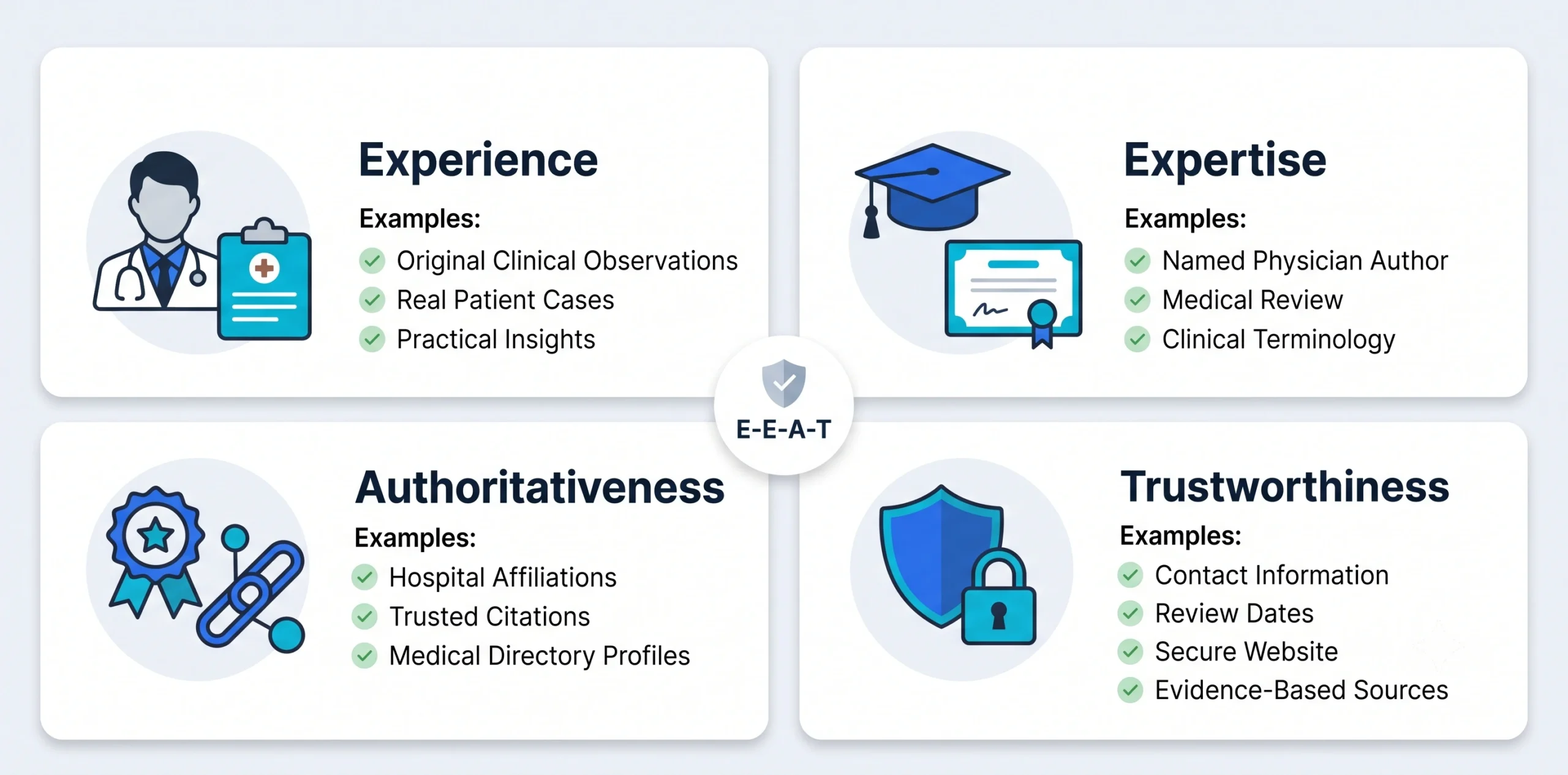
E-E-A-T stands for Experience, Expertise, Authoritativeness, and Trustworthiness. It is the framework Google’s human quality raters use to evaluate pages, and their assessments inform how the algorithm is developed and tuned.
Experience was added to the framework in December 2022, and the addition matters more for practices than for anyone else. Google recognized that someone who has actually treated the condition, used the device, or lived through the situation brings something credentials alone do not capture. For a practice website, this is your natural advantage over content farms: you have seen a thousand of these cases and they have seen none.
Translated into things that exist on a page:
- Experience: original clinical observation, specifics from actual practice, real cases and patterns rather than a rewrite of the top-ranking article.
- Expertise: named authors with relevant credentials, medical review by a qualified professional, accurate use of clinical terminology.
- Authoritativeness: recognition from outside your own site, including citations, directory profiles, hospital affiliations, and links from credible sources.
- Trustworthiness: the anchor of the four. Clear contact information, transparent about pages, cited sources, current review dates, secure site, and no misleading claims.
Like YMYL, E-E-A-T is not a direct ranking factor. It is a description of what the algorithm’s many signals are collectively trying to approximate.
Why the swings are so violent for health sites
Three structural reasons.
First, the standard is higher, so the gap between compliant and non-compliant sites is wider. In categories where quality thresholds are looser, a mediocre page still ranks. In health, the same page may be filtered out entirely.
Second, health content is dominated by enormous authority sites. When Google recalibrates trust signals, position on a competitive health query can shift several places because the established players are all strong. Small movements at the top displace everyone underneath.
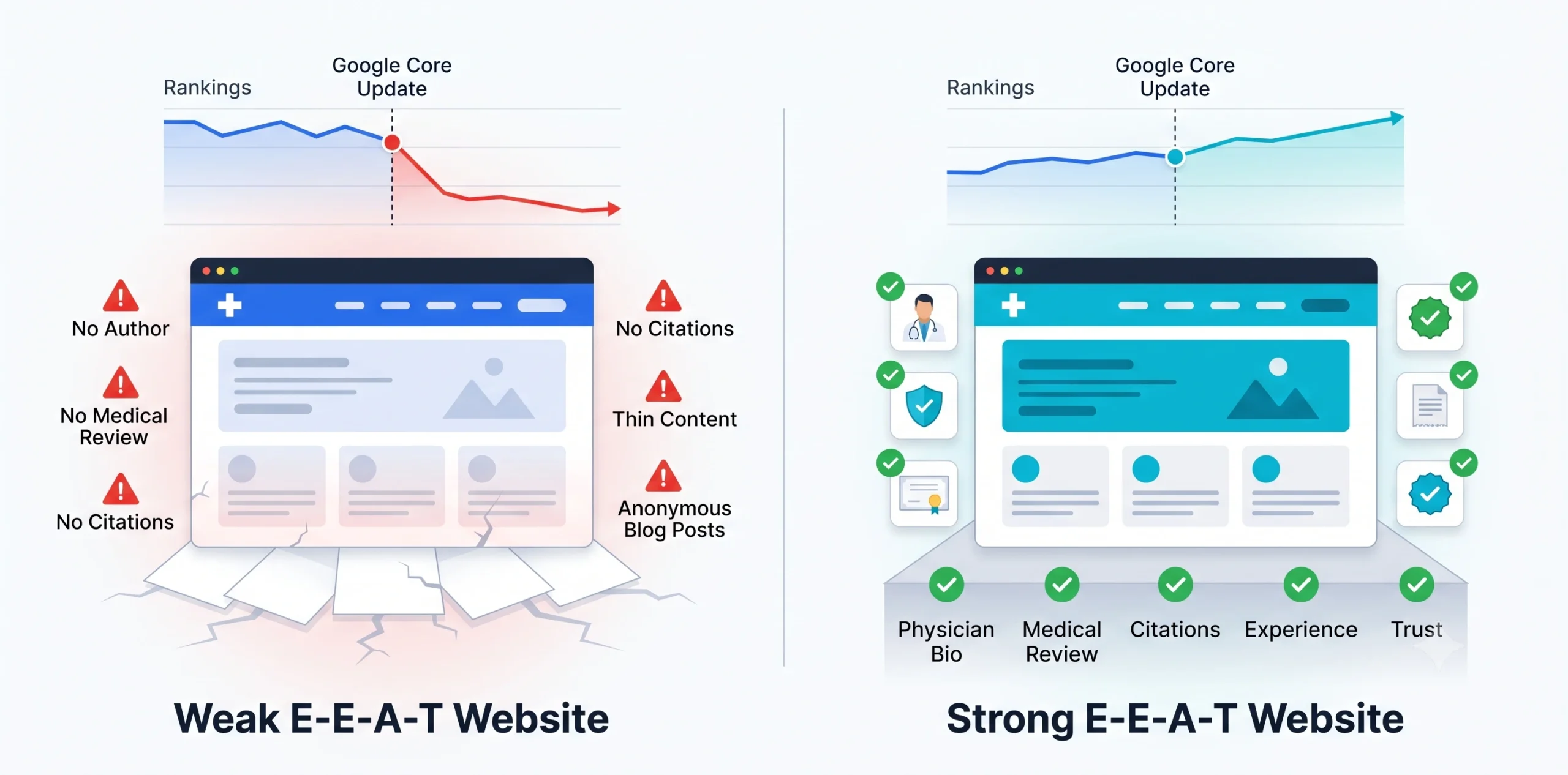
Third, practice sites usually carry legacy content that fails current standards. The blog posts published in 2019 with no author, no citations, and no review date do not just sit there harmlessly. Site-wide quality assessment means weak pages can drag on the pages that matter, which is why the commercial service pages sometimes fall even though nobody touched them.
Recent core updates have reportedly hit YMYL sites hardest, with health among the most affected categories, and reporting around the March 2026 update suggested sites lacking strong E-E-A-T signals lost visibility quickly. [STAT CHECK: the specific volatility scores, the roughly 67% of health sites affected figure, and the 55% of sites experiencing ranking changes claim all trace to agency blogs rather than primary sources. Either verify against Google’s official communications and a named tracking tool’s published data, or remove the numbers and keep the directional statement.]
The four failure patterns
Almost every medical site that drops during a core update fails in at least one of these ways.
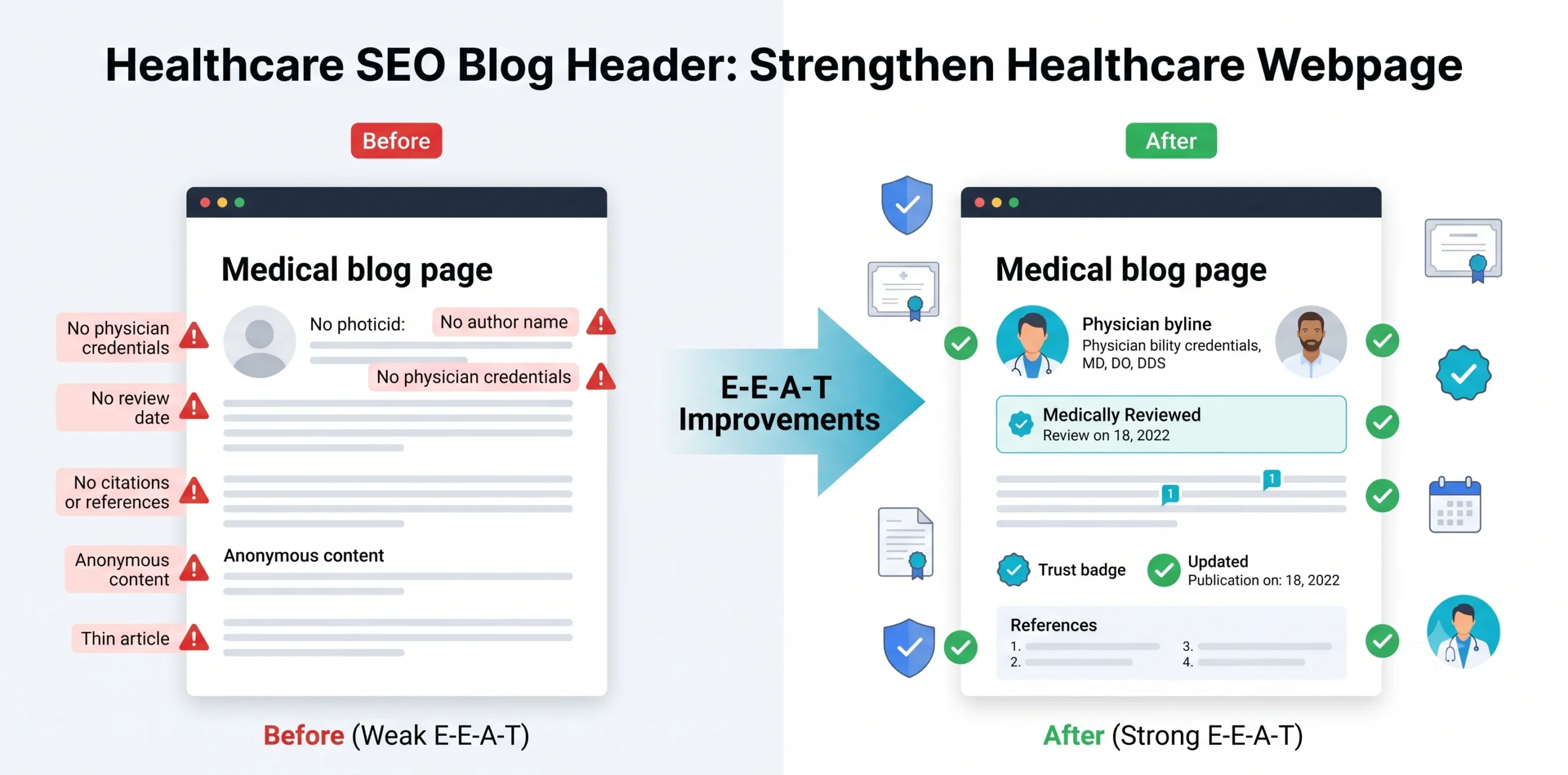
1. Anonymous or unqualified authorship. Content published under “Admin,” a marketing team name, or no byline at all. Google’s rater guidelines explicitly look for author information on YMYL content. For health topics, the reader and the rater both need to know who is speaking and why they are qualified.
2. No medical review layer. A licensed professional should review clinical content, and the page should say so with a name, credentials, and a review date. A “Medically Reviewed By” line with a real linked bio is one of the highest-value additions most practice sites can make.
3. Thin legacy blog content. Three hundred word posts written for keywords in 2018, never updated, no sources, no author. These pages rarely rank and can weigh on the site as a whole. Consolidate, rewrite, or remove them.
4. Unsupported claims and missing citations. Health statements that cite nothing, outcome claims with no evidence, and content that contradicts medical consensus. This also intersects with the FTC substantiation rules we cover in our guide to medical practice advertising rules, so fixing it serves two purposes.
The remediation checklist
Work through these in order. The first three do most of the work.
Add author infrastructure. Every clinical page gets a named author with a linked bio containing degree, board certifications, affiliations, and years in practice. Put the credentials block near the top of the page, not in a footer. Some reporting suggests Google Discover now requires visible credential information for YMYL content. [STAT CHECK: verify Discover YMYL requirements against Google’s own publisher documentation before stating this as fact.]
Implement a medical review workflow. Assign a reviewing clinician, add the review byline and date, and re-review on a schedule. Health content should be revisited whenever clinical guidelines change, and at minimum every six months.
Audit and fix legacy content. Inventory every blog post. Score each one for author, sources, depth, review date, and traffic. Rewrite the ones with potential, merge the near-duplicates, and remove the rest with proper redirects.
Cite primary sources. Link to peer-reviewed literature, specialty society guidelines, and government health sources. Not other agency blogs, not content farms.
Strengthen trust signals sitewide. Complete contact information, physical addresses, provider credentials on every bio page, clear privacy policy, secure hosting, and accurate structured data.
Lean into experience. This is where a practice beats a health publisher. Write what you actually see: how patients in your area present, what questions come up in your consultations, what you have observed across years of cases. A content farm cannot manufacture that, and it is exactly what the Experience signal was added to reward.
What to do when you have already been hit
Confirm what actually dropped. Pull Search Console data for the periods before and after the update. Determine whether you lost clicks on commercial service pages or on informational blog content. These are different problems with different fixes, and blog traffic loss may reflect AI Overviews rather than a ranking change at all.
Do not panic-rewrite everything. Core update recovery is slow by design. Google has been consistent that recovery generally requires substantive improvement and often does not land until a subsequent update. Frantic changes make it impossible to know what worked.
Fix the structural failures first. Author infrastructure and medical review touch every page and are the highest-leverage repairs available.
Expect months, not weeks. Plan on the next core update as the realistic checkpoint. Practices that treat recovery as a quarter-long project outperform those treating it as an emergency.
Frequently asked questions
Is E-E-A-T a ranking factor?
No, not directly. Google uses many signals that collectively approximate these qualities, and quality rater assessments of E-E-A-T inform how those signals are developed. The practical effect on YMYL content is significant regardless of the technical distinction.
Can a small practice compete with WebMD and Mayo Clinic?
Not on general condition queries, and you should not try. You compete on local intent, on your specific services, and on genuine clinical experience the large publishers cannot claim. That is a separate strategy question worth its own discussion.
Do I need a physician to write every blog post?
No, but a qualified professional should review clinical content, and the page should say who reviewed it and when. A professional writer working from clinician input, with clinician review, is a normal and acceptable workflow.
Is AI-written medical content automatically penalized?
Google’s stated position is that it rewards quality content regardless of how it was produced. In practice, unreviewed AI content on health topics usually fails on experience, sourcing, and accuracy. AI-assisted drafting with genuine clinical input and review is a different thing from publishing raw output.
How often should medical content be updated?
Review at least every six months, and immediately when clinical guidelines change. Display the review date. Stale health content is a trust problem, not just a freshness problem.
My rankings dropped but I did not change anything. Why?
Core updates re-evaluate existing content against adjusted standards. You did not get worse; the bar moved, or competitors improved. This is also why doing nothing is not a recovery strategy.
How long does recovery take?
Typically months, and often not until a subsequent core update processes your improvements. Make substantive changes, document when you made them, and measure against the next rollout.
The bottom line
Medical sites swing hardest during core updates because Google demands the most from them. That demand is legible: say who wrote it, have a qualified professional review it, cite real sources, remove the thin pages nobody reads, and write from actual clinical experience rather than rewriting whatever currently ranks.
Practices that build that infrastructure stop dreading core updates. The volatility that punishes weak sites is the same volatility that promotes strong ones, and most of your local competitors have not done any of this.
CGColors builds medical content with E-E-A-T infrastructure as the default: named clinical authorship, medical review workflows, primary source citations, and legacy content remediation. Your site stops taking damage every time Google recalibrates, and your practice gets found first, called first, booked first.