
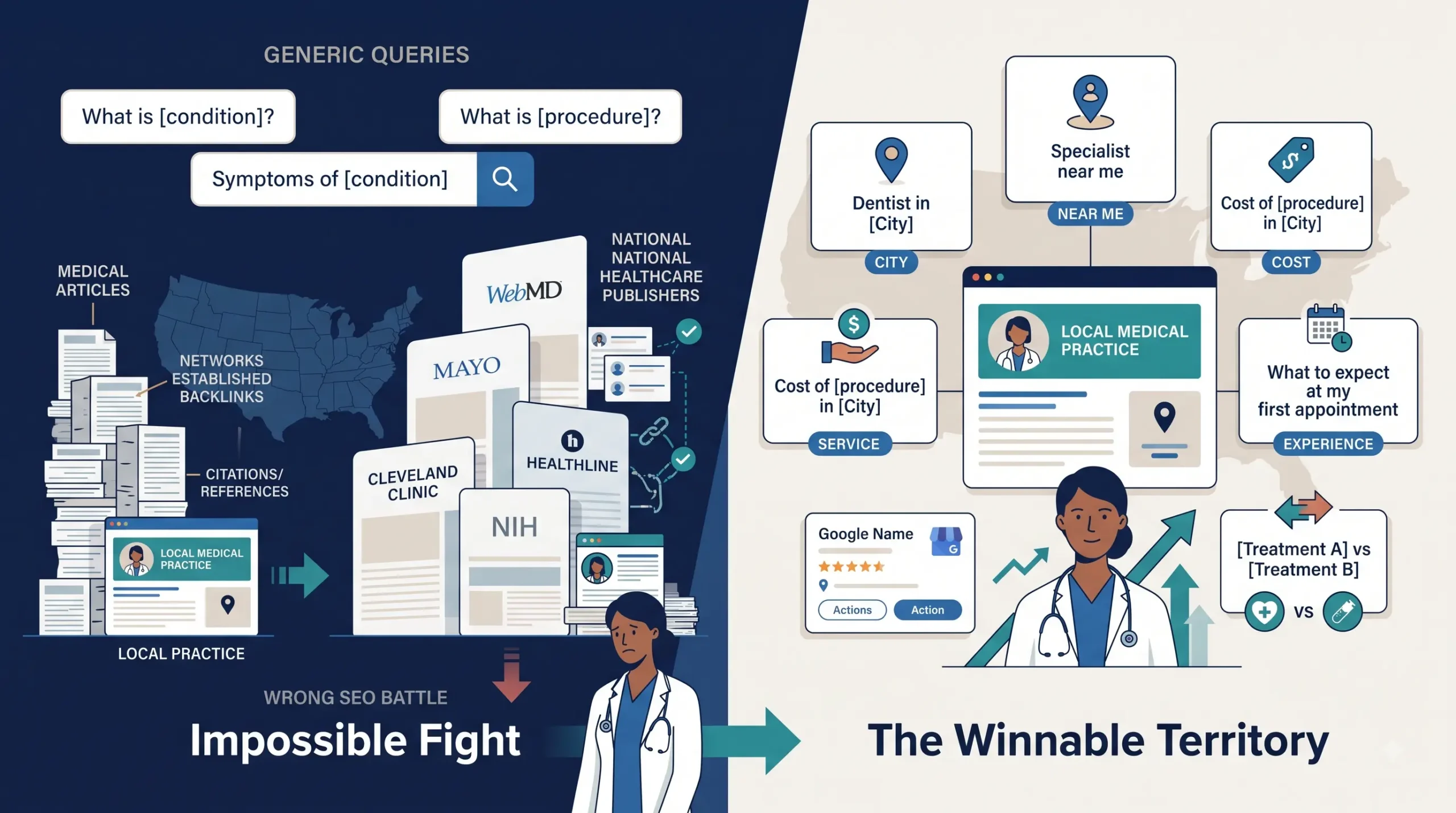
Open almost any medical practice blog and you will find the same content. What is plantar fasciitis. Symptoms of anxiety. Ten signs of sleep apnea. Understanding hypertension.
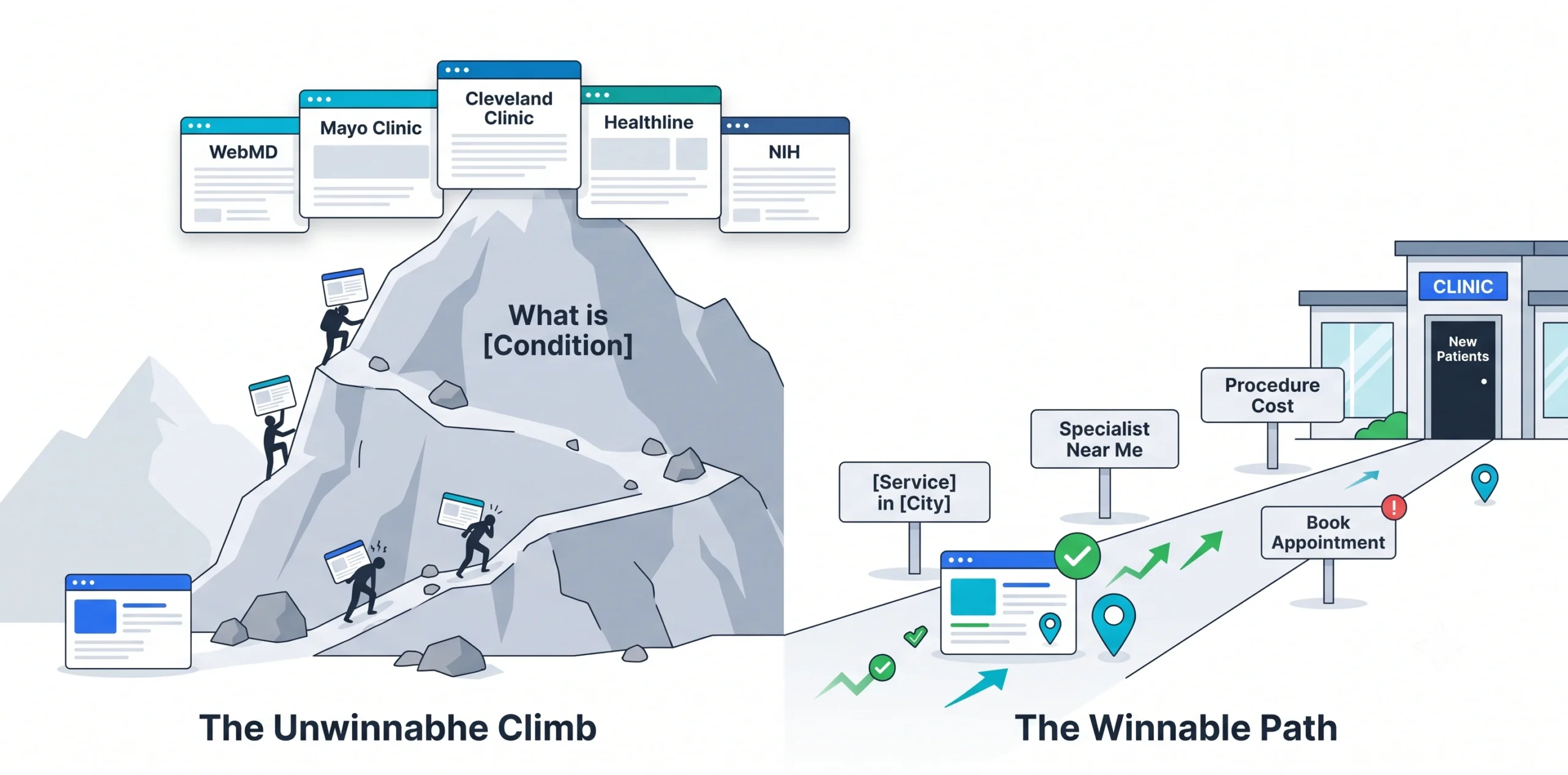
Every one of those posts is competing directly with WebMD, Mayo Clinic, Cleveland Clinic, Healthline, and the NIH. Every one of those sites has decades of authority, thousands of medical reviewers, and link profiles a practice cannot approach in a lifetime. The practice writes fifty of these posts, sees a handful of impressions, and concludes that SEO does not work for healthcare.
SEO works fine. The strategy was wrong from the first post. Those queries were decided years ago, and no amount of better writing changes that. Meanwhile the queries that actually book patients sit largely uncontested, because everyone is busy writing symptom explainers.
This post covers why the generic queries are closed, which queries are open, and how to rebuild a content plan around the ones you can win.
Why generic condition queries are already decided
Three reasons, and none of them are fixable with better content.
Authority compounds and you started late. Google’s evaluation of health content leans heavily on authoritativeness and trust, as we covered in our guide to YMYL and core updates. The established health publishers have accumulated citations, links, and recognition over twenty years. A practice site publishing its first explainer in 2026 is not entering a fair fight; it is entering a decided one.
The intent behind those searches is not to book anything. Someone typing “symptoms of sleep apnea” at 11pm wants information. They are not choosing a provider yet, and most of them never become anyone’s patient. Even a top ranking converts poorly.
AI Overviews absorbed the traffic anyway. Informational health queries are exactly the type that get answered directly on the results page now. Ranking well for a definitional query increasingly means being cited in a summary the user never clicks past. The prize for winning that race has shrunk while the race got harder.
Put those together and the standard practice blog is running the hardest possible race for the least valuable possible reward.
What you can actually win
Your advantages are specific, and they map to specific query types.
Geography. No national publisher can be the best result for a search that contains your city. This is structurally protected territory.
Commercial intent. Publishers write about conditions. You provide treatment. Queries where someone wants a provider are yours to lose.
Real clinical experience. Google added Experience to its quality framework precisely because practitioners bring something content farms cannot. You have treated these cases. WebMD has summarized them.
Specificity. You can write about your exact procedure, your exact patient population, your exact market. Large publishers write for everyone, which means they write for no one in particular.
The five query types worth your time
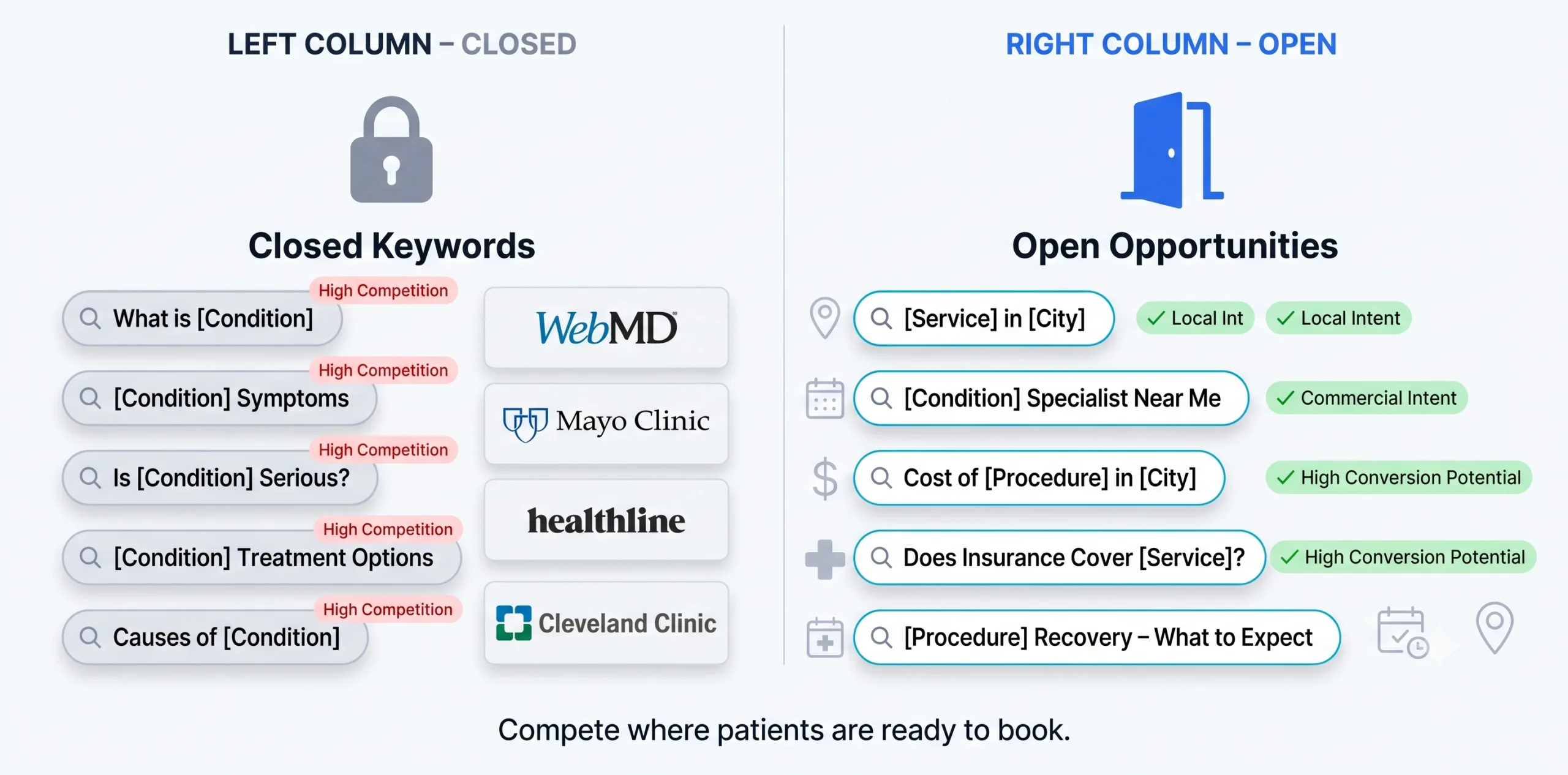
1. Service plus location. “Pediatric dentist in [city],” “sports physical therapy [neighborhood],” “anxiety therapist [city].” These are the highest-value queries a practice can rank for and they are the reason local SEO exists. Every location and every service deserves a real page, not a paragraph on a combined services page.
2. Near me and provider-seeking. “Endocrinologist near me,” “urgent care open now,” “same day appointment [specialty].” These are won primarily through your Google Business Profile, reviews, proximity, and technical local signals rather than blog content.
3. Cost, insurance, and logistics. “How much does [procedure] cost in [city],” “does insurance cover [service],” “do I need a referral for [specialty].” Practices avoid these because pricing feels uncomfortable. That avoidance is exactly why the queries are open. Patients search them constantly and the results are usually forums and aggregators. A clear, honest page here outranks national content because national content cannot answer a local pricing question.
4. Procedure and preparation specifics. “What to expect at your first [specialty] appointment,” “how to prepare for [procedure],” “[procedure] recovery timeline,” “how long does [treatment] take.” Publishers cover these generically. You cover them as they actually happen at your practice, with your protocols, your facility, your timeline. That is Experience made visible.
5. Decision and comparison queries. “[Treatment A] vs [treatment B],” “when to see a specialist for [symptom],” “signs you need [service].” These sit at the moment of choosing, and a practicing clinician’s perspective genuinely outperforms a generic overview here.
Notice the pattern. Every one of these is either local, commercial, or grounded in experience a publisher does not have. That is the entire filter.
The one exception worth knowing
Condition content is not universally useless. It earns its place in two situations.
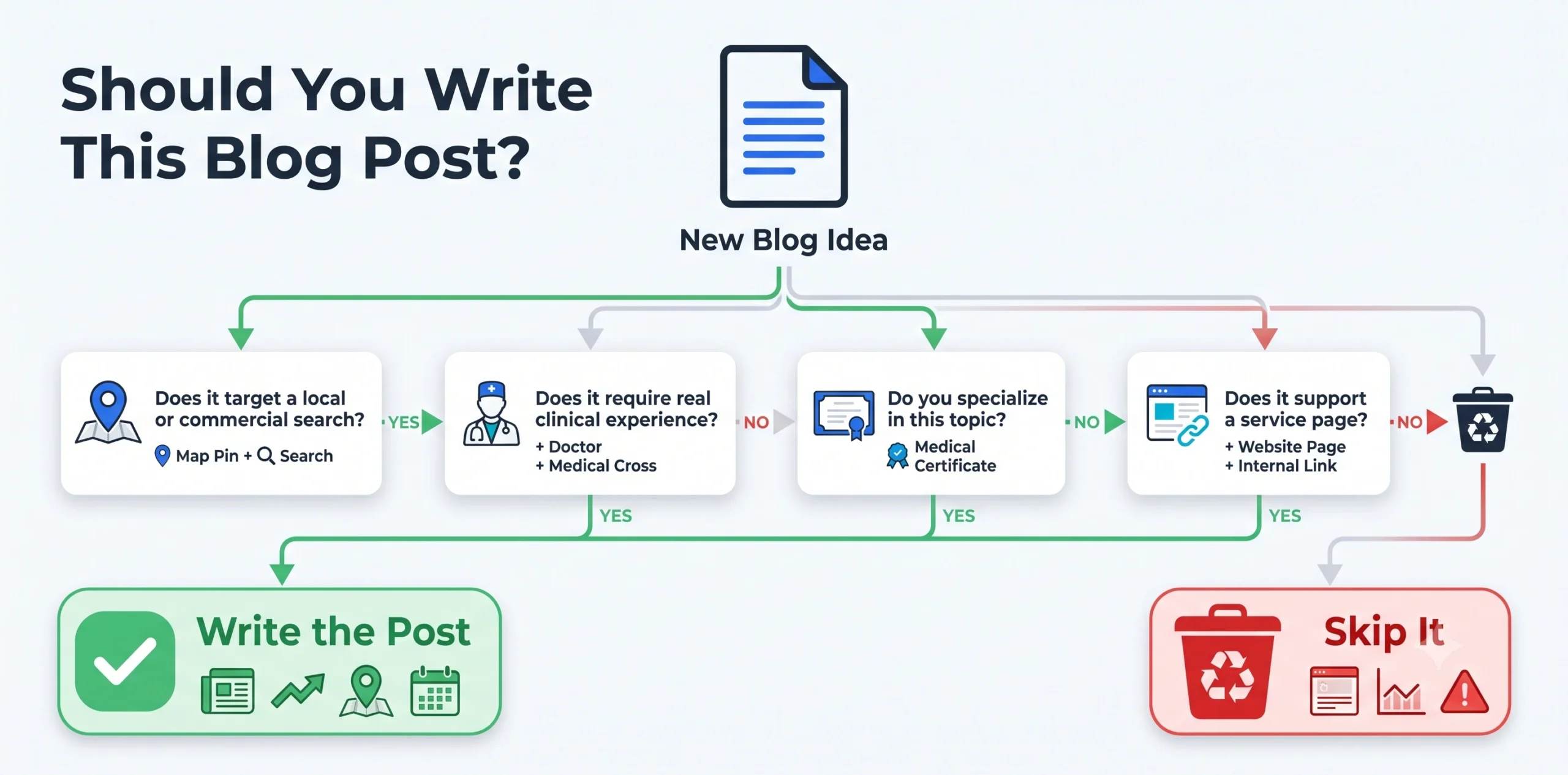
As cluster support. A condition page that exists to establish topical context and funnel readers toward your treatment pages does a job even if it never ranks nationally. Written for your local audience with internal links to your service pages, it supports the pages that matter.
As genuine specialization. If you treat something uncommon, or treat a common thing in an uncommon way, the authority gap narrows sharply. A practice doing high volume in a niche procedure can absolutely own content about that procedure, because the big publishers cover it thinly and few competitors cover it at all.
The test: would this page be recognizably better coming from a practicing clinician than from a professional writer with access to the same references? If yes, write it. If no, skip it.
Rebuilding the plan
Audit what you have. Pull every blog post with its clicks and impressions. Most practices find that a small fraction of pages produce nearly all the value and a long tail of condition explainers produce essentially nothing. That long tail is not neutral; thin pages can weigh on site quality.
Build service pages before blog posts. Every service you offer, at every location, needs a substantive page. This is the highest-return work available and most practices skip straight to blogging.
Fix the Google Business Profile. For provider-seeking queries, the profile and reviews carry more weight than anything on your website. If the profile is incomplete or the reviews are stale, no amount of content fixes the problem.
Write the pages nobody wants to write. Costs, insurance, wait times, what happens at the first visit, how to prepare. Uncomfortable, useful, and largely uncontested.
Then add experience-driven content. Once the commercial foundation exists, blog content grounded in real clinical observation supports it and strengthens topical authority.
Redirect the effort, not the budget. This is not a smaller SEO program. It is the same investment aimed at queries you can win.
Frequently asked questions
Should I delete all my condition explainer posts?
Not automatically. Keep the ones that draw local traffic, support service pages, or reflect a genuine specialty. Consolidate near-duplicates and remove thin pages with no traffic and no supporting role, using proper redirects.
What if a competitor practice outranks WebMD for a condition term?
Check what is actually happening. Usually the query has local intent Google is resolving locally, or the competitor is ranking below the fold on a page where publishers hold the top spots. Occasionally a practice with real specialty depth has earned it, which proves the specialization exception rather than the general rule.
How many pages do I need?
Enough to cover every service at every location properly, plus the logistics and preparation pages, plus experience-driven content that supports them. Depth per page matters more than page count, and one strong service page beats ten thin ones.
Is blogging a waste of time for medical practices?
No, but generic condition blogging usually is. Blogging that answers real patient questions with real clinical perspective builds topical authority and gives your service pages internal link support.
Should I write about pricing when I cannot give exact numbers?
Yes. Ranges, the factors that move the price, what insurance typically covers, and what a consultation costs are all publishable and all searched heavily. Patients are not expecting a quote; they are trying to find out whether they can afford to call.
What about ranking in AI answers instead of traditional results?
Different mechanics, similar conclusion. Local and specific queries with clear, well-structured, credible answers are more winnable than broad definitional ones, where large publishers dominate citations too.
The bottom line
The medical SEO strategy that fails is the one that competes with publishers on their strongest ground for traffic that does not convert. The one that works competes on ground publishers cannot enter: your city, your services, your prices, your protocols, your clinical experience.
Nobody in your market is fighting hard for “cost of [procedure] in [your city].” Everyone is fighting for “what is [procedure].” Go where the fight is not.
CGColors builds medical SEO around the queries that produce appointments: complete service and location coverage, logistics content patients actually search, Google Business Profile optimization, and experience-driven content that only a practicing clinician could support. That is how a practice gets found first, called first, booked first.