You built a solid landscaping business. Your work speaks for itself. Neighbors wave when your trucks roll through. Past clients send referrals. But when someone three streets over types “landscaper near me” into Google at 9pm on a Tuesday, your name is nowhere to be found.
That is not a branding problem. It is not a pricing problem. It is a visibility problem, and it is costing you more than you probably realize.
Here is the truth most landscaping business owners do not want to sit with: the way homeowners find and hire landscapers has fundamentally shifted, and the businesses winning the most jobs right now are not necessarily the most skilled. They are the ones who understood where their customers were looking and invested in local SEO for landscapers to make sure they showed up there.
This post breaks down exactly what homeowners type into Google before they ever pick up the phone, why your business is likely invisible during the moments that matter most, and what you need to understand to fix it.
The Homeowner Has Already Decided Before You Answer the Phone
Let us start with a stat that should change how you think about your business: according to Google research, 76% of people who conduct a local search on their mobile phone visit a business or contact a service provider within 24 hours. And 97% of consumers check a company’s online presence before making any kind of purchase or hiring decision.
That means by the time someone calls you, they have already been on Google. They have already compared at least two or three companies. They have already read reviews. They may have already visited your competitor’s website, liked what they saw, and mentally moved on before your phone even rang.
You are not competing at the point of the phone call. You are competing at the point of the search. And if you are not visible at that stage, you never get a chance to compete at all.
This is the gap that most landscaping businesses are operating blind to. They focus on doing great work, staying busy through word of mouth, and trusting that reputation alone will carry them. And for a while, it does. But word of mouth has a ceiling. Google does not.
The Exact Words Homeowners Type When They Need a Landscaper
Understanding search intent is the foundation of local SEO. Before we talk about why you are not showing up, you need to understand what showing up actually means, which requires knowing what people are searching for in the first place.
Homeowner searches fall into four distinct categories, and each one represents a different stage in the hiring journey.
The “I need someone right now” search. This is the highest-intent category. These are people who have already made up their mind to hire. They are not researching. They are shopping. The searches look like this: “landscaper near me,” “lawn care service near me,” “tree trimming near me,” “landscaping company in [city].” According to keyword data from Semrush and Ahrefs, “lawn care near me” generates approximately 81,000 monthly searches in the US alone. “Landscaping near me” pulls another 33,000. “Tree removal near me” adds 38,000 more. These are not abstract numbers. These are real homeowners in your service area, with a job to give, typing a phrase into their phone right now.
The “help me figure out what I need” search. This group knows they have a problem but is not sure what category of service they need. They search things like “how to fix a patchy lawn,” “why does my yard flood when it rains,” “how much does it cost to build a patio,” and “do I need a landscape designer or a landscaper.” These are people you can educate and convert before they even know they are being sold to.
The “I want to vet you before I call” search. Once someone finds a company they are interested in, they immediately run a secondary search to check credibility. This looks like “[company name] reviews,” “is [company name] licensed,” or “best landscaping company in [city].” If your reviews are thin, your Google Business Profile is incomplete, or your website looks like it was built in 2009, this is where you lose people who were already interested in hiring you.
The comparison and price research search. Before committing, homeowners want to know whether they are being overcharged or underserved. These searches sound like “how much does landscaping cost in [city],” “average cost of sod installation,” “hardscaping price per square foot,” and “is this landscaping quote too high.” People searching these terms are close to hiring. They just need confidence that the investment is reasonable. Whoever answers that question on their website earns the call.
Why You Are Not Showing Up (And It Is Not Your Fault That Nobody Told You)
Here is the uncomfortable reality. Most landscaping business owners built their online presence the same way they built their early client base: by doing the minimum necessary and relying on the work to speak for itself. That meant setting up a basic website, maybe claiming a Google listing, and letting things run.
That approach no longer works, and here is specifically why.
Your Google Business Profile is either incomplete or abandoned. Google Business Profile, formerly Google My Business, is the single most important piece of real estate for any local service business. It is what populates the local map pack, which appears above all organic search results for queries like “landscaper near me.” Studies show that 72% of consumers go directly to Google when looking for local services, and 86% of them rely on Google specifically for reviews. Our Google Business Profile optimization guide covers exactly what to fix and in what order.
An incomplete Google Business Profile, meaning one with missing hours, no photos, no description, sparse reviews, or outdated service categories, tells Google’s algorithm that your business is not worth surfacing. Google rewards profiles that are complete, active, and regularly updated. If your profile has not had a new photo, a review response, or a Google Post added in months, you are being deprioritized in favor of competitors who are more active, even if their work is inferior to yours.
You have one website page trying to rank for every service you offer. This is one of the most common and most damaging mistakes landscaping businesses make. A single “Services” page that lists mowing, mulching, sod installation, patio building, irrigation, and tree trimming is not a search-optimized website. It is a brochure.
Google needs dedicated pages to understand what your business does and where you do it. Each service you offer in each city or neighborhood you serve deserves its own page. “Patio installation in [City],” “sod installation in [Suburb],” “irrigation repair in [County].” Without this structure, your site tries to rank for everything and ends up ranking for nothing. Your competitor who built a dedicated page titled “Lawn Care Services in [City]” two years ago is sitting comfortably at the top of results while you wonder why the phone is not ringing.
You have not earned enough reviews, or you are not responding to the ones you have. Review quantity and recency are direct ranking factors in Google’s local algorithm. According to SOCi data, businesses see nearly a 3% lift in their Google Business Profile conversions for every 10 new reviews they earn. And 93% of consumers checked online reviews at some point in the past 12 months before making a hiring decision.
If your business has fewer than 20 reviews, or if your most recent review is from six months ago, or if you have negative reviews sitting unanswered, you are losing ground to competitors who actively manage their reputation. Even more important: 65% of consumers say they are more likely to choose a business that responds to all of its reviews, both positive and negative. Responding to a one-star review thoughtfully and professionally is not damage control. It is a marketing asset.
Your website is not built for how homeowners actually search. Most landscaping websites are written the way the owner thinks about the business, not the way customers think about their problems. They lead with company history, list generic services, and bury the phone number in the footer. But homeowners are searching with intent-driven, specific, location-anchored phrases. They type “affordable landscaper in [suburb],” not “quality landscaping services.” They search “french drain installation near me,” not “drainage solutions.” The vocabulary mismatch between what your website says and what your customers search is a gap that sends them directly to a competitor whose site happens to use the right words.
Your NAP information is inconsistent across the web. NAP stands for Name, Address, and Phone number. If your business is listed differently across Yelp, Angi, Houzz, Facebook, and your own website, Google treats that inconsistency as a trust signal problem and deprioritizes your listing. Something as minor as “Street” on one platform and “St.” on another, or a phone number that changed two years ago still showing up on an old directory listing, can quietly suppress your rankings without you ever knowing it is happening.
The Search Queries Most Landscapers Have Never Even Thought to Optimize For
Beyond the obvious “landscaper near me” searches, there is a massive category of high-value, lower-competition queries that most landscaping businesses completely ignore. These are the long-tail searches, and they represent more than 91% of all search queries on Google, according to Ahrefs research.
Think about the homeowner who searches “how much does a retaining wall cost in [city]” or “do I need a permit for a fence in [county]” or “best time to aerate lawn in [state].” These people are not quite ready to call yet, but they are very close, and they are actively seeking expertise. The landscaping company that publishes a well-written blog post answering that exact question earns that person’s trust before any other competitor even enters the conversation.
This is where landscaping companies leave enormous amounts of business on the table. They treat their website as a static brochure and never add content that answers the questions their future customers are actively searching. Meanwhile, the competitor who published 20 blog posts over the past year answering common homeowner questions has built domain authority, organic traffic, and a pipeline of warm leads who feel like they already know and trust the business before ever picking up the phone.
There is also a growing category of AI-driven research queries to be aware of. Homeowners increasingly ask ChatGPT and Google’s AI Overview things like “what questions should I ask before hiring a landscaper,” “concrete pavers vs natural stone for a patio,” and “which landscapers in [city] specialize in irrigation.” If your business is not producing content that answers these questions in depth, you are invisible not just in traditional search but in the AI-generated results that are increasingly eating the top of the search page. This is one of the newer pillars of a full-service SEO strategy for landscapers, and it separates businesses that plan ahead from those that are always playing catch-up.
What Showing Up Actually Looks Like in Practice
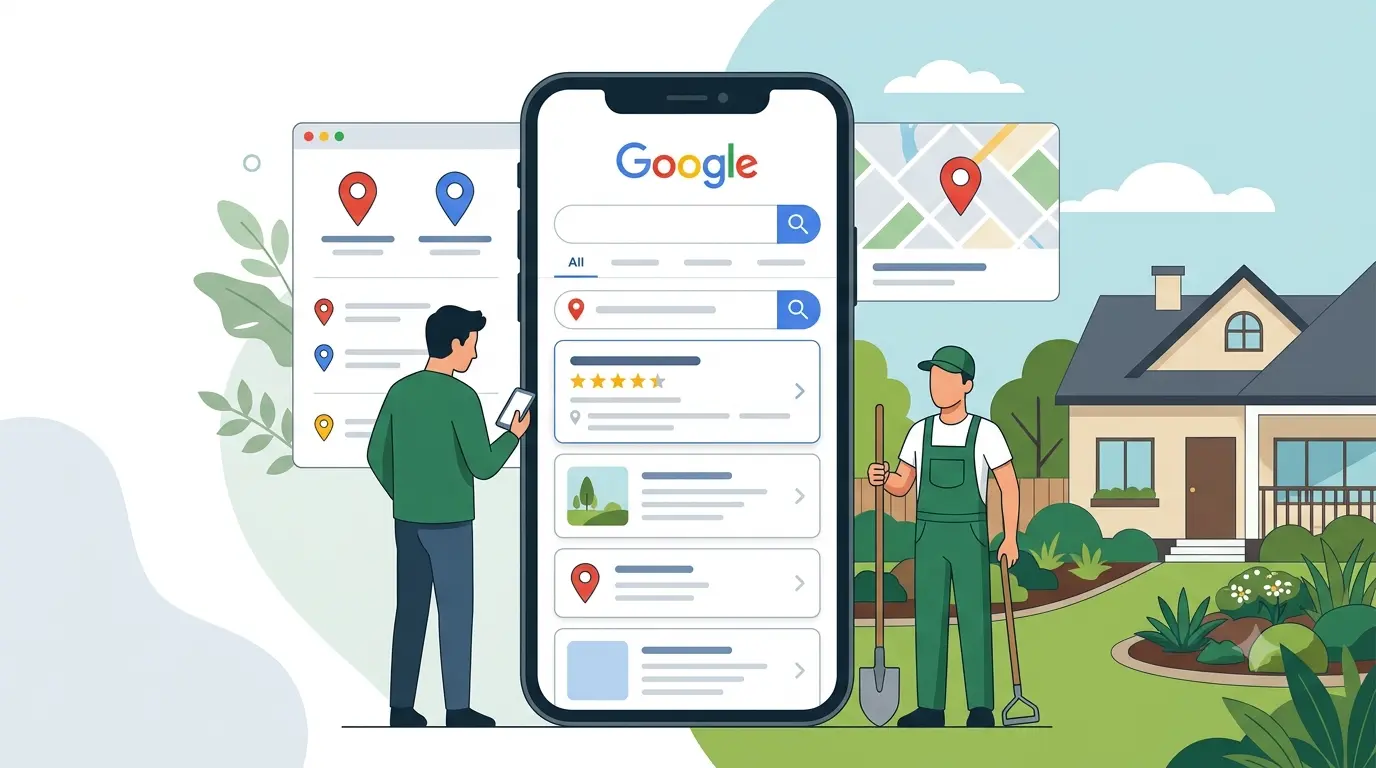
Let us make this concrete. When someone in your service area opens Google on their phone and types “landscaping company near me,” three things determine whether your name appears.
First, Google checks proximity. Are you close enough to the searcher to be relevant? This is about your verified business address and the service area you have set in your Google Business Profile.
Second, Google checks relevance. Does your profile and website signal clearly that you do exactly what this person is searching for? This is about the categories you have selected, the services listed on your profile, the keywords on your website, and the content you have published.
Third, Google checks prominence. Are you a well-established, trusted business in the eyes of the algorithm? This is about your review count and rating, your backlinks from other local websites, your citation consistency across directories, and how frequently your profile is being engaged with by real users.
Proximity you mostly cannot control. Relevance and prominence are entirely within your power to build. Most landscaping businesses neglect both, and closing that gap is exactly what a dedicated local SEO program for landscaping companies is designed to do.
The Cost of Invisibility Is Not Just Missed Calls
Here is a number to sit with: 80% of US consumers look up local businesses online every single week. That means every week you are not visible on Google, homeowners in your own neighborhood are finding your competitors instead of you.
The landscaping market in most mid-size cities is not won by the best landscaper. It is won by the most visible landscaper, the one who shows up when someone is ready to spend money. Every week of invisibility is not a neutral outcome. It is lost revenue, compounding, in favor of whoever is outranking you.
The businesses that dominate local landscaping markets in 2026 are not there by accident. They invested in understanding how their customers search, built their online presence around those searches with the help of local SEO services built specifically for contractors and home service businesses, and now collect the majority of organic leads in their area while their competitors keep relying on referrals and hoping the phone rings.
The gap between where you are and where they are is not talent. It is strategy. And the first step in closing that gap is understanding exactly what your customers are typing into Google before you ever get a chance to speak with them.
What You Should Do Next
If you have read this far and recognized your business in any of the problems described above, you are already ahead of most landscapers in your market. Most are operating blind.
Start by Googling your own business the way a homeowner would. Search “landscaper near me” from your phone and see where you appear. Search your city name plus your main service. Search your company name and look at what comes up. What you find, or fail to find, is exactly what your potential customers see every day.
If you want a proper assessment of where you stand and a clear plan for what it would take to get you ranking consistently for the searches that matter most in your market, that is exactly the work we do. No jargon, no vanity metrics. Just more calls from homeowners who are ready to hire.
Want to know exactly which search terms your competitors are ranking for in your city that you are not? See how our local SEO for landscapers works and get in touch. We will pull the data for your market.