There is one search phrase that drives more ready-to-hire homeowners to landscaping businesses than almost anything else.
It is not “best landscaping tips.” It is not “how to fix a patchy lawn.” It is not your company name.
It is “landscaper in [your city]” and every variation of it.
That phrase, typed by a homeowner on their phone with a job to give and money to spend, is the moment your business either shows up or disappears. And for most landscaping companies, it disappears.
This post explains why that one phrase matters more than every other keyword on your list, what the search data actually shows, and exactly how to build a website that owns it.
The Search That Actually Produces Jobs
There are two types of searches homeowners run before hiring a landscaper.
The first is research. They search “how much does sod installation cost,” “what is the difference between hardscaping and softscaping,” or “best time to overseed a lawn.” These searches collect information. They do not immediately produce calls.
The second is buying. They search “landscaper in [city],” “lawn care company in [suburb],” “patio installation [city] [state].” These searches produce jobs. The homeowner has already made the decision to hire. They are now looking for who to hire.
46% of all Google searches contain local intent. — Google Research
28% of those local searches result in a purchase or hire within 24 hours. — Ranktracker Local SEO Statistics, 2025
That conversion speed is what separates local keyword traffic from every other kind of traffic on the internet. A homeowner who searched “landscaper in [your city]” and found your website is not browsing. They are deciding. If your site answers their questions and gives them an easy way to call, a significant portion of them will call that same day.
The question is whether your site appears when they search.
What the Search Volume Data Actually Shows
Here is what the keyword data looks like in real numbers.
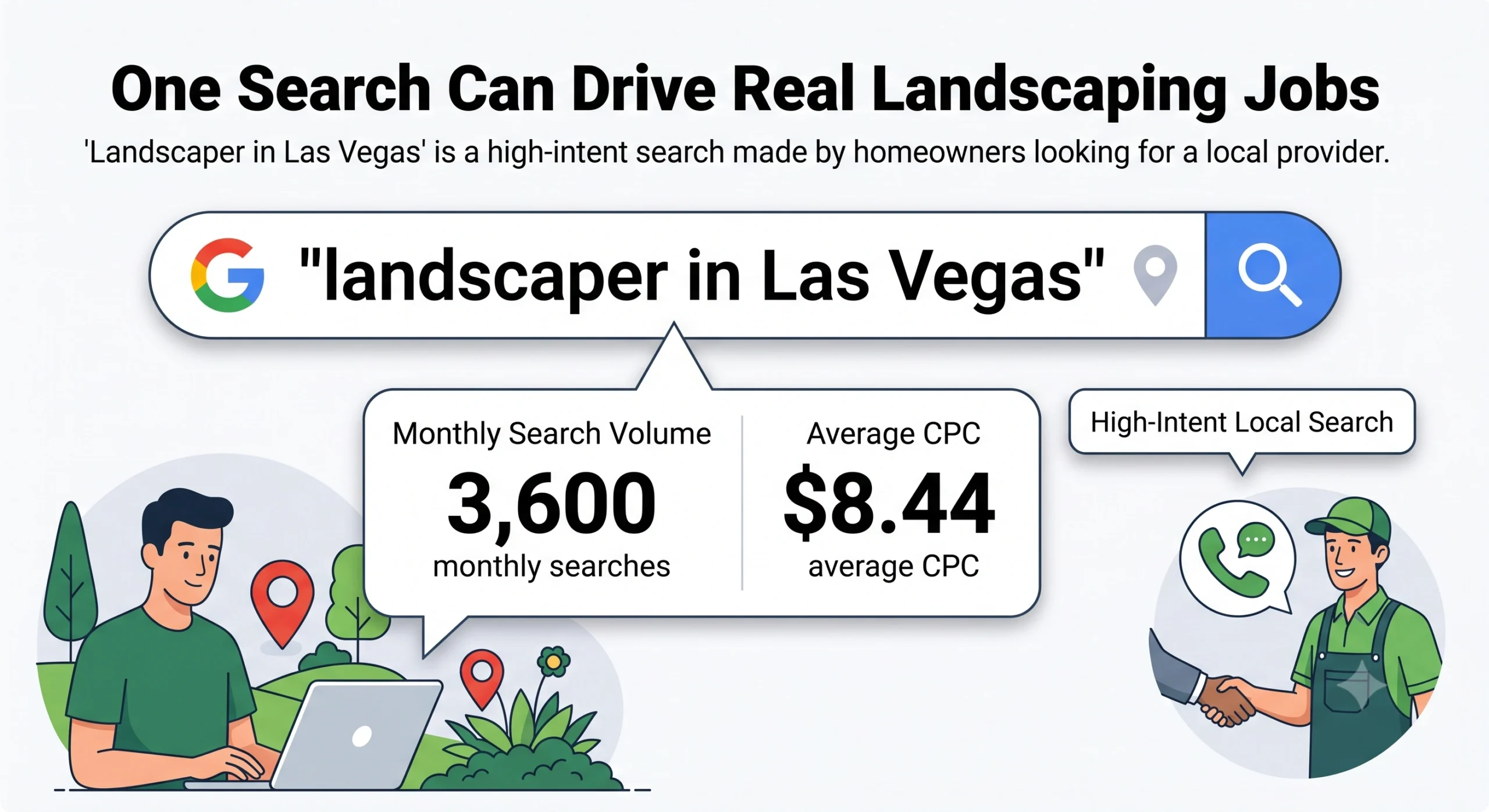
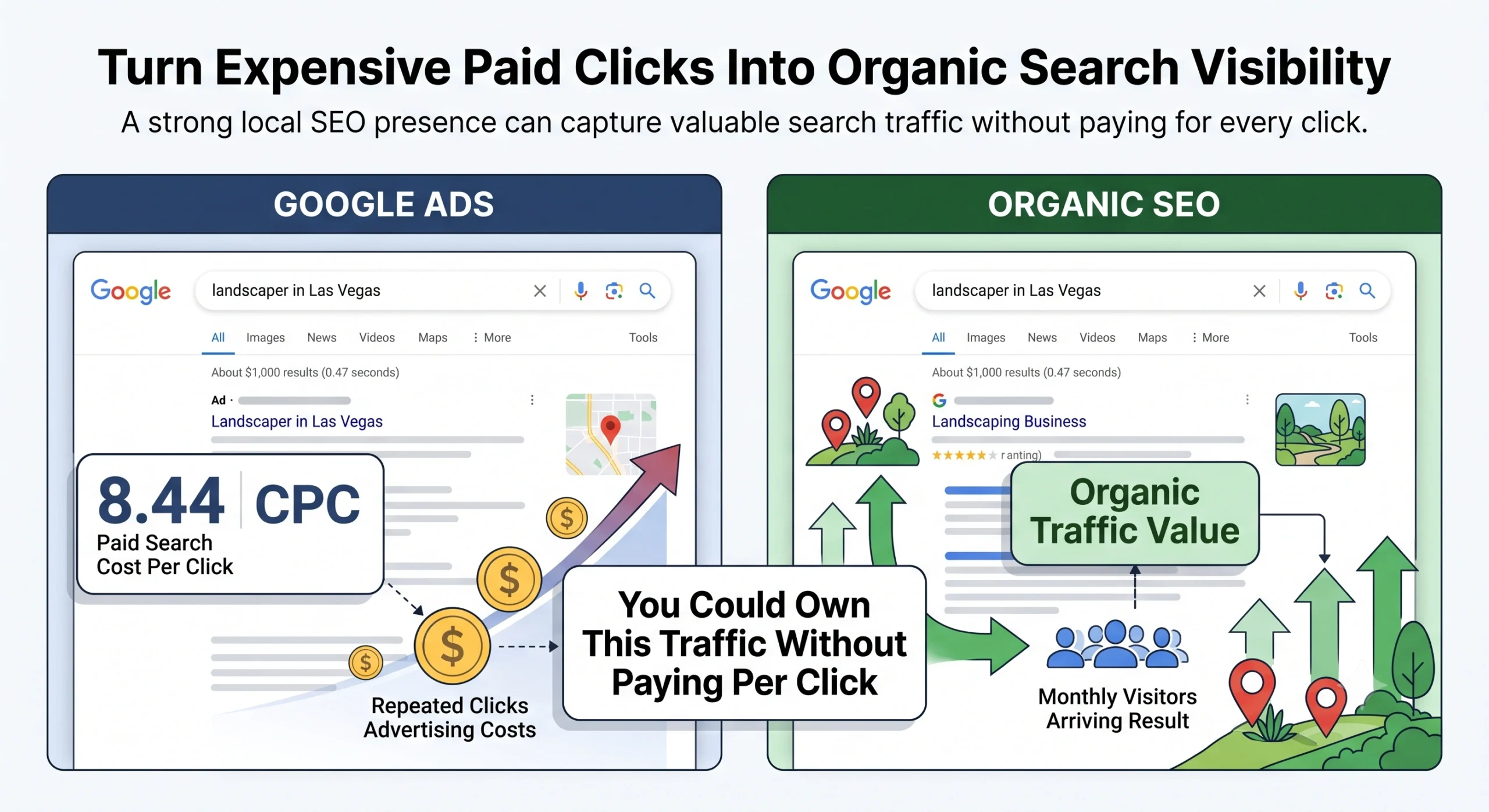
“Landscapers near me” generates approximately 110,000 monthly searches in the US alone, at an average CPC of $8.44 per click. — Softscotch, 2026
That $8.44 figure matters. It is what landscaping companies are paying per click when they run paid ads for that keyword. If you rank organically for a phrase at an $8+ CPC, every organic visitor you earn is worth $8+ in saved ad spend.
The city-specific searches add up quickly across local markets:
- Las Vegas: 3,600 monthly searches for local landscapers
- Denver: 2,400 monthly searches
- San Diego: 1,600 monthly searches
- Portland, OR: 1,600 monthly searches
- Plano, TX: 1,300 monthly searches at $17.00 CPC
Smaller markets still generate 1,000 to 1,900 monthly local landscaping searches, with lower competition and faster ranking timelines.
And “near me” searches are not slowing down.
“Near me” searches have increased 400% year over year. 1.5 billion of them occur every single month.
Every single one of those searches is someone, somewhere, looking for exactly what you offer. The question is whether your website is one of the three results they see.
Why One Generic Services Page Will Never Rank for This
This is the most important thing most landscaping business owners have never been told.
Google does not rank websites. It ranks pages. And it ranks pages that are specifically, clearly, relevantly about one thing.
A single Services page that lists lawn mowing, mulching, patio installation, sod, irrigation, and tree trimming is not one specific page about anything. It is a brochure trying to do everything at once. Google cannot tell from that page whether you specialize in lawns or hardscaping, whether you serve three cities or thirty, or whether you are the right fit for someone searching “patio installation in [suburb].”
So Google does not rank it. For anything.
Your competitor who built a dedicated page titled “Landscaping Services in [City]” two years ago has been ranking for that phrase ever since. That page is the reason they get calls you do not.
Businesses that build 10 to 15 location-specific pages experience an average 55% increase in conversions. Businesses with 40 or more location pages have seen conversion improvements up to 500%. — Arc4, 2026
Local searches convert 18% faster than non-local searches, because buyers have already narrowed their decision to their area.
The math is simple. More specific pages rank for more specific searches. More specific searches convert faster. The only question is how many of those pages your website currently has.
The Right Way to Build City Pages (And the Wrong Way)
The wrong way is what most landscaping businesses do when they first hear about this strategy.
They take their generic Services page, copy it, change the city name, and publish 10 of them in a row. Google sees this as duplicate content and penalizes the entire approach. The pages either do not rank or actively drag down the rest of the site.
The right way takes more work, but it is not complicated. Here is what each city-specific page needs to genuinely rank:
A specific URL structure:
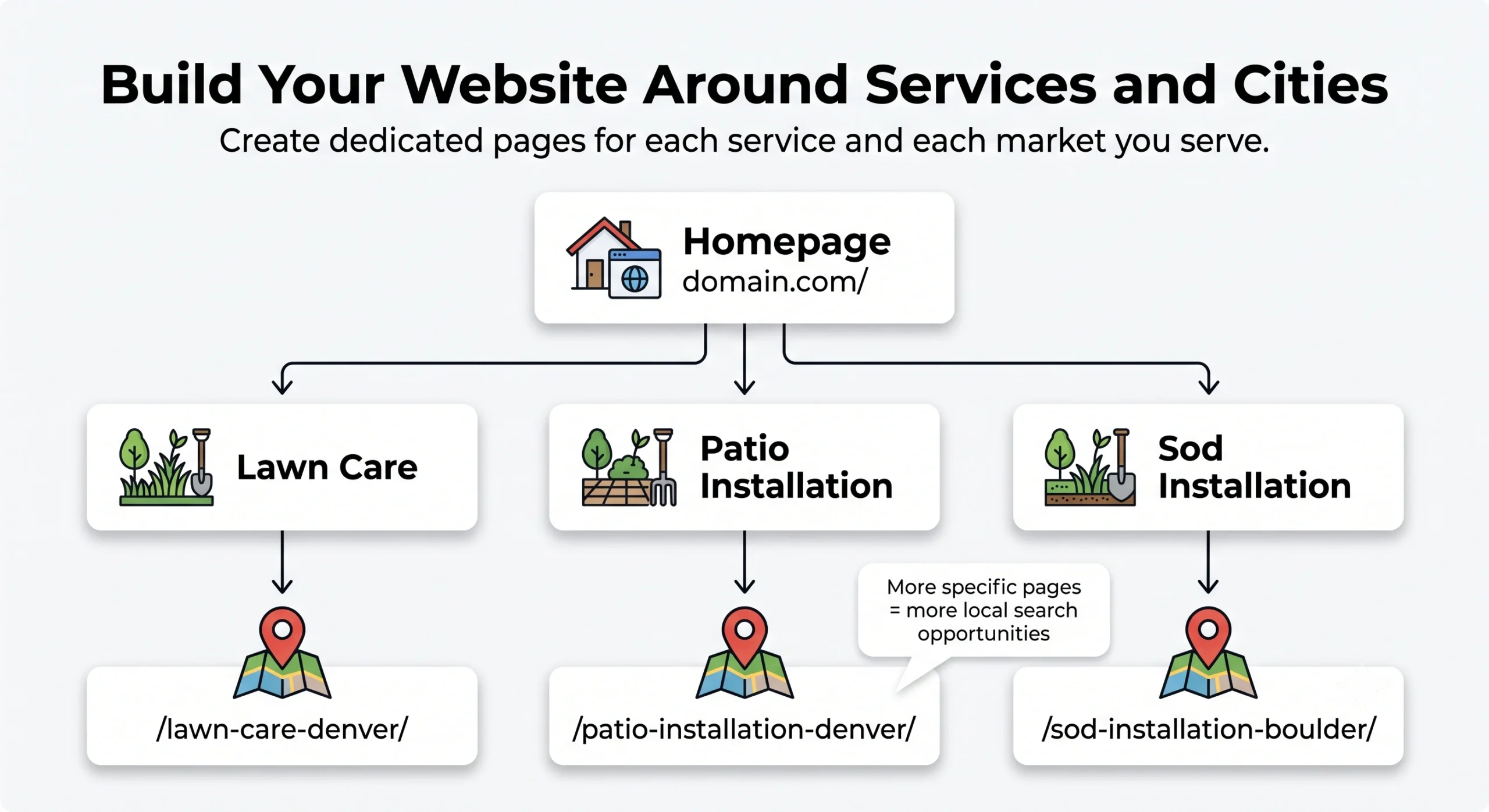
- domain.com/landscaping-[city]/
- domain.com/patio-installation-[city]/
- domain.com/lawn-care-[city]/
A unique title and headline
containing the service and city name. “Lawn Care Services in [City], [State]” as the H1 is not optional. It is how Google knows what the page is about.
Genuinely local body content.
Not just city name swaps. Reference:
- Neighborhoods you have worked in within that city
- Local weather patterns and how they affect lawn care (clay soil, drought conditions, frost dates)
- Specific projects you have completed in that area
- Local landmarks as geographic reference points (“We serve the [Neighborhood] and [Neighborhood] areas of [City]”)
Customer reviews from that specific city.
A testimonial from a homeowner in [City] on the [City] page is one of the most powerful local signals you can add. It shows Google that real people in that market have hired you.
A contact form and phone number above the fold.
The homeowner searching for a landscaper in their city is ready to call. Remove every obstacle between their search and your phone ringing.
How Many Pages You Need and Where to Start
One of the most common questions landscaping business owners ask when they hear this strategy is: how many pages do I actually need to build?
The answer depends on how many services you offer and how many cities you serve. But here is a practical framework to start with.
Step 1: Identify your top 5 cities by revenue.
These are the markets where you do the most work and make the most money. Build your first pages here because this is where ranking will have the most immediate impact on your business.
Step 2: Build one page per primary service per city.
If you offer lawn care, patio installation, and sod installation in five cities, that is 15 pages. Each one is a separate ranking opportunity for a separate high-intent search.
Step 3: Add lower-competition cities for faster wins.
Smaller markets have less competition and shorter ranking timelines. A city with 50,000 people and lower landscaping competition can often get a new page into the top three within 60 to 90 days, giving you wins while the larger markets build.
Realistic ranking timelines by market size:
- Small markets (under 200,000 population): 60 days
- Mid-size metros (Omaha, Kansas City): 3 to 5 months
- High-competition metros (Phoenix, Charlotte, Denver): 6 to 9 months
This is exactly the type of prioritized execution that separates a real local SEO strategy for landscapers from random content publishing. The goal is not to build the most pages. It is to build the right pages, in the right order, for the right markets.
What Happens When These Pages Start Ranking
The results are not subtle.
One documented case from the local SEO space showed keywords moving from page three or four into the top three, with some cities reaching the number one position within weeks of the pages being published. Impressions for new city pages routinely jump from zero to thousands within the first 30 to 60 days, even before the pages reach the first page of results.
And here is what makes this strategy particularly valuable for landscaping businesses:
The traffic that comes from “landscaper in [city]” searches is not casual. It is not informational. It is transactional. Homeowners running that search have already decided to hire. They are picking who.
88% of smartphone users who search for a local service visit or call a business within 24 hours. — Google Research
$1 invested in local SEO generates an estimated $19.90 in return, compared to $4.40 for paid search.
And the lead cost difference is significant. SEO-generated leads in home services typically cost between $25 and $45 each. The average cost per lead through Google Ads for the same keywords runs $90 or higher. A properly built city page that ranks organically generates leads at less than half the cost of the paid alternative, indefinitely, without ongoing ad spend.
The AI Search Angle Most Landscapers Have Not Considered
Google’s AI Overview and Google’s AI Mode are now appearing above traditional search results for a growing number of local queries.
When a homeowner asks Google AI “who is a good landscaper in [city],” the AI generates an answer by pulling from structured, clearly labeled content. A well-built city-specific landing page, one that clearly says “we provide landscaping services in [city]” and backs it up with reviews, projects, and local references, is exactly the type of content these AI systems extract and recommend.
City-specific pages provide clear geographic context signals that AI systems rely on for local recommendations, giving businesses with these pages an advantage in AI-generated results.
Businesses without city pages are invisible in AI search for local queries. Businesses with them are the ones getting recommended.
This is still an early advantage. Most landscaping businesses have not built city pages yet, which means the window to establish a dominant position in AI-generated local results is still open. It is not going to stay open forever.
The Content Trap to Avoid
There is one mistake that will make all of this work backfire.
If you build city pages and simply copy your existing content with the city name swapped, Google will identify this as duplicate content. The pages will not rank. In some cases, they can actively hurt your existing rankings.
Each page needs to be substantively different. Not entirely different, but genuinely written for that city. The structure can be the same. The specific content, the neighborhood references, the local project examples, the local weather or soil context, needs to be original.
This is also what makes these pages more persuasive to homeowners. A landscaping company page that mentions “we frequently work in the [Neighborhood] area of [City], where homes with clay-heavy soil need specific aeration techniques” reads as a local expert. A generic page with just the city name inserted reads as a template.
Homeowners can tell the difference. Google can tell the difference. Write the page like you actually know and work in that city, because you do.
The Internal Linking Structure That Multiplies Your Ranking Power
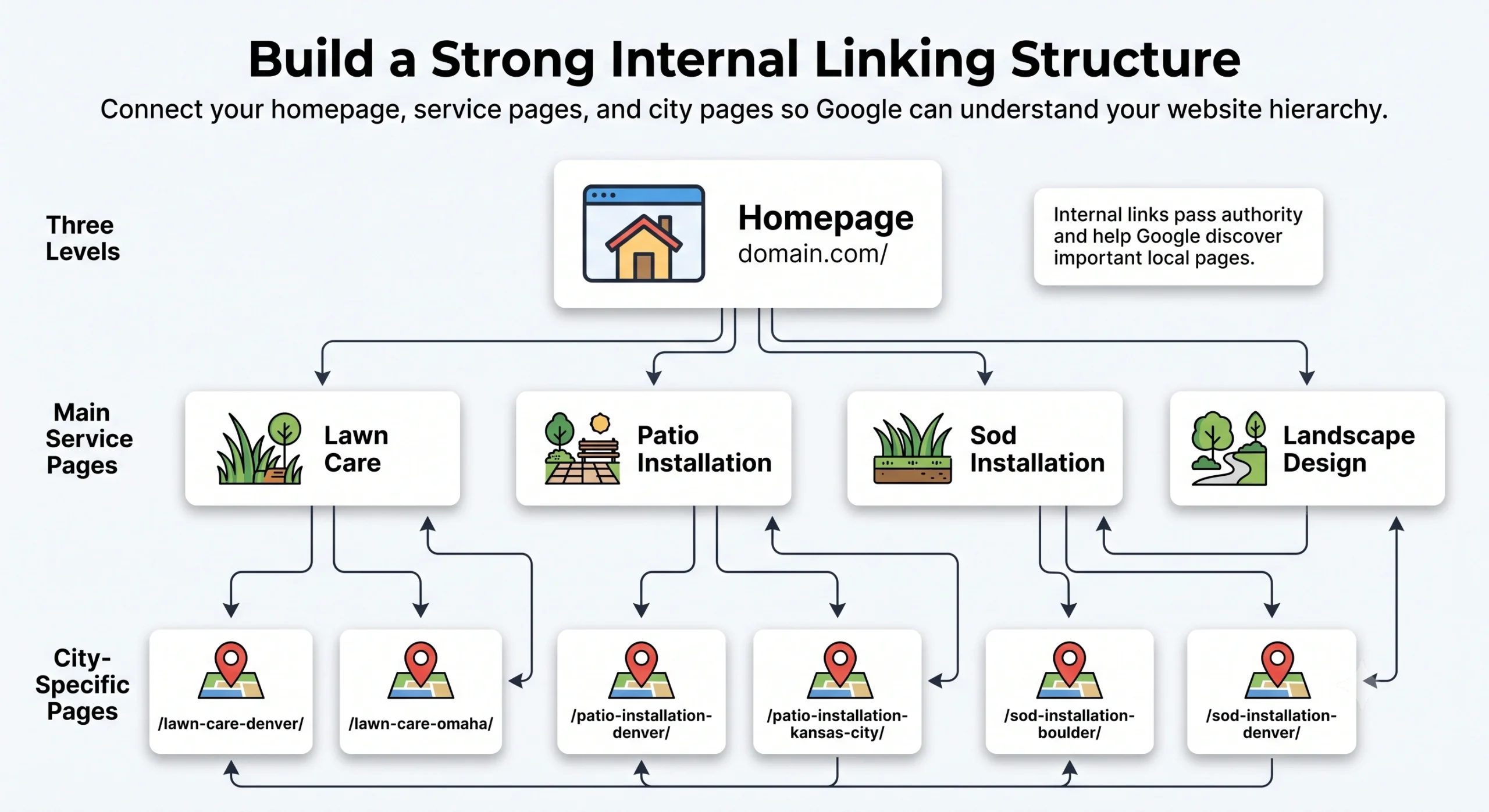
City pages do not work in isolation. They work best when they are connected to the rest of your website through a deliberate internal linking structure.
Here is how to set it up:
- Your homepage should link to your main service pages
- Your main service pages should link to each city-specific page for that service
- Your city pages should link back to your main service pages and to your contact page
- Your blog posts should link to relevant city pages when discussing services in a specific area
This internal linking structure tells Google two things. First, it tells Google that these pages are real, important parts of your site, not orphaned pages floating disconnected from everything else. Second, it passes ranking authority from your stronger pages to your newer city pages, helping them rank faster.
This kind of site architecture is a core component of what our SEO program for landscaping businesses builds from the start, because a city page that no other page links to will rank far slower and rank lower than one embedded in a properly structured site.
The Three Pages You Should Build This Week
If you have been reading this and thinking “I know I need to do this but I do not know where to start,” here is the most direct answer possible.
Pick the three cities that generate the most revenue for your business right now. For each one, write a page that does the following:
- Opens with a headline that includes your primary service and the city name
- Describes your services in two or three specific paragraphs referencing local details
- Includes at least one real customer review from that city
- Shows one before-and-after project photo from work you have done in that area
- Contains your phone number and a contact form visible without scrolling
Those three pages will not turn your rankings around overnight. But they will start accumulating ranking signals immediately, and within 60 to 90 days you will see measurable movement for city-specific searches you are currently invisible for.
That is the first step. From there, you build the rest of your city page structure systematically, service by service, city by city, until your site is the most comprehensive and locally relevant landscaping resource in your market.
What This Looks Like When It Is Done
A landscaping business with a fully built local page structure looks completely different in Google from one without it.
Instead of appearing once for a vague search, they appear multiple times across different searches. “Lawn care in [City A]” shows their lawn care city page. “Patio installation in [City B]” shows their patio city page. “Landscaping company near [Neighborhood]” shows a page that specifically references that neighborhood.
Each page captures a different homeowner at a different moment. Each one is a door into your business. The more doors you have, the more homeowners walk through.
This is the real reason the most successful landscaping businesses in local markets dominate their competitors on Google. It is not one great page. It is a system of specific, relevant, locally-grounded pages that collectively make your business the obvious choice no matter how the homeowner searches.
If you want to know how many of these pages your top local competitors already have and a roadmap for closing the gap in your specific market, see how our local SEO service for landscapers works and get in touch for a free audit.