
Every spring, the same thing happens.
Landscaping businesses that went quiet in November scramble to get their website updated, their Google Business Profile refreshed, and their service pages live, right when the phones should already be ringing. They publish spring cleanup content in April. They post about lawn aeration in May. By then, their competitors who started publishing in January have already claimed the top spots in Google. The late movers spend the busiest season of the year watching leads flow to whoever got there first.
This is not bad luck. It is a timing problem. And it is completely preventable.
This post breaks down exactly when to publish seasonal SEO content for every quarter of the year, which winter keywords drive real leads that most landscaping businesses ignore, and how to build a content calendar that earns you visibility before your competitors even start thinking about it.
Why Timing Is Everything in Landscaping SEO
SEO does not respond in real time. When you publish a new page or blog post, Google needs time to find it, crawl it, index it, evaluate it, and eventually rank it. That process takes weeks at minimum and often months for competitive keywords in established markets.
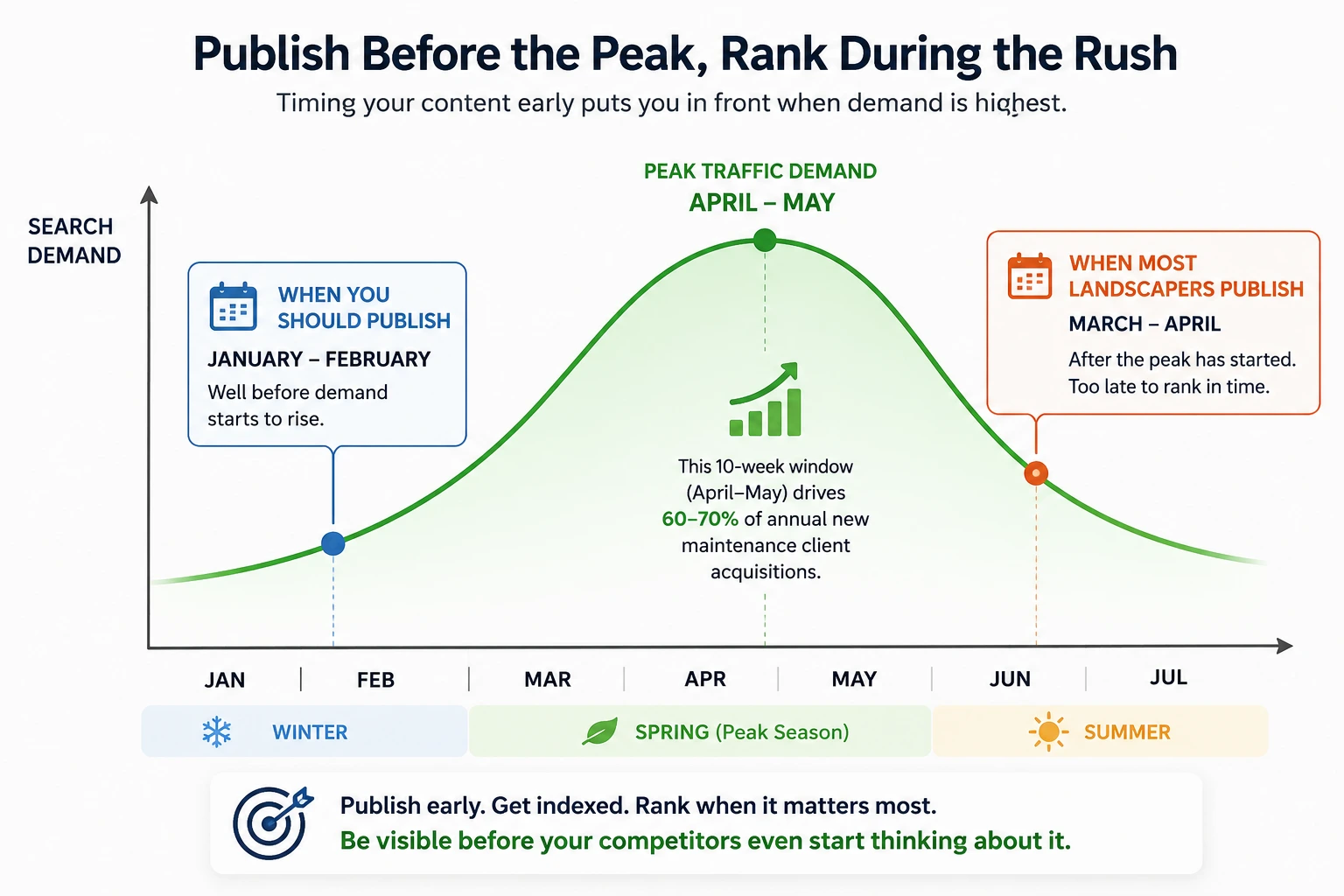
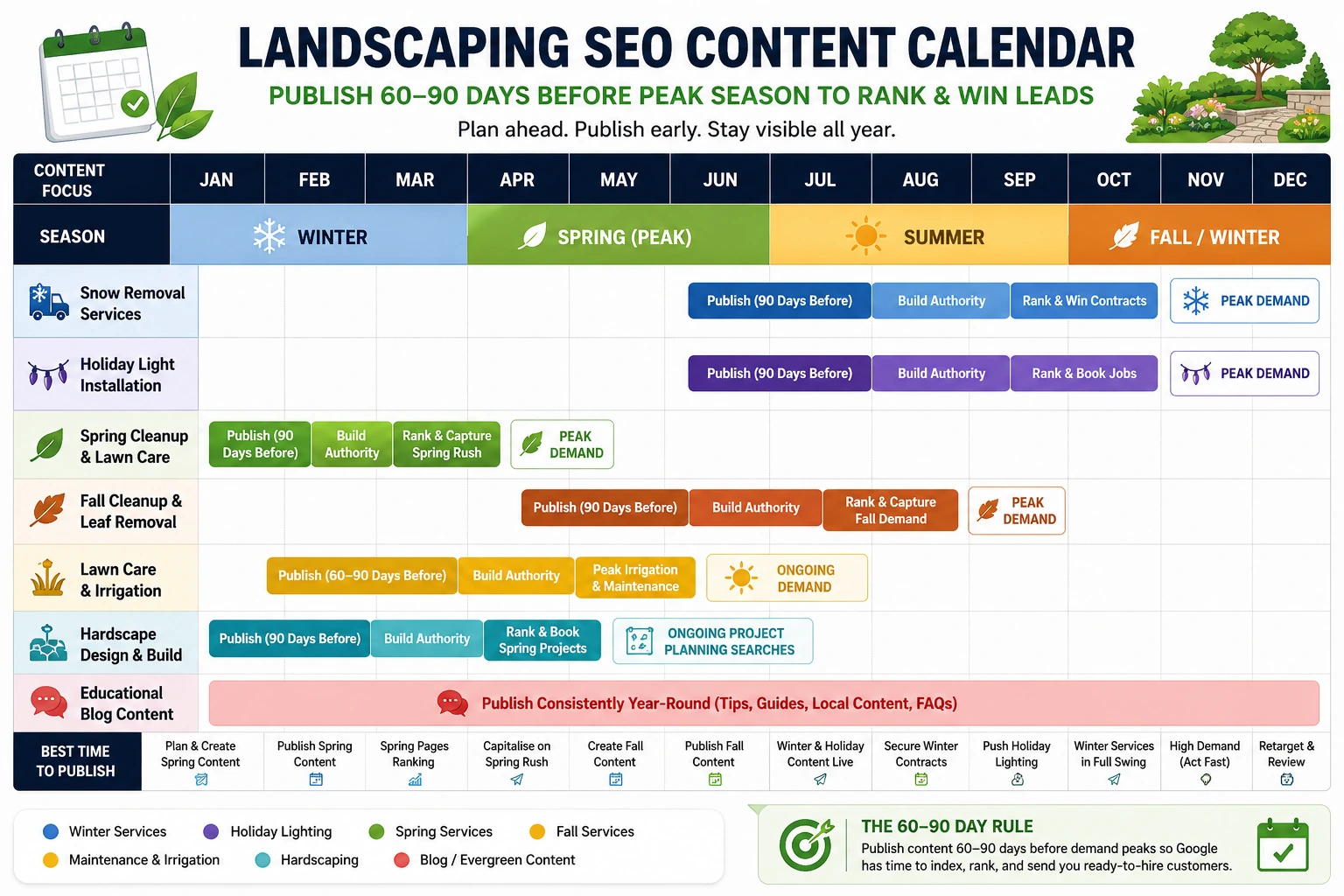
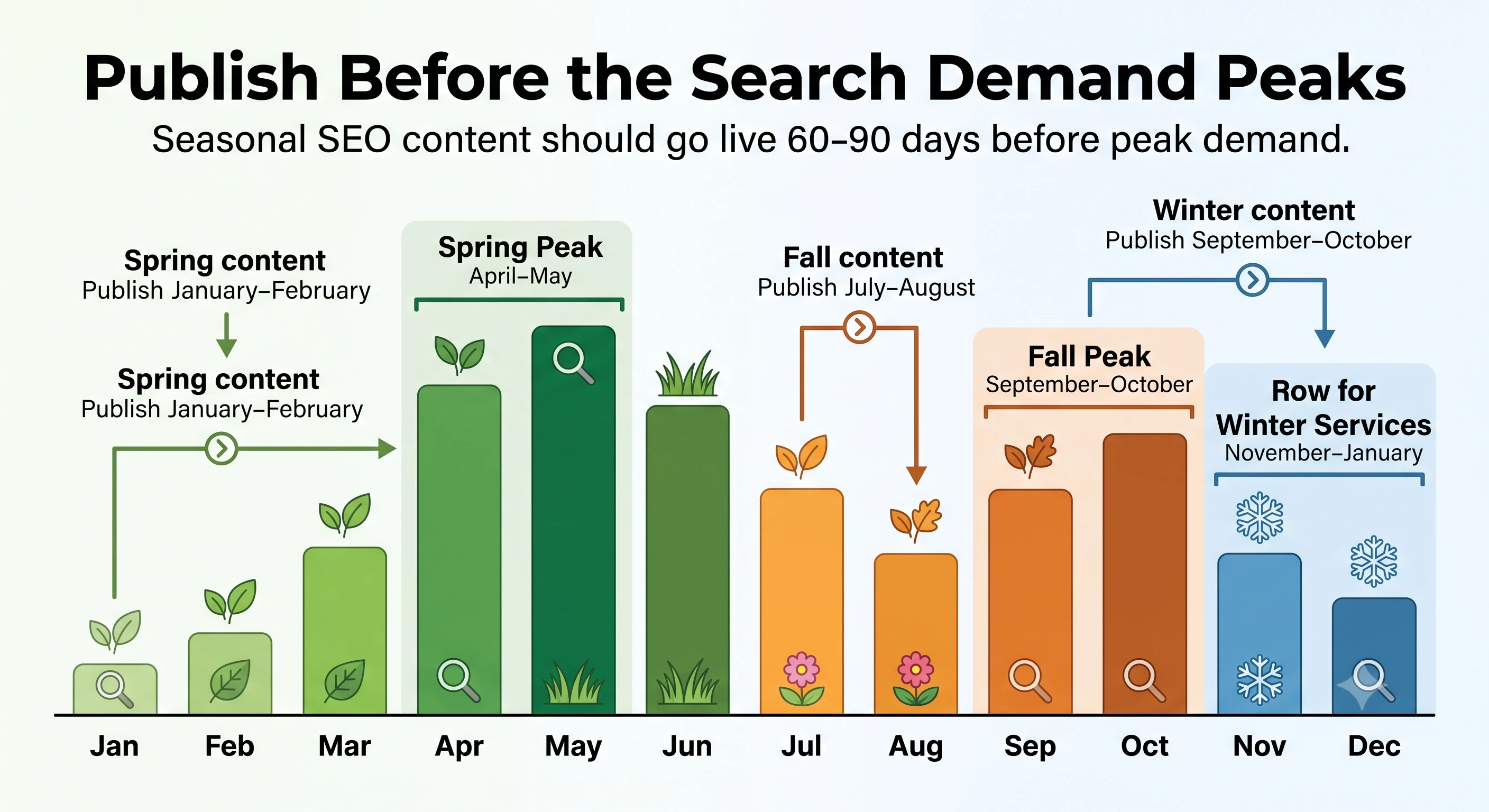
Seasonal SEO content must be published 60 to 90 days before your expected traffic peak. Pages published at the start of a season will not rank in time to capture the demand they were built for.
This is the rule that most landscaping businesses have never been told. And it is the reason their seasonal marketing perpetually underperforms.
The homeowner searching for “spring lawn cleanup” in March did not just decide to search it. They have been thinking about their yard since January. The businesses that published spring content in January and got indexed in February are the ones appearing in front of that homeowner in March. The businesses that published in March are invisible during the entire spring peak.
The 10-week window from April through May accounts for 60 to 70% of annual new maintenance client acquisitions for landscaping companies. — BizIQ, 2026
Missing even part of that window because your content was published too late is not a minor inconvenience. It is a compounding loss that reverberates through your revenue for the entire year.
The Hidden Opportunity Most Landscapers Completely Miss: Winter
Before building out the full calendar, it is worth spending time on the season most landscaping businesses treat as dead time.
Winter is not a dead season for landscaping search. It is a redirected season.
Search volume shifts, not disappears. Homeowners do not stop using Google between November and February. They start searching for different things:
- Snow removal services and contracts
- Holiday light installation and takedown
- Winter mulching and plant protection
- Hardscape design and planning (for spring installation)
- Tree pruning during dormancy
- Gutter cleaning before freeze
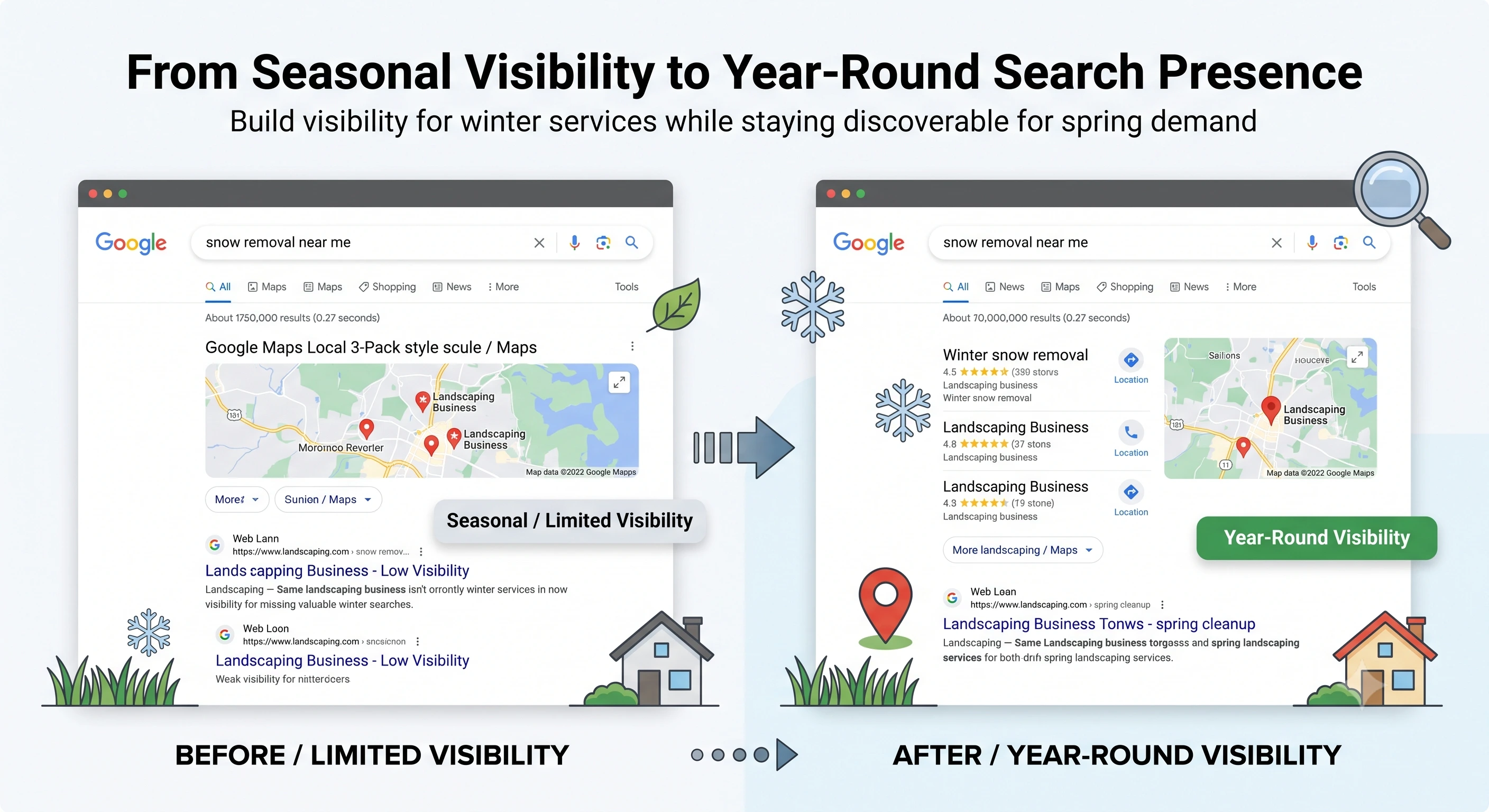
92% of “snow removal near me” searches trigger the Google Local 3-Pack. The top three map positions capture approximately 42% of all clicks for that search.
That is a significant volume of ready-to-hire homeowners searching for a service that most landscaping businesses either do not offer or have never built an SEO presence around.
And here is the commercial opportunity that the numbers underscore:
Commercial snow removal contracts signed in July through September generate 3 to 5 times the lifetime value of per-event residential snow removal work.
The highest-value winter contracts are not won in December when it is already snowing. They are won in late summer and fall, when facility managers and property owners are planning their winter budgets. Landscaping businesses with SEO content targeting “commercial snow removal contract [city]” in September are already having conversations that their competitors do not even know are happening.
The One Rule That Saves Your Seasonal Pages From Losing Ground
Before diving into the calendar, there is one tactical decision that protects all the seasonal ranking work you do.
Never delete seasonal pages.
Many landscaping businesses take down their “spring cleanup” page in June and their “snow removal” page in March. This seems logical. The season is over. Why leave the page up?
Here is why: when you delete a page that has earned backlinks, reviews, and ranking history, you destroy everything Google has attributed to it. External sites linking to that page suddenly hit a dead end. The ranking authority that took months to build disappears instantly.
The right approach is to keep every seasonal page live year-round and update two things:
- Remove it from your main navigation so it does not confuse visitors who find your site in the off-season
- Update the call-to-action to capture early interest (“Spring bookings open in March. Join the waitlist now.”)
This approach preserves the SEO authority that compound over years while still giving you control over what the page does for your business in each season.
The Month-by-Month Seasonal SEO Calendar
Here is how a landscaping business with a proactive content strategy should operate across all four quarters.
Q1: January, February, March
What homeowners are searching:
- “Spring lawn cleanup near me”
- “Lawn aeration services in [city]”
- “Spring fertilization service”
- “Landscaping company [city] spring”
- “Patio installation cost” (planning purchases)
What you should be publishing:
January and February are the most important publishing months of the year for spring content. Every piece of spring-focused content you want to rank in March and April needs to be live and getting indexed now.
- Publish or refresh your spring cleanup service page
- Publish a blog post answering “when to schedule spring lawn care in [city]”
- Update your homepage to reflect spring services are opening for bookings
- Add spring-focused Google Posts to your GBP
What you should also be running in parallel:
- Your snow removal and holiday lighting pages should still be live (they are off-season now, but the ranking authority continues to build)
- Your GBP should be publishing posts about winter services winding down and spring bookings opening
Updating an existing seasonal page 60 days before season start often outperforms publishing a brand-new page, because the existing page has already accumulated ranking authority.
Q2: April, May, June
What homeowners are searching:
- “Landscaper near me”
- “Lawn care service in [city]”
- “Sod installation [city]”
- “Patio builder near me”
- “Summer weed control service”
- “Irrigation repair near me”
This is your peak season. The content you published in January and February is now ranking. Your phone should be ringing.
What most landscaping businesses do wrong in this quarter: they stop publishing.
While you are busy with spring work, your competitors who understand SEO are already publishing content for the next season.
What you should be publishing in Q2:
- Fall cleanup and leaf removal service pages (going live in May gives Google 4 months to rank them before fall demand peaks)
- Fall overseeding and aeration content
- Winterization and sprinkler blowout service pages
- “How to prepare your yard for fall in [city]” blog content
Yes, you are publishing fall content in May. That is exactly the point.
GBP activity for Q2:
- Add 3 to 5 new spring project photos weekly
- Respond to the surge of new reviews you should be earning from spring jobs
- Publish weekly Google Posts showing completed projects in specific neighborhoods
Q3: July, August, September
What homeowners are searching:
- “Fall lawn care near me”
- “Leaf removal service [city]”
- “Lawn overseeding service”
- “Sprinkler winterization near me”
- “Commercial snow removal contract [city]” (facility managers planning ahead)
- “Hardscape installation near me” (planning fall projects)
What you should be publishing:
July through September is when the most disciplined landscaping businesses make their biggest competitive gains. Most competitors are too busy with active summer projects to think about content. The businesses that publish now will dominate fall and early winter searches before those competitors wake up.
- Snow removal service page (yes, in July)
- Holiday light installation page
- Fall cleanup and leaf removal content
- Winterization checklists and service pages
- “Best time to aerate lawn in [city/state]” content
A landscaping company that maintained a permanent holiday light installation page year-round saw its November leads increase from 122 to 516, a fourfold jump, compared to competitors who only activated the page seasonally. — BizIQ, 2026
The word “permanent” in that case study is the key. That page was not taken down after December and rebuilt each October. It sat live year-round, compounding authority, so that when November search volume spiked, the page was already ranked.
Commercial snow removal outreach should begin now. Property managers and facility directors finalize winter vendor contracts in August and September. A landscaping business with a well-ranked snow removal page, strong reviews, and an active GBP is in the conversation. One that only starts thinking about snow removal in October is not.
Q4: October, November, December
What homeowners are searching:
- “Snow removal service near me”
- “Holiday light installation near me”
- “Leaf removal service near me”
- “Winter mulching service”
- “Landscape design ideas” (planning for spring, booking consultations)
- “Hardscape installation [city]” (design-build projects planned in winter for spring execution)
What most landscaping businesses do in Q4: nothing.
They close out the season, reduce marketing spend, and go quiet until March. This is exactly why Q4 is the biggest opportunity available to the landscaping business willing to stay active.
What the best businesses do in Q4:
- Run their snow removal and holiday lighting pages at full visibility
- Publish “now booking spring 2026 landscaping projects” content to capture homeowners who start planning in November
- Offer early booking discounts for spring projects to generate deposits and secure the calendar
- Use Google Posts to show holiday lighting installation projects as they happen
- Collect reviews from the entire year’s worth of satisfied customers before the year ends
Organic SEO outperforms paid search in return on investment by month 9 to 12, generating compounding results that do not disappear when ad spend stops. — PipelineOn Research
The businesses that stay active in Q4 are not just generating winter leads. They are building the domain authority, review velocity, and content depth that makes them dominant in the following spring, while their competitors are starting from a standstill in March.
The Two Types of Winter Pages Every Landscaping Business Should Have
If you do nothing else from this post, build these two pages before October.
Page 1: Snow Removal Services in [City]
- Target: “snow removal near me,” “snow removal [city],” “snow plowing service [city]”
- Include: residential and commercial service options, your service area, pricing model options (seasonal contract vs. per-event), and a contact form for contract inquiries
- Add your GBP service area specifically to include your target cities for snow removal
- Build this page in July. Link to it from your homepage. Let it accumulate authority for four months before the first snow.
Page 2: Holiday Light Installation in [City]
- Target: “holiday light installation near me,” “Christmas light installation [city],” “holiday lighting service [city]”
- Include: a project gallery, pricing range, your booking window, and a contact form
- Keep this page live year-round, not just October through January
- The LawnSavers case study documented 4x more November leads specifically from maintaining this page permanently
Both of these pages serve homeowners who are ready to hire right now. They also serve homeowners who are planning ahead, which is an even more valuable lead because the decision has already been made before a competitor enters the picture.
The Internal Linking Move That Speeds Up Seasonal Rankings
One of the fastest ways to help a new or refreshed seasonal page rank more quickly is to link to it from pages that already have strong ranking signals.
When you publish your spring cleanup page in January, immediately add a link to it from:
- Your homepage
- Your main services page
- Any recent blog post that mentions spring lawn care
- Your current Google Posts
This internal linking tells Google that the new page is important and connected to the rest of your site, which accelerates the crawling and indexing process. Pages that sit without any internal links pointing to them take significantly longer to rank.
This is a small technical step that most landscaping businesses skip, and it costs them three to four weeks of ranking time on every seasonal page they publish.
Why Your Competitors Are Already Ahead and What to Do About It
The businesses dominating seasonal searches in your market right now almost certainly built their content months ago. Their spring cleanup pages have six months of ranking history. Their snow removal pages have been live since July. Their holiday lighting page has never been taken down.
The compounding advantage of this approach means the gap between them and a landscaping business that starts today is not insurmountable, but it is real and it takes time to close.
The good news is that most of your local competitors are not doing any of this. They publish when it feels urgent, delete pages at the end of each season, and wonder why the spring rush always seems to favor the same two or three businesses in their market.
Starting now, even if you are not starting perfectly, puts you ahead of every landscaping business that starts in March.
If you want to know exactly which seasonal keywords your competitors are ranking for that you are not, and a prioritized content calendar built around your specific service area and seasonal patterns, that is exactly the kind of work our local SEO program for landscaping businesses is built around.
Not generic advice. A specific calendar for your market, your services, and your competitive landscape.
The Seasonal SEO Checklist for Landscaping Businesses
Use this across the year:
Q1 (January to March):
- Spring service pages live and indexed
- Spring blog content published
- GBP updated with spring service announcements
- Snow removal and holiday pages still live (do not delete)
Q2 (April to June):
- Fall cleanup and overseeding pages published (now, not in September)
- Spring project photos added to GBP weekly
- Reviews collected aggressively from spring jobs
- Winterization service page drafted and published
Q3 (July to September):
- Snow removal page live
- Holiday light installation page live
- Commercial snow removal contract outreach supported by SEO content
- GBP posts targeting fall transition searches
Q4 (October to December):
- Winter service pages at full visibility
- Early spring booking content live
- Year-end review collection push
- Spring content calendar drafted for January publishing
This is what a year-round local SEO strategy for landscapers actually looks like in practice. Not a one-time website update. Not a sprint before spring. A system that keeps your business visible and generating leads in every season, including the ones your competitors have already written off.