

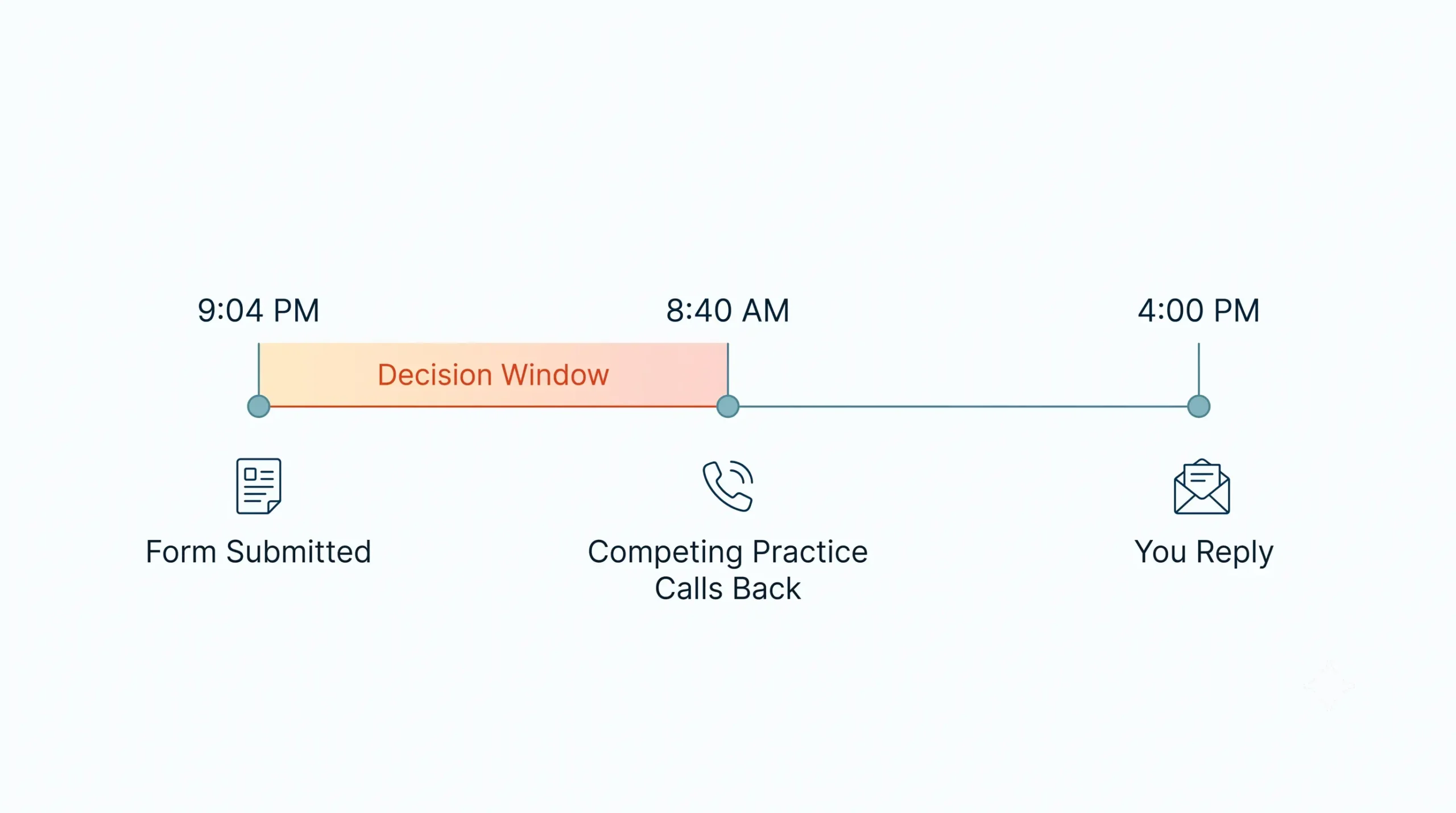
A prospective client finds your practice at 9:04 on a Tuesday night. She reads your specialties page twice. She checks whether you take private pay. She types four sentences into your contact form, hits submit, and closes the laptop.
That form fill cost you money. You paid for the search ad that brought her in, or you paid for the SEO work that ranked the page, or you paid for the directory placement. The click is billed. The lead is real. Then nothing happens for fourteen hours. You see the notification at 11 a.m. between sessions. You reply at 4 p.m. By then she has already spoken with a clinician who called her back at 8:40 that morning, felt heard on the phone, and booked a consultation for Thursday.
Your marketing worked. Your intake lost the client. Most practices treat that gap as an administrative problem. It is a paid media problem, and it belongs on the same dashboard as your cost per click.
The window closes faster than it feels
The research on response time is old, large, and consistent.
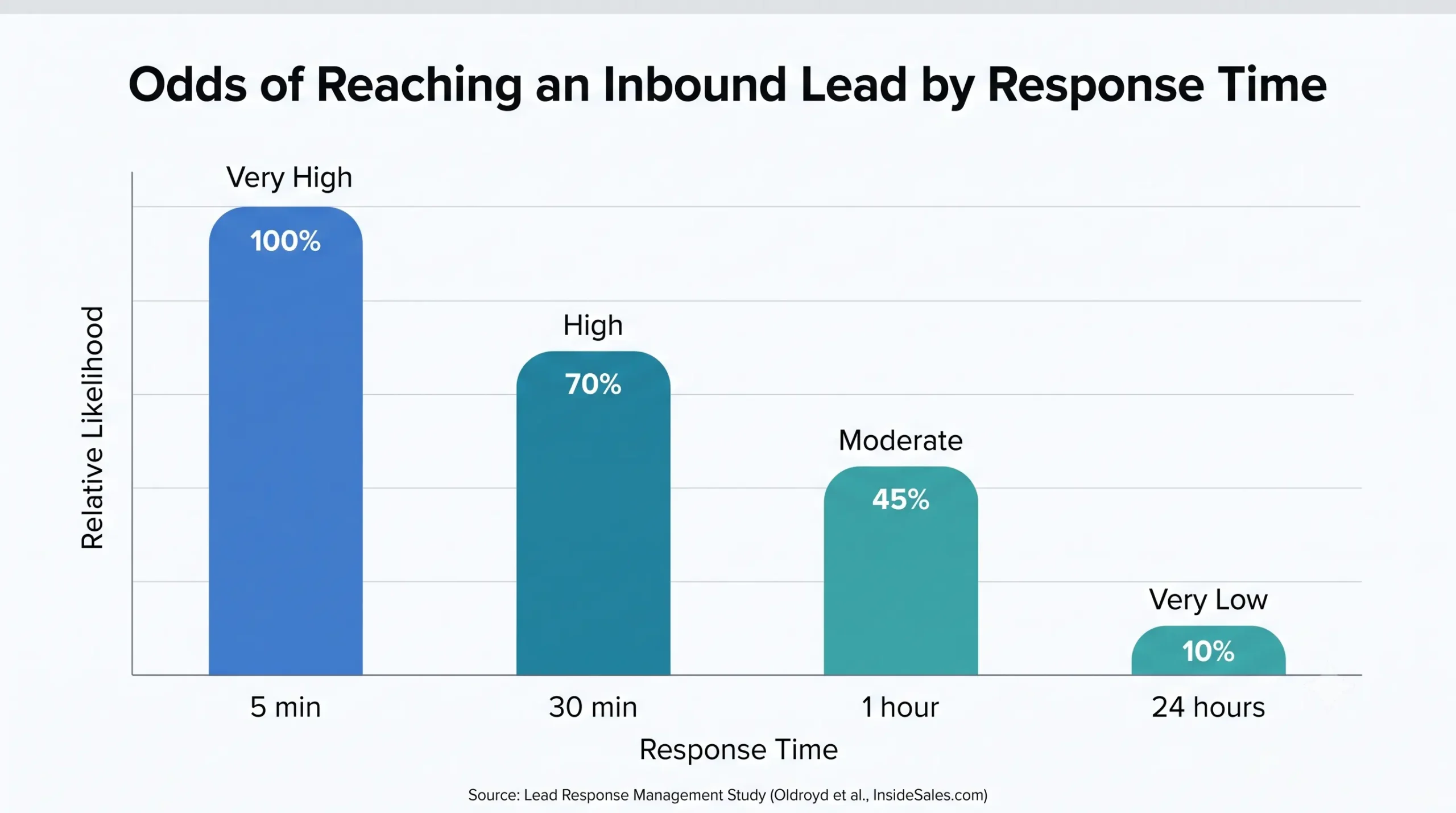
Dr. James Oldroyd studied inbound lead response behavior at Kellogg and later at MIT, working with InsideSales.com. The finding that gets quoted everywhere came from that work: contacting an inbound lead within five minutes instead of thirty raised the odds of reaching the person by roughly 100 times, and the odds of qualifying them by roughly 21 times.
[SOURCE NOTE: 2007 Lead Response Management study, Oldroyd with InsideSales.com. Reported sample: six companies, 15,000+ leads, 100,000+ dials. Confirm the sample description against the original PDF before publishing. This stat is widely misattributed to Harvard Business Review across the web. Do not repeat that error.]
In March 2011, Oldroyd published a follow-up in Harvard Business Review with Kristina McElheran and David Elkington, titled “The Short Life of Online Sales Leads.” They audited 2,241 US companies by submitting test inquiries through web forms and timing the reply. Thirty-seven percent answered within an hour. Twenty-four percent took longer than a day. Twenty-three percent never answered at all. Among the companies that did respond within thirty days, the average time to first reply was 42 hours.
Those studies covered software, financial services, education, automotive, and healthcare. None of them measured therapy practices specifically. The direction holds anyway, and there are good reasons to think it holds harder in mental health than it does in software.
Why therapy inquiries decay faster than most leads
The message is the peak of the curve, not the start of it. Someone spent weeks deciding to reach out. That contact form represents the top of a courage curve. Every hour of silence gives ambivalence room to work, and ambivalence is a clinical feature of the population you serve, not a marketing inconvenience.
Distress does not keep business hours. Inquiries cluster in the evening and on Sunday nights, which is exactly when your practice is closed. The hours people reach out and the hours you are available barely overlap.
They contacted more than one of you. A person comparing three therapist profiles rarely contacts one and waits. They send three messages in twelve minutes. The first clinician to reach them with a warm, human response usually gets the consultation, and the other two get a polite decline or nothing.
Silence carries meaning. For a client whose presenting concerns include rejection sensitivity, shame, or a history of being dismissed by providers, an unanswered message is not neutral. It reads as confirmation.
Private pay raises the bar. Someone paying out of pocket is making a discretionary purchase at a real price. Friction early in the process gives them a reason to keep shopping.
Put a dollar figure on one missed inquiry
Work the numbers for your own practice. Here is the shape of the calculation using placeholder figures.
A practice spends $2,000 a month on search ads. At a $12 cost per click, that buys about 166 clicks. At an 8 percent form fill rate, that is roughly 13 inquiries a month, or about $154 per inquiry.
Now assume 5 of those 13 never get a reply inside 24 hours. That practice paid about $770 for silence. Not for bad clicks. Not for the wrong keywords. For inquiries that arrived and sat.
Set that against lifetime value. A private pay client at $175 a session who stays for 12 sessions is worth $2,100. One recovered inquiry a month covers the entire ad budget with room left over.
[SOURCE NOTE: The $12 CPC and 8 percent form fill rate are placeholders. Pull real benchmarks for mental health and therapy search terms from WordStream’s industry benchmark report or Semrush before publishing, or replace this section with an anonymized client figure. Do not publish invented benchmarks as industry data.]
Intake response time is a paid media metric
Here is the reframe that changes how a practice manages its budget.
Cost per lead is a fictional number if a share of those leads never receive a reply. The only figure that reflects reality is cost per booked consultation, and intake speed sits directly between the two.
This has a technical consequence most practices miss. If your Google Ads account optimizes toward form submissions, and half of those submissions go unanswered, you are training the bidding algorithm to find people you will never call. The system has no way to distinguish a form fill that became a client from one that died in an inbox. Feed booked consultations back into the ad platform as an offline conversion, and the account starts buying the traffic that actually converts into care.
You cannot optimize an ad account that stops measuring at the form submit.
Five numbers that belong on your dashboard
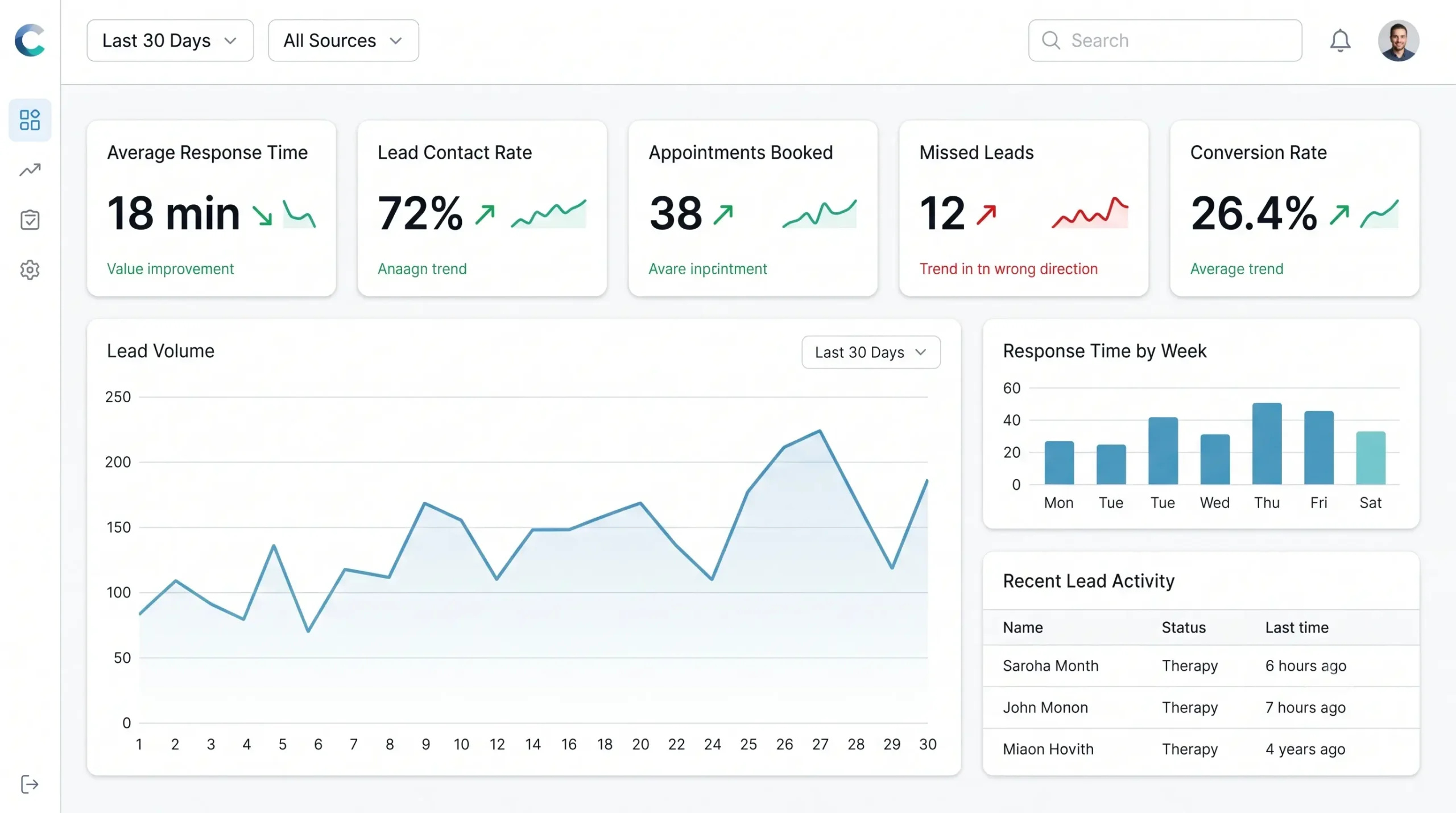
Median time to first response. Use the median, not the average. One reply at 9 a.m. and one reply four days later averages out to something that looks acceptable and describes nothing.
After-hours response time, tracked separately. Evening and weekend inquiries behave differently. Blending them into one number hides your worst gap.
Contact rate. The percentage of inquiries that reached an actual conversation with a person, not the percentage that received an email.
Inquiry to booked consultation rate. This separates a marketing problem from an intake problem. Plenty of inquiries and few bookings points at intake. Few inquiries points at marketing.
Cost per booked consultation. Total spend divided by consultations booked. This is the number that should drive budget decisions.
Fix it without hiring a call center
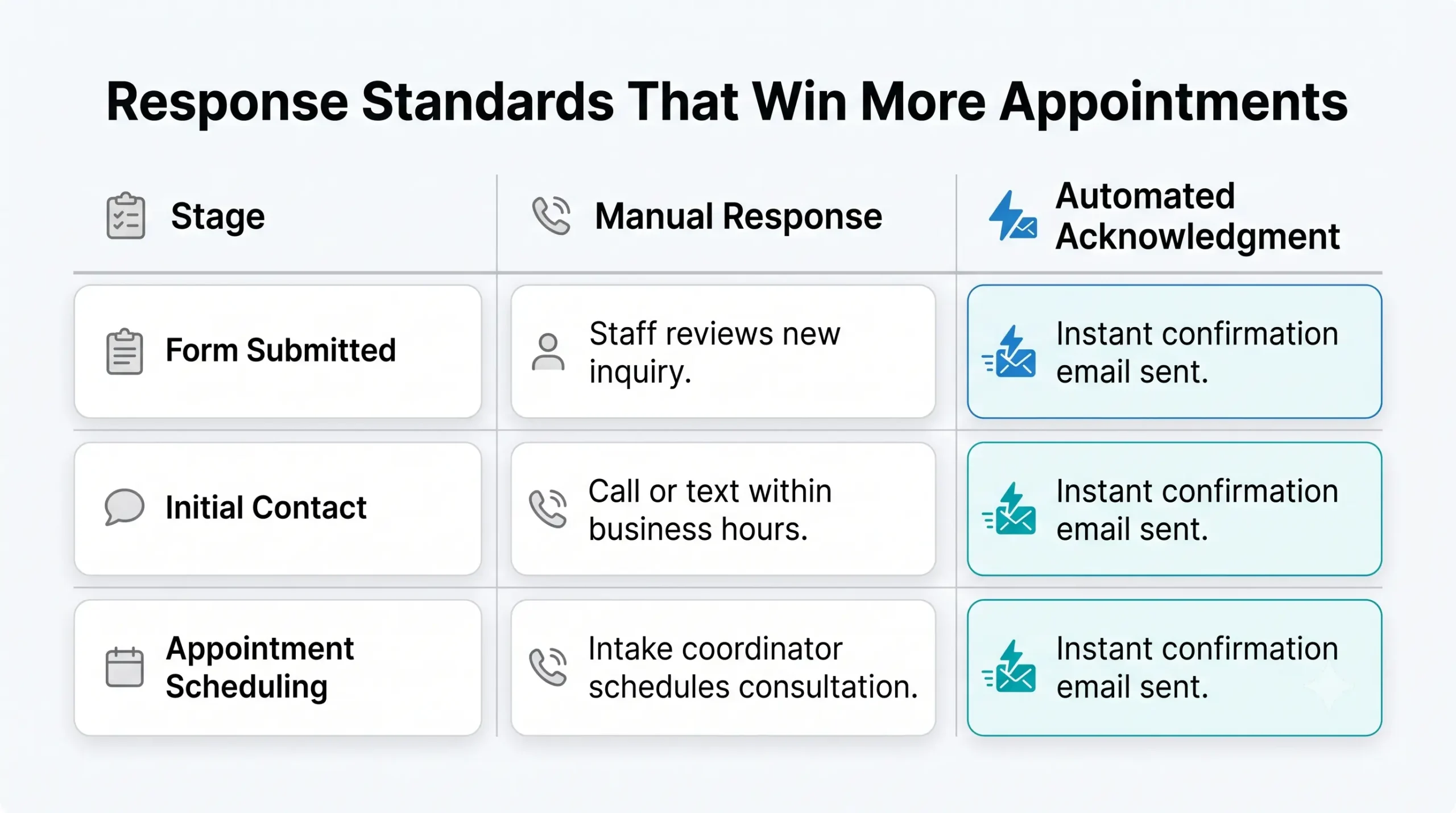
Acknowledge immediately with a specific commitment. An automated reply within sixty seconds that says “I received your message and I will call you before 10 a.m. tomorrow” outperforms a thoughtful reply that lands sixteen hours later. Name a time. Then hit it.
Include crisis language in every automated reply. State plainly that the inbox is not monitored for emergencies, and direct anyone in immediate distress to 988 or 911. Have a written protocol for what happens when an intake message contains risk indicators. This protects the person on the other end and protects your practice.
Reply by text, not only by email. Ask on the form for a preferred contact method and explicit permission to text. Response rates on text run far ahead of email for this audience.
Put a scheduling link in front of the form. Many prospective clients will book a fifteen minute consultation themselves at 9 p.m. if you let them. That removes the response gap entirely for the people ready to act.
Set a two-touch rule. One attempt is not follow up. Make a second attempt through a different channel within the first hour of your next working window.
Publish your response policy on the contact page. “I respond to all new inquiries within one business day, and same day if you write before 3 p.m.” A stated standard reduces the number of people who send three messages elsewhere while waiting on you.
A quick compliance note: an inquiry that identifies a person seeking mental health treatment can constitute protected health information. Use a secure form, document consent before you send unencrypted text or email, and keep the content of your first reply minimal. CGColors builds intake flows, not compliance programs, so confirm your specific setup with your own compliance advisor or attorney.
A standard you can actually keep
| When the inquiry arrives | Automated acknowledgment | Human contact |
|---|---|---|
| Weekday, business hours | Under 5 minutes | Within 2 hours |
| Weekday, evening | Under 5 minutes | Before 10 a.m. next day |
| Weekend | Under 5 minutes | Monday before noon |
What changes when you fix this
Nothing about your ad account changes. Same keywords, same budget, same landing pages. More consultations get booked, so cost per acquired client falls without touching a single bid.
That is the least expensive improvement available to most private practices. It requires no new spend. It requires deciding that the inbox is part of the campaign.
Marketing earns attention. Intake converts it. Practices that treat both as one system get found first, called first, and booked first.