
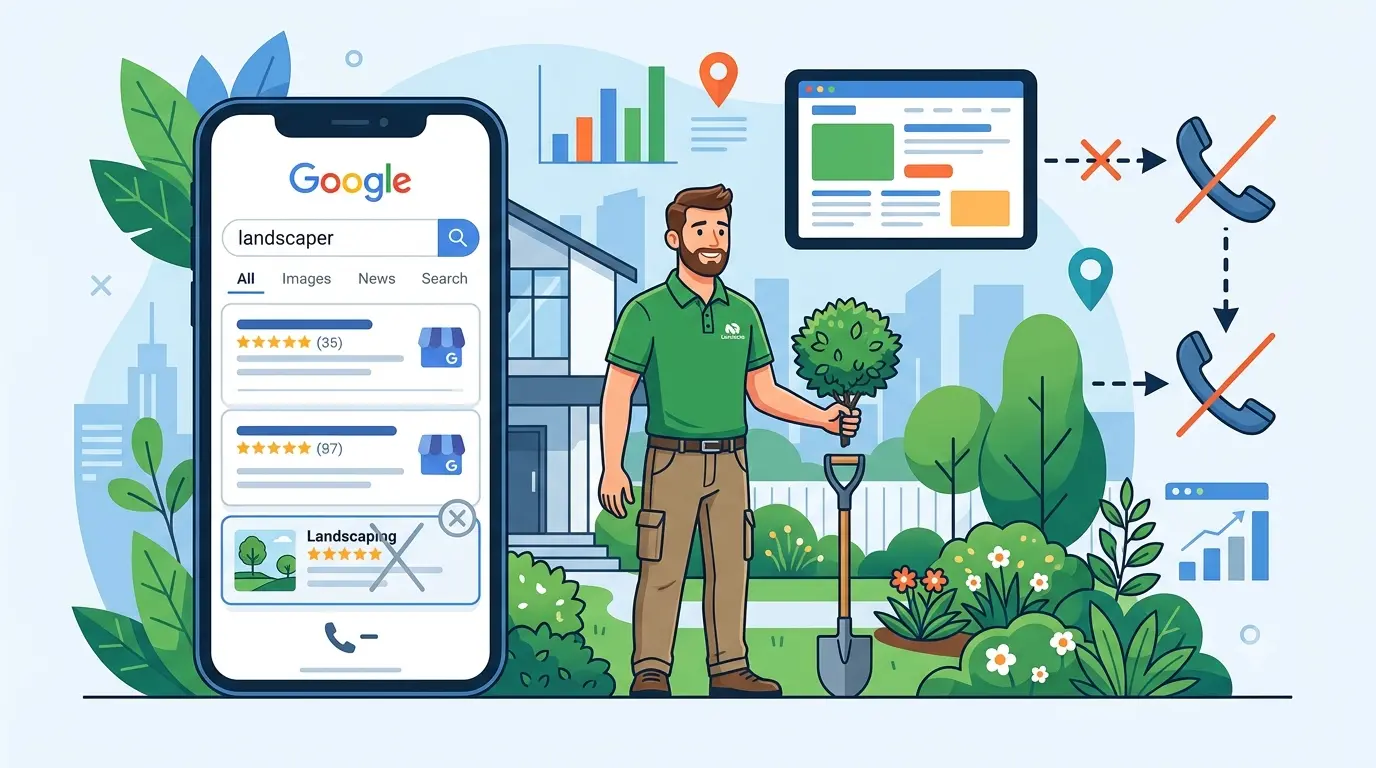
“But I already have a website.”
It is the single most common thing landscaping business owners say when someone brings up their online presence. And they are not wrong. They do have a website. The problem is that having a website and having a website that actually generates calls are two completely different things, and most landscaping businesses have one while mistaking it for the other.
If your website has existed for more than a year and you are still getting most of your new customers through word of mouth, referrals, or door-knocking, your website is not working. It is sitting there, looking like a website, while your competitors collect the leads that should be coming to you.
This is not about effort. Most landscaping business owners who have a website put real time and money into building it. The issue is not that the site exists. The issue is structural, and it shows up in very specific, diagnosable ways. This post walks through every one of them.
Having a Website Does Not Mean Google Knows You Exist
Let us start with the most uncomfortable truth in local SEO for landscapers: Google does not rank websites. It ranks pages. And it only ranks pages it can find, understand, and trust. A website that was built three years ago by a nephew who “does computers,” never updated since, with no reviews pointing to it and no location-specific content on it, is essentially invisible to Google regardless of how good it looks when you share the link on Facebook.
Here is why this matters more than most landscaping businesses realize. According to click-through rate data from First Page Sage, the top result on Google’s first page captures 39.8% of all clicks. The second result gets 18.7%. Third gets 10.2%. By the time you get to position seven, you are competing for 3% of clicks. If you are on page two at all, you are effectively invisible. Research consistently shows that fewer than 1% of users click past the first page of Google results.
That means if your website ranks on page two for “landscaper near me” in your city, you are getting approximately zero traffic from that search, not a little traffic. Zero. The homeowner searching that term is choosing from the businesses on page one, and they are calling whoever is in the top three positions. If you are not there, you do not exist to that customer.
The question then is not “do I have a website?” The question is “where does my website rank, and for what?” Most landscaping business owners genuinely do not know the answer to that question. They assume the website is working because it is there. It is not the same thing.
Your Google Business Profile Is Carrying More Weight Than Your Website
Here is a fact that surprises most landscaping business owners: 42% of local conversions come from users who never visit the company website at all. They find the business through a Google Business Profile, read the reviews, see the photos, get the phone number, and call directly. The website never enters the picture.
That stat has enormous implications. It means your Google Business Profile is, in many cases, more important than your website for generating actual phone calls. And yet most landscaping businesses treat it as an afterthought. They claimed it once when someone told them to, maybe filled in the basics, and have not touched it since. If you want a full walkthrough of every setting that moves the needle, our Google Business Profile optimization guide covers it step by step.
Research from NewMedia shows that profiles with complete information generate approximately 2.1 times more customer actions than incomplete listings. Businesses with 100 or more photos on their profile receive about 35% more website clicks than those with just a few. Profiles that are updated every 90 days earn roughly 22% more engagement. And profiles with 50 or more reviews generate about 32% more engagement than those with fewer than 10.
Now ask yourself honestly: when did you last add photos to your Google Business Profile? Have you posted an update in the last month? Do you have 50 reviews? Do you respond to every review you receive, both positive and negative?
For most landscaping businesses, the honest answers to those questions reveal why the phone is not ringing. An abandoned Google Business Profile in a competitive local market is like opening a second office and never staffing it. The real estate is there. The opportunity is there. But nothing is happening because no one is working it.
The businesses ranking at the top of Google Maps in your city are not there because Google randomly favors them. They got there by actively maintaining their profiles: adding project photos weekly, generating reviews consistently, responding to every piece of feedback, keeping their hours and services current, and using Google Posts to publish regular updates. Each of those actions sends a signal to Google that this is an active, legitimate, trusted business. Your profile sitting untouched for six months sends the opposite signal.
Your Website Is Probably Too Slow to Convert Anyone
Assume for a moment that a homeowner does find your website. They clicked your listing, they want to learn more. What happens next is where most landscaping websites silently lose customers they never knew they had.
According to load time research from Tooltester, 53% of mobile site visitors will leave a page if it takes more than three seconds to load. Conversion rates drop by 4.42% for every additional second of load time between zero and five seconds. The average mobile page currently takes 8.6 seconds to load, which means the average website is losing more than half its mobile visitors before those visitors have even seen the homepage. We have a full breakdown of how to diagnose and fix this in our guide on how to improve page speed on WordPress sites, and if you need it handled for you, our website speed optimization service is built exactly for this.
This is not a minor inconvenience. It is a structural leak in your lead pipeline. A homeowner searching “landscaper near me” on their phone at 7pm after work is not going to wait eight seconds for your homepage to load. They are going to hit the back button and call whoever loaded instantly.
Mobile optimization compounds this problem further. If your website was built for desktop and never adapted for mobile, the buttons are too small to tap, the phone number requires zooming and copying, the images stretch awkwardly, and the layout feels broken. These are not aesthetic complaints. They are conversion killers. Remember that 61% of Google Business Profile impressions come from mobile devices. The homeowners finding you are on their phones. If your site does not work perfectly on a phone, you are functionally invisible to the majority of your potential customers even when they find you. Not sure how yours holds up? Here is how to check if your site is mobile-friendlyin a few minutes.
You Are Attracting the Wrong Visitors
Even when a landscaping website is fast and mobile-friendly, it still fails to generate calls if it is attracting the wrong kind of traffic. This is the keyword problem, and it is more common than most business owners realize.
There are two broad categories of search intent: informational and transactional. Informational searches are people looking for answers, for example “how to fix a patchy lawn” or “what causes yellowing grass.” Transactional searches are people looking to hire someone, for example “lawn care service near me” or “landscaping company in [city].”
Many landscaping websites, especially those with a blog section, accidentally optimize for informational keywords. They rank for “how to aerate your lawn” and get a flood of homeowners who want to do it themselves. Those visitors read the article, maybe bookmark it, and leave without ever considering calling anyone. The site shows traffic in Google Analytics, the owner feels like the site is working, but no calls come in because the traffic was never in buying mode.
The fix is not to stop publishing helpful content. It is to make sure your primary pages are built around transactional keywords, specifically the service-plus-location combinations that signal buying intent. Pages titled “Lawn Care Services in [City],” “Patio Installation in [Suburb],” and “Sod Installation in [County]” are what capture people who are ready to hire. These pages need to rank. If your site is getting traffic but no calls, one of the first things to examine is whether that traffic is informational or transactional, and whether your transactional pages are even visible in search results at all. Building and optimizing exactly these pages is a core part of what our landscaper SEO service delivers.
Your Website Is Talking About You When It Should Be Talking to the Customer
Pull up your landscaping website right now and read the first sentence on the homepage. Chances are it says something like “Welcome to [Company Name], your trusted local landscaping experts serving [City] since [Year].” Or maybe “At [Company Name], we are passionate about transforming outdoor spaces.”
That copy is about you. And homeowners do not come to your website to learn about you. They come because they have a problem and they want to know if you can solve it.
According to research on local service website conversion failures, homepages that focus on company history and credentials rather than customer problems see dramatically higher bounce rates. The five-second rule is real: visitors decide within five seconds whether your site is worth staying on. If your headline does not immediately speak to their situation, they leave. A homepage that leads with “Do you want a yard that makes the neighbors stare? We handle everything from the first phone call to the final cleanup” converts at a meaningfully higher rate than one that leads with company history.
This extends to every page on your site. Your service pages should describe the outcome the customer gets, not just the process you follow. Your about page should explain why your team is trustworthy, not just how long you have been in business. Your contact page should set clear expectations about what happens after someone fills out the form, not just display a generic form with a submit button.
The website that converts is the one that makes a homeowner feel understood before they have spoken a word to you.
Your Trust Signals Are in the Wrong Place
Most landscaping websites that do have reviews, project photos, and credentials tend to bury them. They live on a dedicated testimonials page no one visits, or at the bottom of the homepage after scrolling past three screens of copy.
Trust signals only work when they appear at the moment someone is deciding whether to act. Research on conversion behavior shows that placing specific customer reviews near contact forms and call-to-action buttons measurably increases form submissions. A four-star Google review quote positioned right next to your “Get a Free Estimate” button is more persuasive than a full testimonials page buried in the navigation. This is one of the core areas our conversion rate optimization service addresses, rearranging what is already on your site to convert more of the visitors you are already getting.
The same principle applies to project photos. Before-and-after images of real work you have done in real local neighborhoods are one of the most powerful conversion tools available to a landscaping business. They answer the homeowner’s core question, “can these people actually do the job?” without requiring any additional trust to be built. But if those photos are compressed to thumbnail size, organized in a vague gallery, or only accessible through a nav menu click, they are doing almost none of the persuasive work they could be doing.
The Phone Number Problem Most Landscapers Never Notice
This one seems almost too simple to be real, but it costs landscaping businesses real leads every week. On mobile devices, your phone number must be clickable. A homeowner should be able to tap your number and have their phone dial automatically. If your phone number is displayed as an image, formatted oddly, or placed only in the footer of your site, you are creating friction at the exact moment someone has decided to call you.
Beyond click-to-call functionality, your phone number needs to appear in at least three places on every page of your website: the header (so it is visible the moment anyone lands on any page), near every call-to-action, and in the footer. This is not redundant. It is removing every possible obstacle between a ready-to-hire homeowner and a conversation with you.
Research from Google Business Profile data shows that 38% of profile interactions result in a call. But that percentage drops sharply when the calling process requires extra steps. Every additional tap or scroll required before someone can call you is a percentage of people who give up and call your competitor instead.
What the Gap Actually Costs You
Here is a way to make this concrete. Imagine your service area has 500 homeowners searching “landscaper near me” every month. Position one in Google captures 39.8% of those searches, meaning that business gets roughly 199 inquiries per month from that single keyword. Position three captures 10.2%, meaning about 51 inquiries. Position seven captures 3%, meaning about 15. Page two gets essentially nothing.
If the average landscaping job in your market is worth $2,500, the difference between ranking first and ranking seventh is not a small gap in visibility. It is potentially hundreds of thousands of dollars in annual revenue flowing to whoever earned the top spot.
The businesses at the top of Google in your market did not get there by accident and they are not staying there without effort. They invested in making sure their website ranked, their Google Business Profile was optimized, their pages loaded fast, their trust signals were visible, and their phone number was one tap away. Every one of those things is fixable. None of them require a complete redesign or a massive budget.
What they require is knowing exactly what to fix and in what order.
Where to Start
If you walked through this post and recognized your business in more than two of the problems described, you are not alone. The vast majority of landscaping businesses in mid-size markets are operating with websites that look functional but perform poorly. The good news is that the gap between where you are and where the top-ranked competitor is can almost always be closed, if you know the right sequence to address it.
A proper local SEO audit for a landscaping business typically reveals three to five high-priority issues that, when corrected, produce measurable ranking improvements within 60 to 90 days. Not overnight. But faster than most business owners expect, because the baseline is usually low.
If you want to know specifically where your website is losing calls and what it would take to fix it, that is exactly the kind of work we do for home service businesses. We look at where you rank, what your competitors are doing that you are not, and we build a prioritized plan around the changes that move the needle fastest.
Your website should not be a digital brochure that sits quietly in the corner. It should be your best-performing salesperson, working every hour of every day. If it is not doing that right now, something specific is wrong, and it is fixable.
Want a free ranking check for your landscaping business? We will show you exactly where you stand versus your top three local competitors, what they are doing that you are not, and what it would realistically take to close the gap. See how our local SEO for landscapers works and get in touch to get started.